
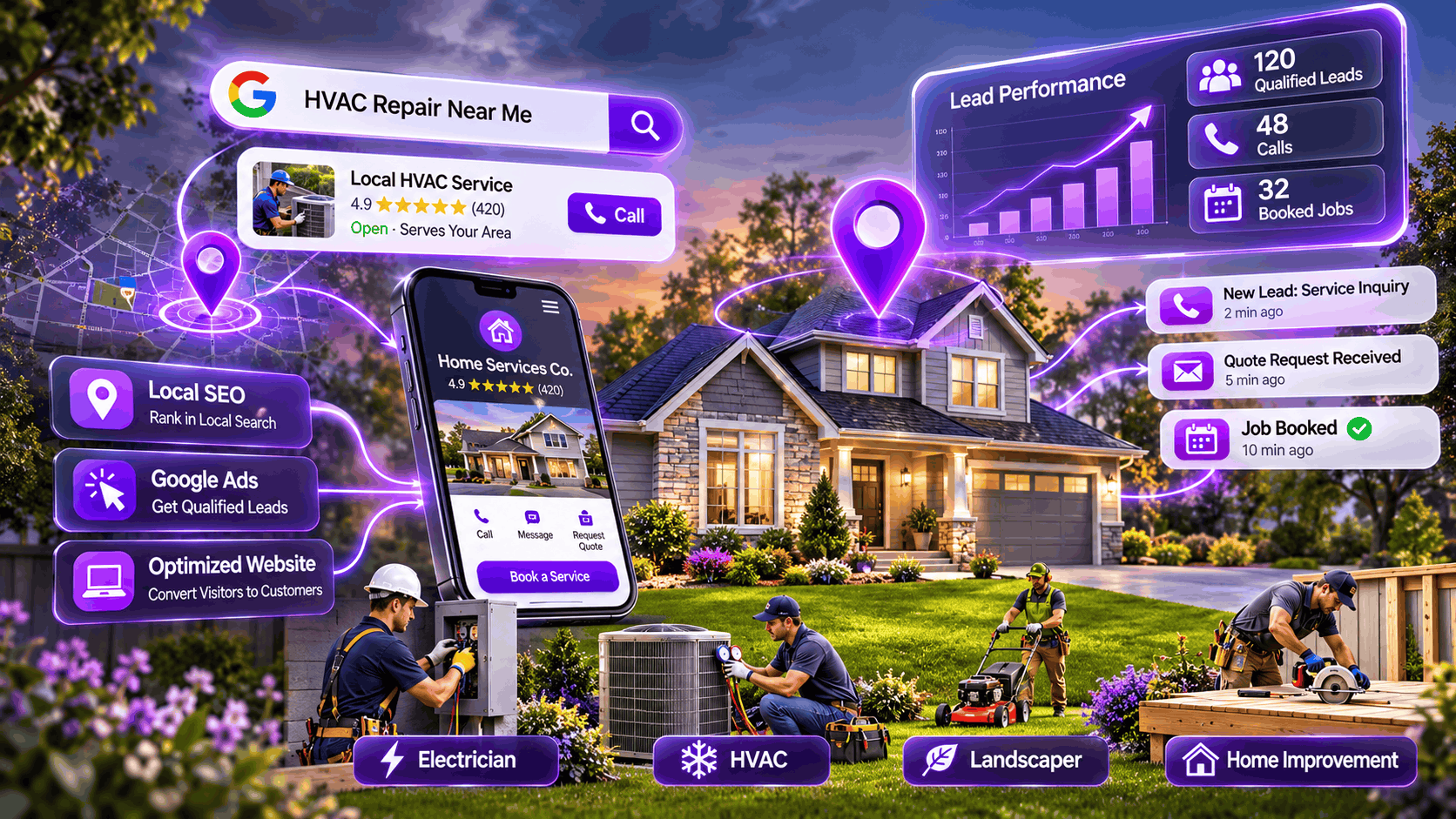
For a home-service business, getting more website visitors is not always the same as getting more customers. An electrician may receive dozens of website visits but only a few calls from people who actually need electrical work. A landscaping company may receive quote requests from outside its service area. An HVAC contractor may spend money on advertising but struggle to turn inquiries into scheduled appointments.
The real goal is not simply to generate more traffic. It is to attract people who need your services, are located within your service area, and are likely to become paying customers.
A practical approach to local lead generation for home service businesses connects local search visibility with targeted advertising, helpful service pages, a conversion-focused website, and consistent lead follow-up. It also measures performance through qualified inquiries, booked estimates, and completed jobs—not just clicks and impressions.
This guide explains how home-service businesses can bring these elements together using Local SEO, Google Business Profile optimization, Google Ads, and better lead management.
What Counts as a Qualified Home-Service Lead?
Before investing in marketing, it is important to understand what your business actually considers a good lead.
A website visitor is not automatically a lead. Someone who clicks an advertisement is not necessarily interested in hiring your company. Even a phone call may not be a qualified opportunity if the caller needs a service you do not provide.
A qualified home-service lead generally meets several conditions:
- Service relevance: The customer needs a service your business actually offers.
- Location fit: The customer is within your realistic service area.
- Project suitability: The requested work matches your capabilities and project requirements.
- Timing: The customer has a reasonable timeframe for the service.
- Contactability: You have enough information to respond and discuss the request.
Consider an HVAC contractor that provides residential air-conditioning repair in three nearby cities. A homeowner searching for AC repair in one of those cities may be a strong lead. Someone looking for commercial refrigeration services outside the company’s coverage area is probably not.
It helps to distinguish the different stages of the customer journey:
Search → Business Profile or Website → Inquiry → Qualified Lead → Booked Estimate → Completed Job
Each stage represents a different outcome. Your reporting should make these distinctions clear so you can understand where potential customers are being lost.
Start With Your Most Valuable Services and Service Areas
Many home-service businesses begin marketing by targeting every service and every nearby city at once. That can make campaigns difficult to manage and marketing budgets harder to evaluate.
Start with the services and locations that make the most business sense.
Choose the jobs you actually want
Not every service has the same value, demand, or operational requirements.
An electrician might offer:
- Electrical panel upgrades
- Outlet and switch installation
- Lighting installation
- Electrical troubleshooting
- EV charger installation
An HVAC contractor might prioritize AC repair, furnace installation, seasonal maintenance, or system replacement.
A landscaping company may focus on lawn installation, recurring maintenance, landscape design, or hardscaping.
Consider your team’s capacity, equipment, expertise, seasonal demand, and the profitability of each service. A marketing campaign should attract work your business can realistically deliver.
Define where you can deliver profitably
Identify your primary service locations before building location-based campaigns or website pages.
Consider:
- Your main operating city
- Nearby communities you regularly serve
- Travel time and transportation costs
- Areas where your team has the capacity to accept work
- Locations where your services are commercially viable
Do not confuse your desired service area with guaranteed Google visibility. A business may serve several cities without appearing equally prominently in local search results across all of them.
Set a lead-value target
Understanding the financial value of a customer helps you decide how much you can reasonably invest in marketing.
For example, imagine a hypothetical home-service company receives 20 qualified leads in a month. If five become paying customers, its lead-to-customer conversion rate is 25%.
If the average gross profit from each completed job is $800, those five customers represent $4,000 in gross profit before marketing and other operating expenses.
This is a simplified example, not an industry benchmark. Your actual numbers will depend on job size, labor, materials, overhead, close rates, and customer lifetime value.
The important point is to connect marketing performance to business economics.
Build a Complete and Accurate Google Business Profile
For many local service companies, Google Business Profile is an important part of the customer discovery process.
When someone searches for a nearby electrician, HVAC contractor, or landscaper, local business information can appear in Google Search and Google Maps. A well-maintained profile helps potential customers understand what your business does and how to contact you.
Start by checking the fundamentals:
- Use your real business name.
- Select the most accurate primary business category.
- Add relevant additional categories where appropriate.
- Provide accurate phone, website, and business hours.
- Add the services your business actually provides.
- Set your service area accurately if you operate as a service-area business.
- Upload genuine photographs of your team, work, equipment, and completed projects.
- Keep business information updated when something changes.
Google’s Business Profile guidelines explain how businesses should represent themselves on the platform. Service-area businesses should use an eligible central business location and accurately describe the areas they serve. A virtual office should not be used to create an ineligible profile.
Build trust through genuine reviews
Reviews help potential customers evaluate a business before making contact.
Create a consistent process for asking customers to share honest feedback after a completed job. You can send a review link through an appropriate follow-up message or email.
Respond professionally to both positive and negative feedback. Thank customers for sharing their experiences, and address concerns without exposing private customer information.
Never buy reviews, offer incentives in exchange for positive reviews, or selectively ask only satisfied customers to leave feedback. Review requests should follow Google’s policies.
Common Google Business Profile mistakes to avoid
Some businesses unintentionally create problems while trying to improve local visibility.
Avoid:
- Adding service keywords or city names to your business name when they are not part of your real-world name.
- Using a virtual office or misleading address.
- Creating multiple profiles for the same eligible business location.
- Listing services or locations you do not genuinely support.
- Buying reviews or using misleading review practices.
- Treating profile posts, photographs, or service-area settings as guaranteed ranking tactics.
Google explains that local results are primarily influenced by relevance, distance, and prominence. Complete and accurate business information helps Google understand the business, but no agency or profile edit can guarantee a particular ranking.
Read Google’s guidance on improving local rankings.
Use Local SEO to Connect Your Services With Customer Searches
Local SEO helps your business become more discoverable when potential customers search for the services you provide in your market.
For a home-service company, the objective is to make it easier for customers and search engines to understand:
- Which services you offer
- Where you provide those services
- What makes your business relevant to the search
- How customers can learn more or request an estimate
Build useful service pages
Your website should have dedicated pages for important services rather than relying on one general page to explain everything.
For example, an electrician could create separate pages for:
- Electrical Panel Upgrade
- Residential Electrical Repair
- Lighting Installation
- EV Charger Installation
Each page should explain the service in enough detail to help a potential customer make an informed decision.
Include:
- A clear description of the service.
- Common problems or situations the service addresses.
- What customers can expect from the process.
- Relevant project photographs or examples.
- Important qualifications or credentials, where applicable.
- Answers to common customer questions.
- A clear phone number or estimate request option.
Use natural language and write for customers first. Repeating a keyword excessively does not make a page more useful.
Create location pages only when they add real value
If your business serves multiple cities, location pages can help explain where your services are available.
However, creating dozens of nearly identical pages by changing only the city name is not a useful local SEO strategy.
A valuable location page should provide meaningful information, such as:
- Services genuinely available in that area
- Relevant local project examples
- Actual service coverage
- Local customer questions
- Useful information about scheduling or service availability
Only create pages for locations you genuinely serve. Do not suggest that you have a physical office in a city when you do not.
Strengthen credibility across your website
Customers want to know whether they can trust the company they are considering.
Build credibility with genuine project photographs, accurate business information, relevant testimonials, clear service descriptions, and transparent contact details.
You should also connect related pages through internal links. For example, an article about electrical panel warning signs can link to your electrical panel upgrade service page.
For more guidance, explore Local SEO services and website SEO from Revolute X Digital.
Use Google Ads to Reach Customers Searching for Your Services
Local SEO helps build visibility over time. Google Ads can provide another way to reach people actively searching for specific services.
For example, a homeowner searching for “emergency electrician near me” may have an immediate need. A properly targeted search campaign can help an eligible business appear in relevant paid search placements.
However, advertising performance depends on more than selecting keywords and setting a budget.
Match campaigns to service intent
Organize campaigns around meaningful service differences.
An HVAC business might separate:
- AC repair
- Furnace repair
- HVAC installation
- HVAC maintenance
This makes it easier to align advertisements, search terms, and landing pages with the customer’s actual need.
Review search-term reports regularly. If a campaign is attracting irrelevant searches, adjust targeting and consider negative keywords.
For example, a residential contractor may want to exclude searches related to employment, training courses, or unrelated commercial equipment if those searches are not relevant to its services.
Google explains how negative keywords work in Google Ads.
Match the landing page to the advertisement
A common advertising mistake is sending every visitor to the website homepage, regardless of what they searched for.
If someone clicks an advertisement for AC repair, the landing page should clearly explain AC repair.
A useful landing page should include:
- The exact service being advertised
- The locations where the service is available
- A clear headline
- A visible phone number
- A simple quote or appointment form
- Relevant photographs or proof of work
- Accurate information about availability and next steps
The visitor should not have to search through the website to understand what the company offers.
Set budgets around business economics
Advertising spend should be based on business capacity and financial targets rather than an arbitrary budget.
Consider the following:
- How much can the business invest each month?
- Which services are most valuable?
- How many additional jobs can the team handle?
- What percentage of qualified leads become customers?
- What is the gross profit associated with those jobs?
Remember that advertising spend and agency management fees are separate costs. Your reporting should make both clear.
Do not judge a campaign only by how many clicks it generates or how inexpensive each click appears. Evaluate whether the campaign produces relevant inquiries and profitable work.
Consider Local Services Ads where eligible
Google Local Services Ads are different from standard Google Search Ads.
Local Services Ads are designed for eligible service providers and have their own screening and verification requirements. Depending on the business category and location, Google may require business registration, insurance, licenses, or background checks.
Not every home-service category is eligible in every location.
Before planning around this channel, check the current Local Services Ads eligibility and screening requirements.
Turn Website Visits Into Calls and Quote Requests
Getting the right visitors to your website is only part of the process. Your website must make it easy for those visitors to take the next step.
A potential customer may leave if the phone number is difficult to find, the service description is unclear, or the website is difficult to use on a mobile device.
Focus on these conversion essentials.
Write a clear headline. Explain what service you provide and the general area you serve.
Make contact information visible. Display your phone number prominently, particularly on mobile devices.
Keep quote forms simple. Ask for the information needed to understand the request, such as name, phone number, location, and service required.
Show genuine work. Use original project photographs and authentic customer feedback where permission has been obtained.
Explain what happens next. Tell customers whether they can expect a phone call, an estimate discussion, or another follow-up step.
Keep the website easy to use. Check page speed, mobile layouts, navigation, and form functionality.
Avoid fake countdowns, misleading guarantees, invented testimonials, or claims about licensing and warranties that the business cannot support.
Build a Follow-Up Process That Does Not Lose Inquiries
A business can invest in excellent marketing and still lose opportunities if incoming leads are not handled properly.
For example, a homeowner may contact three electricians. If one company responds promptly and the others take several days, the first company may have an advantage.
Create a straightforward lead-handling process.
- Assign responsibility for answering incoming calls and website inquiries.
- Record every inquiry in a CRM or organized lead-tracking system.
- Follow up within a realistic and clearly defined response window.
- Record whether the inquiry matches your services and service area.
- Track whether an estimate or appointment was scheduled.
- Record the final outcome when the opportunity is won or lost.
Automation can help with lead notifications, appointment reminders, and internal task management. However, automated messages should support genuine customer service rather than replace it.
If you use marketing emails or text messages, review the applicable consent, privacy, and opt-out requirements before launching campaigns.
Measure Qualified Leads, Booked Jobs, and Profitability
Marketing reports should help business owners make better decisions.
A report showing 5,000 website visitors may look impressive, but it does not explain how many people requested an estimate or hired the company.
Track metrics that connect marketing activity to business outcomes.
| Metric | What it tells you |
|---|---|
| Total inquiries | How many people contacted the business? |
| Qualified leads | How many inquiries matched the service and location requirements? |
| Cost per qualified lead | How much did it cost to generate a relevant inquiry? |
| Booking rate | How many qualified leads became appointments or estimates? |
| Close rate | How many opportunities became paying customers? |
| Customer acquisition cost | How much did it cost to acquire a customer? |
| Attributed revenue | How much revenue can reasonably be connected to marketing activity? |
| Gross profit | Did the completed work justify the acquisition and operating costs? |
For example, a campaign may generate 30 inquiries, but only 12 may match the business’s services and service area. If six of those qualified leads become customers, the business should evaluate the campaign based on those six customers—not simply the original 30 inquiries.
Also distinguish advertising spend from total marketing costs. If you calculate return on ad spend, remember that revenue is not the same as profit.
Attribution is not always perfect. A customer might discover your company through Google, return directly to your website, and call several days later. Use call tracking, form tracking, CRM records, and analytics together where appropriate, while recognizing their limitations.
A Practical 90-Day Implementation Plan
A structured implementation plan helps a home-service business prioritize improvements without trying to change everything at once.
The following schedule is a planning framework, not a promise of rankings or a specific number of leads.
Days 1–30: Understand and Fix the Foundations
- Review the website and Google Business Profile.
- Confirm the main services and realistic service areas.
- Identify inaccurate business information.
- Check mobile usability and contact forms.
- Set up or review conversion tracking.
- Establish a process for recording and qualifying inquiries.
- Identify the services with the strongest business priorities.
Days 31–60: Improve Visibility and Campaign Structure
- Improve priority service pages.
- Add useful location-specific content where appropriate.
- Strengthen internal links between related pages.
- Review Google Business Profile services, categories, photographs, and information.
- Launch or refine targeted Google Ads campaigns where appropriate.
- Review search terms and exclude irrelevant traffic.
- Establish a consistent review-request and lead follow-up process.
Days 61–90: Evaluate and Improve
- Review the number of qualified leads.
- Compare inquiries with booked estimates and completed jobs.
- Identify campaigns attracting irrelevant searches.
- Improve landing pages based on customer behavior.
- Adjust advertising budgets according to performance and business capacity.
- Review service-area priorities.
- Identify the next improvements based on actual data.
The objective is to create a more reliable marketing and lead-management process. Results depend on the business, competition, market demand, budget, website, and implementation quality.
Client-Reported Examples From Revolute X Digital’s Work
Different businesses need different marketing strategies. A local electrician may need a better website and stronger visibility for electrical services, while a landscaping company may need service pages, location-specific content, and a more effective Google Business Profile.
The following examples are based on client reviews published on Clutch. The figures are client-reported outcomes from individual engagements, not independently audited results or guaranteed outcomes for other businesses.
Ollie’s Electric: Website and Local Search Improvements
Ollie’s Electric, an electrical installation and repair company, worked with Revolute X Digital on website development and SEO.
According to the client’s Clutch review, the engagement included rebuilding the website, improving its mobile experience, optimizing the Google Business Profile, and implementing a local search strategy.
The client reported:
- A 40% increase in organic phone calls specifically associated with Google Business Profile optimization.
- A website conversion-rate improvement of over 20%.
- Improved local search visibility and stronger placement for its primary local search terms.
The review also describes how the client used Google Search Console, Google Business Profile Insights, and Google Analytics to monitor performance.
This example illustrates how website improvements and local search work can support one another. Better visibility can help customers discover a business, while a clearer and faster website can make it easier for those visitors to contact the company.
ProClass Lawn & Landscaping: Website and Local SEO
ProClass Lawn & Landscaping provides lawn care and landscaping services.
According to its Clutch review, Revolute X Digital worked on website development and local SEO. The project included a mobile-friendly website, service pages, a gallery, lead capture forms, Google Business Profile optimization, keyword research, location-specific content, and local citation work.
The client reported:
- Approximately 200% growth in website traffic.
- Approximately 130% growth in calls and quote requests.
- Improved Google Business Profile visibility and customer interactions.
The client also described improved visibility for several lawn care and landscaping searches in its service areas.
These results were reported by the client in its review and relate to this specific engagement. They should not be interpreted as a forecast for another landscaping company or as evidence of paid Google Ads performance.
Together, these examples demonstrate why a lead-generation strategy should consider the entire customer journey—from local discovery to the website experience and the final inquiry.
Frequently Asked Questions
1. What is the difference between a lead and a qualified lead?
A lead is someone who contacts your business or expresses interest in your services. A qualified lead is an inquiry that matches your services, service area, project requirements, and other business criteria. Qualified leads are generally more useful for evaluating marketing performance.
2. Should a home-service business start with Local SEO or Google Ads?
It depends on the business’s needs, budget, market, and current online presence. Google Ads can help a business reach relevant searches through paid placements, while Local SEO supports organic visibility over time. Some businesses benefit from using both, provided each channel is properly managed and measured.
3. How should a contractor decide on a marketing budget?
Start with your business economics. Consider your average job value, gross profit, lead-to-customer conversion rate, available capacity, and customer acquisition cost. Then set a budget that the business can support and evaluate it using qualified leads and completed jobs.
4. Do I need a separate page for every city I serve?
Not necessarily. Create location pages when they provide useful, genuinely different information for customers in those areas. Avoid publishing large numbers of nearly identical pages that only replace one city name with another.
5. How can I tell whether marketing is generating booked jobs?
Connect your marketing and sales records. Track phone calls, forms, qualified inquiries, estimates, booked appointments, and completed jobs. Use analytics and CRM records where possible so you can evaluate more than clicks and website traffic.
6. Can an agency guarantee Google rankings or a specific number of leads?
No responsible agency can guarantee a specific Google ranking or a fixed number of leads. Search visibility and lead volume depend on factors such as competition, location, demand, business eligibility, budget, website quality, and customer behavior. An agency should explain its strategy, reporting, and measurement process clearly.
How Revolute X Digital Can Support Your Lead-Generation Strategy
A home-service business needs more than website traffic. It needs a marketing process that connects local visibility, relevant inquiries, website conversions, and follow-up.
Revolute X Digital works with businesses on digital marketing services that include:
- Local SEO
- Google Business Profile optimization
- Website SEO
- Website development
- Google Ads and digital advertising
- Lead generation
- Marketing and lead-management automation
Our approach starts with understanding the business, its services, its service areas, and the type of customers it wants to attract.
A practical engagement can follow four stages:
1. Assess: Review the website, local search presence, advertising activity, and existing lead-handling process.
2. Plan: Identify priority services, target locations, customer intent, and qualified-lead criteria.
3. Implement: Improve relevant website pages, local search visibility, advertising campaigns, and conversion tracking.
4. Evaluate: Review inquiry quality, booked estimates, and business outcomes to identify what should be improved next.
Explore our digital marketing services to learn more about how these services can work together.
Explore Revolute X Digital’s Reviews and Agency Profiles
Choosing a digital marketing partner is an important business decision. Before selecting an agency, review its services, relevant client feedback, and approach to reporting and communication.
You can explore Revolute X Digital’s profiles on the following platforms:
- Clutch: The profile currently displays a 5.0/5 rating from 42 reviews. It includes client feedback covering website development, SEO, and local search projects. View Revolute X Digital on Clutch.
- GoodFirms: The profile currently displays a 4.9/5 rating from 30 reviews. It includes feedback from businesses such as Vengony Truck Services about Google Business Profile optimization and local visibility. View Revolute X Digital on GoodFirms.
- Trustindex: The profile currently displays a 4.9/5 rating from 59 reviews, aggregating feedback from multiple review sources. View Revolute X Digital on Trustindex.
- Sortlist: Explore the agency profile for additional company information. View Revolute X Digital on Sortlist.
Ratings and review counts are displayed by the respective platforms and may change. Review counts across platforms should not be added together because the same feedback may appear in more than one place.
We encourage potential clients to read the feedback, review the services, and decide whether our approach aligns with their business needs.
Build a Measurable Path From Search to Booked Jobs
Successful home-service lead generation is not about chasing the highest number of clicks or website visitors. It is about reaching the right customers, explaining your services clearly, making it easy to get in touch, and following up consistently.
Local SEO helps strengthen your presence in relevant local searches. Google Ads can connect your business with people actively searching for services. A useful website supports customer decisions, while reliable tracking helps you understand which marketing activities contribute to booked work.
When these elements work together, your business has a clearer way to evaluate marketing performance and make informed decisions.
Want to identify gaps in your local lead-generation process? Contact Revolute X Digital to discuss your website, search visibility, and lead tracking.

Zack
Zack Robinson is a Digital Marketing Specialist at Revolute X Digital, specializing in SEO, Local SEO, Google Business Profile optimization, AI automation, and lead generation. He helps businesses improve their online visibility, attract qualified customers, and achieve sustainable growth through data-driven digital marketing strategies.