
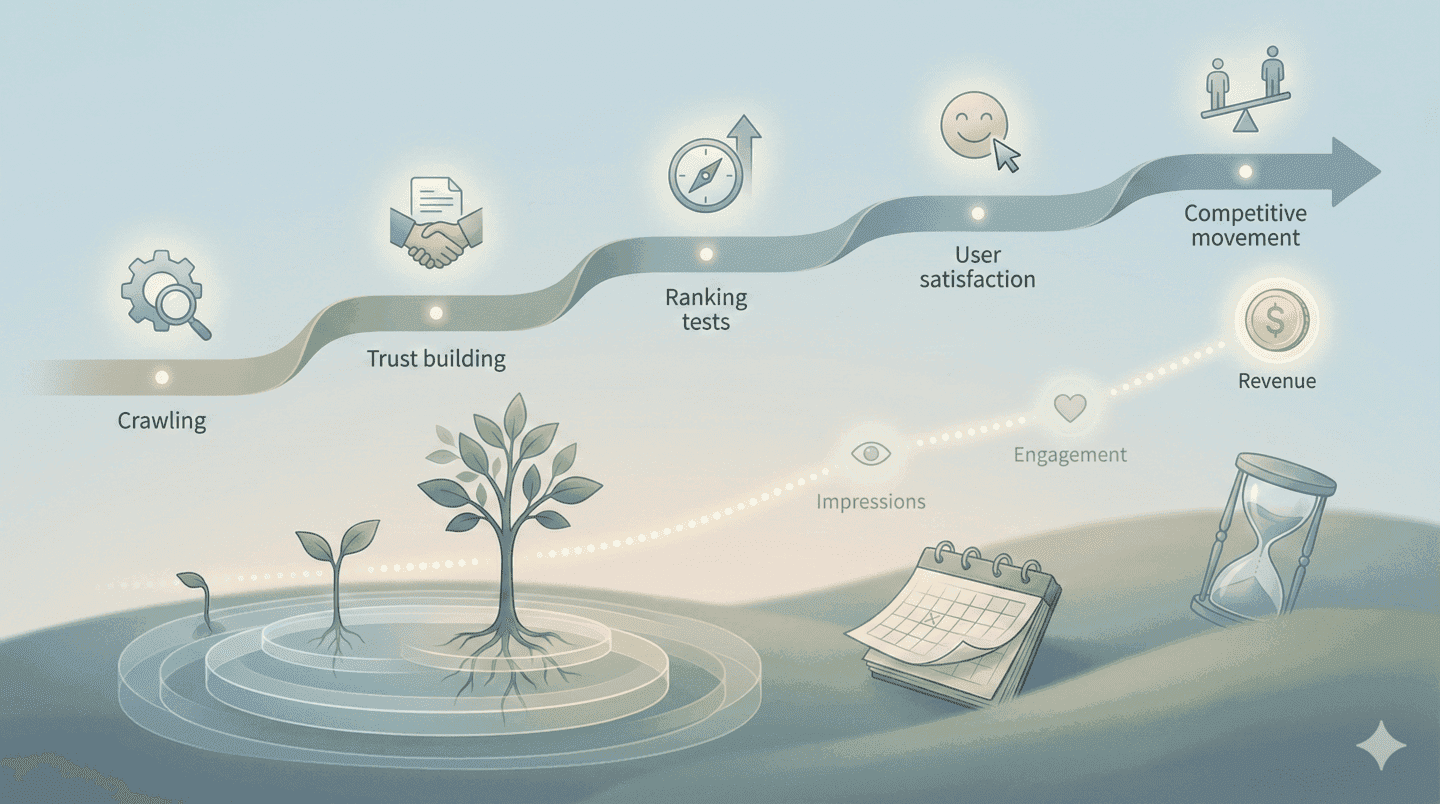
If someone tells you SEO will “pay off in 30 days,” they are selling you a story. SEO is not a switch. It is closer to building a reputation. You can speed it up with smart execution, but you cannot skip time entirely.
For most businesses, a realistic ROI window is six to twelve months. Not because SEO is mysterious, but because Google needs to crawl, interpret, test, and re-evaluate your site over time. Your competitors also keep moving. Your content needs to earn trust. Your pages need to prove they satisfy users. That is what takes time.
That said, “six to twelve months” does not mean you sit in the dark for half a year. You should see progress earlier, just not always in the form of a clean revenue spike.
Why can SEO Feel Slow Even When it is Working?
Two things confuse business owners.
First, the work that matters early is not glamorous. Fixing technical issues, improving site structure, tightening service pages, cleaning internal linking, and sorting out indexing problems. That work rarely creates a dramatic chart in week two, but it removes the brakes. If your site has been dragging a weight for years, the first job is cutting the rope.
Second, many companies track the wrong signals. They watch rankings for a handful of “dream keywords” and assume no movement means failure. Meanwhile, search impressions may be rising, more pages may be getting discovered, and long-tail traffic may be growing quietly. Those early shifts matter because they are the foundation for the bigger wins later.
Four Variables that Decide Your Timeline
You can predict SEO speed well if you are honest about the starting point.
- Age and Authority of your Domain
A brand new domain usually takes longer. A site with history, decent links, and some existing rankings can move faster.
- Competition Level
Dentists in a big city are highly competitive—a niche B2B service in a smaller market – typically easier. The tougher the market, the more authority and content depth you need before you see strong ROI.
- Site Quality
Fast, clean, and well-structured sites respond better. Slow sites with messy navigation, duplicate pages, or weak content need more repair work before growth shows up.
- How Consistently You Execute
SEO does not respond well to “we worked on it for a month, then paused for two months.” Momentum matters. Consistency matters more than big bursts.
What You Should See in Each Phase?
Here is the most accurate way to set expectations. Look for different wins at different times.
Months 1 to 2: The Cleanup and Clarity Phase
This is where you stop leaking value.
What usually happens here:
- Indexing issues get fixed, so Google can actually read the right pages
- Core pages get rewritten to match search intent and convert better.
- Tracking gets cleaned up, so you are not flying blind.
- The site becomes easier to crawl, faster to load, and cleaner on mobile.
What you might notice:
- Better impressions in Search Console
- Slight ranking movement on less competitive terms
- Fewer bounces on updated pages
- More calls or form fills from the same traffic because pages are clearer.
You are not “winning” yet. You are removing friction.
Months 3 to 5: The Traction Phase
This is when the work starts to show in a way non-SEO people can feel.
What usually happens here:
- New content begins to rank for long tail searches
- Existing pages become more stable as Google re-evaluates them.
- Local visibility improves if your Google Business Profile and reviews are active.
- You start seeing which topics bring the right leads and which topics bring tourists.
Typical outcomes:
- Organic traffic grows, sometimes unevenly
- Leads from organic start to appear more consistently
- You can see patterns. which pages attract buyers, which ones do not
At this point, you should be adjusting based on evidence, not guessing.
Months 6 to 12: The ROI Phase
This is where SEO usually becomes hard to ignore.
What tends to improve:
- Rankings for more competitive terms begin to shift
- Authority compounds as content clusters build depth
- Brand searches often rise because you are visible more often.
- Organic becomes a meaningful contributor to the pipeline and revenue.
This is also when many businesses finally make the smart move. They optimize conversion harder. Because once you have traffic, improving the conversion rate often increases ROI faster than publishing ten more blogs.
What “SEO ROI” Should Actually Mean?
ROI is not “we ranked number three.” ROI is money.
At a minimum, you want to track:
- Calls and form submissions from organic
- Booking requests or purchases from organic
- Lead quality – Are these good leads or time-wasters?
- Close rate and revenue where possible
If you cannot connect SEO work to business outcomes, you will always feel unsure about it, even if it is working. Clean tracking and clear conversion goals are not optional.
How to Speed Up ROI without Doing Risky Nonsense?
You cannot force Google to trust you overnight, but you can focus on what moves revenue fastest.
- Start with high-intent pages – service pages, booking pages, location pages
- Answer “buying” questions – price, timelines, comparisons, what to expect
- Fix the website so it converts – clear CTAs, strong proof, fast mobile load
- Build real authority – partnerships, PR, and useful resources that earn genuine links
- Keep your Google Business Profile active if local leads matter.
Most businesses chase traffic when they should chase conversion.
A Quick Warning About Unrealistic Promises
SEO vendors love selling speed. Be skeptical of:
- Guaranteed rankings
- “Hundreds of backlinks” packages
- Content plans that focus on quantity over usefulness
- Reports filled with tasks, but no impact on leads
If the plan does not mention conversions, offers, or buyer intent, it is not designed for ROI.
Conclusion
SEO takes time, but it is not guesswork. With the right foundation, you should see early traction within a few months and clear ROI in the six to twelve-month range for most businesses. After that, the results compound.
Revolute X Digital builds SEO programs with realistic expectations, clean measurement, and a focus on leads and revenue, not vanity charts. If you want an SEO plan that is honest, structured, and built to pay you back, we can help you execute it properly. Contact us today!

Jason
We are an Affordable Digital Marketing Agency in Shawnee with budget-friendly solutions to amplify your brand. Elevate your business without compromising quality or cost.