
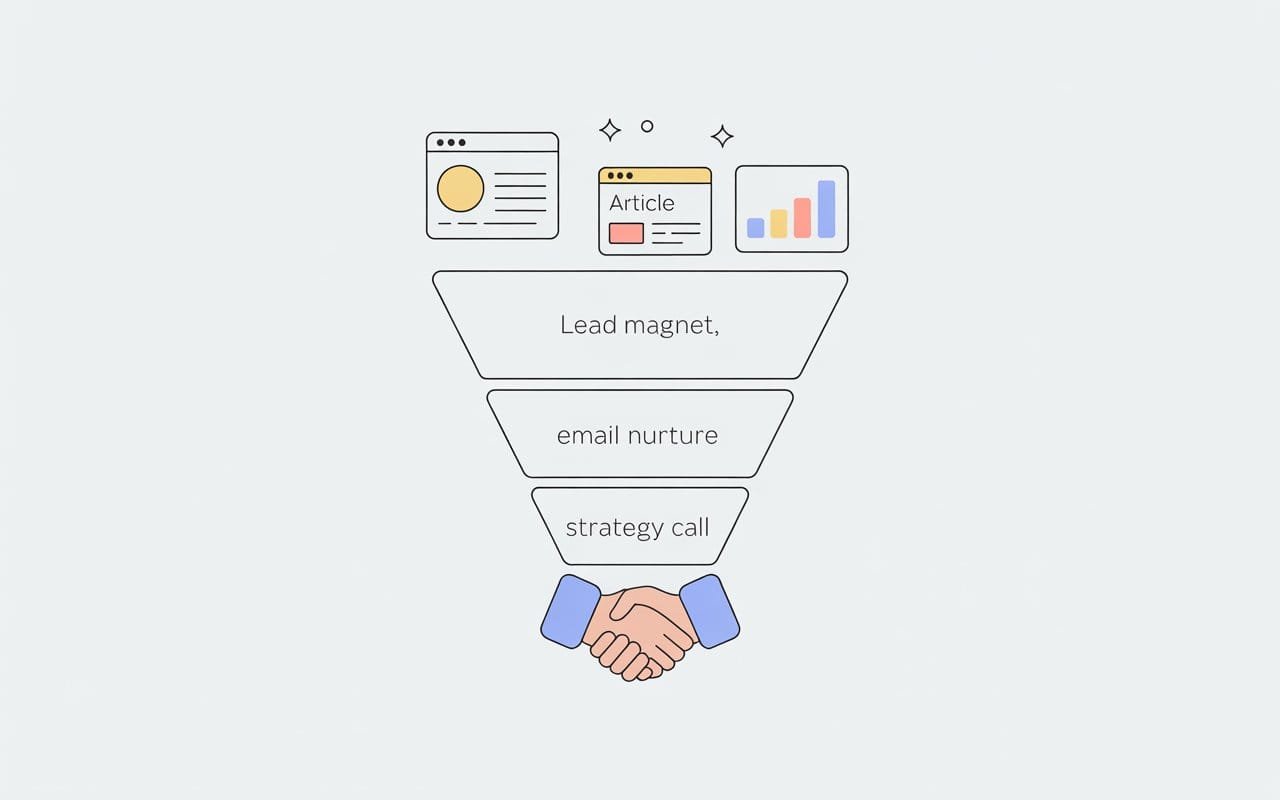
Blog numbers look great. Sessions are up, time on page is solid, and posts get shared. Then you open your CRM and see… almost nothing.
That gap between “people reading” and “people buying” is where most content strategies die. Traffic is not the problem. The missing piece is a clear system that turns a reader into a lead, then into a client. In other words, you need to turn blog traffic on purpose, not by accident.
The Step-by-Step Process to Turn Blog Traffic Into Leads
Let’s walk through how to do that without overcomplicating things.
Step 1: Decide What you Actually Want Readers to do
Before you tweak a single blog post, answer one question.
What is the next realistic step for a reader who likes this content?
Not “become a customer immediately” for everyone. For most blog visitors, the next step is something like:
- Join a newsletter
- Download a checklist or template
- Book a short call
- Try a free tool or audit
Each blog should exist inside a path, not in isolation. If you cannot describe the path in one sentence, that post is “content”, not part of your sales system.
Step 2: Match Topics to Buyer Intent
Some topics are pure research. Some are warm buying signals. Treat them differently.
- Top of funnel: “What is…”, “How to…”, broad guides
- Goal – educate, build trust, get permission to follow up
- Next step – lead magnet, newsletter, low-friction offers
- Mid and bottom of the funnel: comparisons, pricing, mistakes to avoid, “best tools”, “agency vs in-house.”
- Goal – turn blog traffic into real leads
- Next step – strategy call, audit, tailored offer
If every post ends with the same generic “Contact us”, you are wasting intent. Align your CTA with where the reader is in their decision process.
Step 3: Use Specific CTAs, not Throwaway Lines
“Let us know if you have questions” is not a CTA.
Your calls to action should be:
- Clear – They should know exactly what happens next
- Specific – Tied to the topic of the post
- Low friction – Easy first step, not a life commitment
Examples:
- After a post on landing pages.
- “Want us to review your top page and point out the leaks? Build a Lead Funnel with a free 15-minute teardown.”
- After a post on local SEO.
- “Not sure why calls are not matching your traffic? Build a Lead Funnel around your Google Business Profile and top pages with our local visibility audit.”
Readers will take the next step if you spell it out and make it feel valuable.
Step 4: Add Lead Magnets that Continue the Story
If you want to turn blog traffic consistently, you need something between “reading” and “ready to talk to sales.” That is where lead magnets live.
Good ones are:
- Directly connected to the topic of the post
- Quick to consume and easy to use
- Focused on solving one specific problem
Examples:
- Checklists (launch, audit, troubleshooting)
- Templates (email scripts, ad frameworks, reporting sheets)
- Short calculators (ROI, budget, pricing)
- Mini-guides (10-page playbooks, not 80-page ebooks)
Place the lead magnet CTA:
- Inline, inside the content where it feels natural
- At the end of the article
- In a subtle banner or box near high-intent sections
Do not flood the page with pop-ups. One strong, relevant offer beats five generic nags.
Step 5: Build a Simple Nurture Sequence
Getting an email is not the win. The win is moving that contact from “interested reader” to “informed, confident buyer.”
You do not need a 40-email monster. Start with 4 to 6 focused messages:
- Deliver the promised resource and set expectations
- Share a quick win related to the topic they came in on
- Show a case study or story that matches their situation
- Handle a common objection – price, timing, risk
- Make a clear offer – what working with you looks like
- Restate the offer with a different angle or bonus
Make the CTA consistent. “When you are ready to fix this properly, hit reply or click Build a Lead Funnel, and we will map your custom plan.”
Step 6: Fix the On-Page Friction
Sometimes the funnel logic is fine, but the page itself is killing conversions. Quick checks:
- Is the mobile experience clean and readable?
- Does the page load fast enough?
- Are there clear visual cues that separate content from CTAs?
- Does your form ask for more than you really need at this stage?
- Is there any proof (testimonials, results, logos) near your CTAs?
You are asking a stranger to move closer to you. Make that moment feel safe and easy.
Step 7: Watch the Right Numbers
“Pageviews” alone will not tell you if you turn blog traffic effectively. Track:
- Email opt-in rate by article
- Clicks on in-content CTAs
- Calls, demos, or consultations that started on a blog post
- Revenue tied to leads that touched content before buying
Then adjust. Double down on topics and formats that produce leads, not just eyeballs.
Conclusion

Blog traffic with no clients is wasted potential. The content is already doing the hard work of attracting the right people. The missing link is a simple, intentional funnel wrapped around it.
Revolute X Digital helps brands turn scattered blog posts into structured lead funnels that attract, nurture, and convert the right readers. If you are ready to build a lead funnel that makes your content pay for itself, our team can design and implement the system for you.
Frequently Asked Questions (FAQs)
How do you turn blog traffic into paying clients?
To turn blog traffic into paying clients, you need a structured funnel:
- Define a clear next step (newsletter, audit, call).
- Match blog topics to buyer intent.
- Use specific, value-driven calls to action.
- Offer relevant lead magnets.
- Nurture leads with a short email sequence.
- Optimize pages for conversions.
Traffic alone does not generate revenue. A defined conversion path does.
Why isn’t my blog traffic converting into leads?
Blog traffic often fails to convert because:
- There is no clear next step for readers.
- Calls to action are generic or weak.
- Content does not match buyer intent.
- There is no lead magnet between reading and buying.
- On-page friction makes it hard to take action.
The problem is usually not traffic volume — it is funnel structure.
What is the best way to convert blog readers into leads?
The most effective way is to:
- Add a relevant lead magnet connected to the topic.
- Place strong, specific CTAs inside the content.
- Offer low-friction next steps (like a checklist or short audit).
- Follow up with a focused email nurture sequence.
Conversion improves when the offer continues the conversation the blog started.
What type of blog content converts best?
Content that signals buying intent converts best, such as:
- Comparison posts
- Pricing guides
- “Mistakes to avoid” articles
- Service breakdowns
- Case studies
- Problem-solution posts
Educational content builds trust. Decision-stage content generates leads.
How many calls to action should a blog post have?
A blog post should have:
- One primary CTA
- One supporting CTA (optional)
Too many CTAs reduce clarity. One strong, relevant offer placed naturally within the content performs better than multiple generic prompts.
What is a blog lead magnet?
A blog lead magnet is a free resource offered in exchange for contact information.
Common examples include:
- Checklists
- Templates
- Mini-guides
- ROI calculators
- Audit tools
The best lead magnets solve one specific problem related to the blog topic.
How long should a nurture sequence be?
A simple nurture sequence typically includes 4 to 6 emails:
- Deliver the promised resource
- Provide a quick win
- Share proof or a case study
- Address objections
- Present a clear offer
- Reinforce urgency or value
The goal is to build trust and move readers toward a decision.
How do I know if my blog is generating revenue?
Track metrics beyond pageviews, such as:
- Email opt-in rate per article
- CTA click-through rate
- Calls or demos that started on blog pages
- Revenue from leads who first engaged through content
Content should be measured by conversions, not just traffic.
What is the biggest mistake in blog marketing?
The biggest mistake is publishing content without a conversion path.
Blog posts that attract traffic but lack:
- Clear next steps
- Lead magnets
- Intent alignment
- Follow-up systems
Will rarely generate consistent clients.
Can blog traffic really generate clients?
Yes — when structured properly.
Blog traffic becomes a client acquisition channel when:
- Each post supports a funnel
- Offers align with intent
- Trust is built through education
- Conversion steps are simple and clear
Without structure, blog traffic is attention. With structure, it becomes revenue.

Jason
We are an Affordable Digital Marketing Agency in Shawnee with budget-friendly solutions to amplify your brand. Elevate your business without compromising quality or cost.