

Artificial intelligence is changing the way search engine optimization works. If you are still using manual keyword research and traditional strategies you are already behind the times.
In the year 2026 knowing how to use intelligence for search engine optimization is not something you can choose to do or notYou need to know this stuff.
But let me tell you something about intelligence and search engine optimization: artificial intelligence is not going to take the place of search engine optimization experts. The thing about intelligence is that it is here to make the work go faster, take out the guessing and make things more accurate. Think of intelligence as something that helps you get your work done faster, not as something that takes your place.
This guide will show you a step by step intelligence search engine optimization workflow that people who are new to artificial intelligence search engine optimization can follow to get more traffic and better rankings, with the help of artificial intelligence search engine optimization.
What Does It Mean to Use AI for SEO?
Using AI for SEO means leveraging artificial intelligence tools to automate, analyze, and improve different parts of your SEO strategy.
Instead of spending hours on manual tasks, AI helps you:
- Find better keywords faster
- Understand search intent
- Create optimized content
- Fix technical SEO issues
- Track performance in real time
The goal is simple: work smarter, not harder.
Why AI is a Game-Changer for SEO
Before jumping into the workflow, it’s important to understand why AI matters.
AI can process massive amounts of data in seconds. It identifies patterns that humans simply can’t see easily.
This leads to:
- Better keyword targeting
- More relevant content
- Faster execution
- Improved rankings
In short, AI gives you a competitive edge.
Step-by-Step: How to Use AI for SEO
Let’s break down the exact workflow you can follow.

Step 1: AI-Powered Keyword Research
Keyword research is the foundation of SEO.
AI tools help you go beyond basic keywords and find hidden opportunities.
What to do:
- Start with a primary keyword (e.g., how to use AI for SEO)
- Use AI tools to generate variations
- Identify long-tail keywords
- Analyze competition and search volume
What AI does better:
- Finds low-competition keywords
- Suggests related topics
- Predicts ranking difficulty
Pro Tip: Focus on keywords with clear intent, not just high volume.

Step 2: Understand Search Intent with AI
Search intent is everything in modern SEO.
AI helps you understand:
- What users actually want
- Why they’re searching
- What type of content ranks
Types of intent:
- Informational
- Navigational
- Transactional
- Commercial
How to apply:
If someone searches how to use AI for SEO, they want a step-by-step guide, not a sales page.
AI helps you match your content to the exact intent.

Step 3: Generate Content with AI
Now comes the part most people are excited about—content creation.
AI tools can:
- Generate blog outlines
- Suggest headings (H1, H2, H3)
- Write drafts
- Improve readability
But here’s the reality:
AI should assist, not replace you.
Best approach:
- Use AI to create a draft
- Edit for clarity and tone
- Add real insights and examples
- Ensure originality
This hybrid method produces the best results.

Step 4: Optimize Content Using AI
Creating content is not enough—you need to optimize it.
AI tools analyze top-ranking pages and give suggestions like:
- Keyword placement
- Content length
- Heading structure
- Internal linking opportunities
What to optimize:
- Title tag
- Meta description
- Headings
- Keyword density
- Readability
AI ensures your content is aligned with what Google already ranks.

Step 5: Automate Technical SEO
Technical SEO can be complex—but AI makes it easier.
AI tools can automatically:
- Detect broken links
- Improve page speed
- Analyze site structure
- Generate schema markup
Why this matters:
Even great content won’t rank if your site has technical issues.
AI helps you fix problems before they affect rankings.

Step 6: Publish and Index Faster
Once your content is ready:
- Publish it on your website
- Submit it to search engines
AI tools can help monitor indexing and suggest improvements.
Faster indexing = faster results.
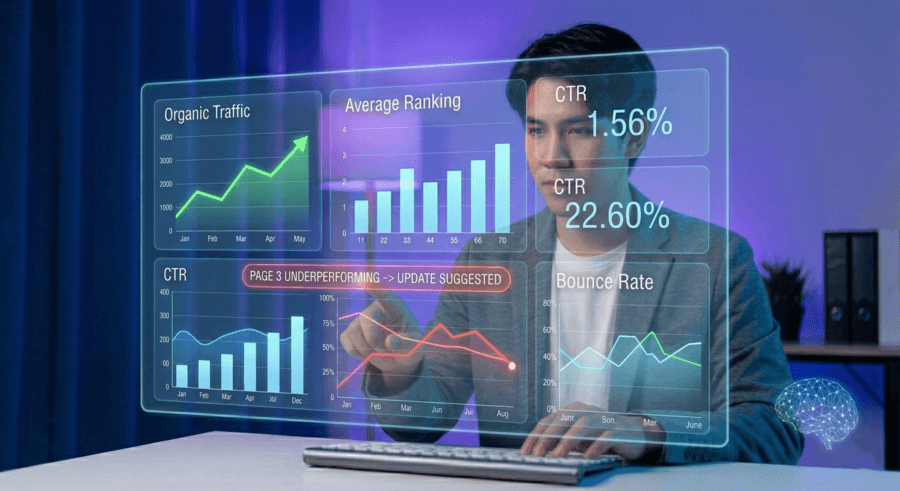
Step 7: Track Performance and Improve
SEO is not a one-time task—it’s ongoing.
AI tracks:
- Rankings
- Traffic
- Click-through rate (CTR)
- Bounce rate
What to do:
- Identify underperforming pages
- Update content regularly
- Improve based on data
AI turns SEO into a continuous optimization cycle.
Best Tools to Use AI for SEO
Here are some popular tools you can use:
Content Creation
- Jasper AI
- Copy.ai
- Frase
Content Optimization
- Surfer SEO
- Clearscope
Keyword Research & Analytics
- Ahrefs
- SEMrush
Technical SEO
- Google Search Console
- Screaming Frog
You don’t need all the tools—start with 1–2 and scale.
Common Mistakes to Avoid
When learning how to use AI for SEO, many beginners make these mistakes:
Over-relying on AI
AI is powerful, but it still needs human input.
Ignoring search intent
Ranking depends more on intent than keywords.
Publishing unedited AI content
This leads to low-quality, generic pages.
Not updating content
SEO requires continuous improvement.
Best Practices for AI SEO in 2026
To succeed, follow these principles:
- Focus on user intent first
- Combine AI + human creativity
- Build topical authority
- Use internal linking strategically
- Keep updating your content
The winning formula = AI efficiency + human strategy
Final Consideration!
Learning how to use AI for SEO is one of the most valuable skills in 2026.
AI doesn’t replace SEO—it amplifies it.
It helps you:
- Work faster
- Make smarter decisions
- Create better content
- Stay ahead of competitors
Revolute X Digital is here to assist you with top-tier approaches. Therefore, call us now to learn more! We comprehend that
The future of SEO belongs to those who use AI intelligently, not blindly.
If you start now and build the right workflow, you can consistently grow your organic traffic and rankings.
FAQS
1. What is AI in SEO?
AI in SEO is about using intelligence tools to help with tasks like finding keywords, creating content, making content better and tracking how well it performs all to get higher rankings in search results.
2. Is AI replacing SEO experts in 2026?
No, AI is not going to replace SEO experts. AI helps by doing tasks automatically but people are still needed for planning, being creative and making important decisions.
3. Which AI tools are best for SEO beginners?
Some good AI SEO tools for beginners are:
* Jasper
* Copy.ai
* Surfer SEO
* Frase
* Ahrefs
* SEMrush
You can start with one or two tools. Add more as you get more comfortable.
4. How does AI help with keyword research?
AI looks at lots of data to find keywords, long phrases that people search for what people are really looking for and how much competition there is. It does this faster than doing it manually.
5. Can AI write SEO content automatically?
Yes AI can create drafts, outlines and headings, for content.. People need to edit it to make sure it’s good, accurate and not copied from somewhere else.

Jason
We are an Affordable Digital Marketing Agency in Shawnee with budget-friendly solutions to amplify your brand. Elevate your business without compromising quality or cost.