
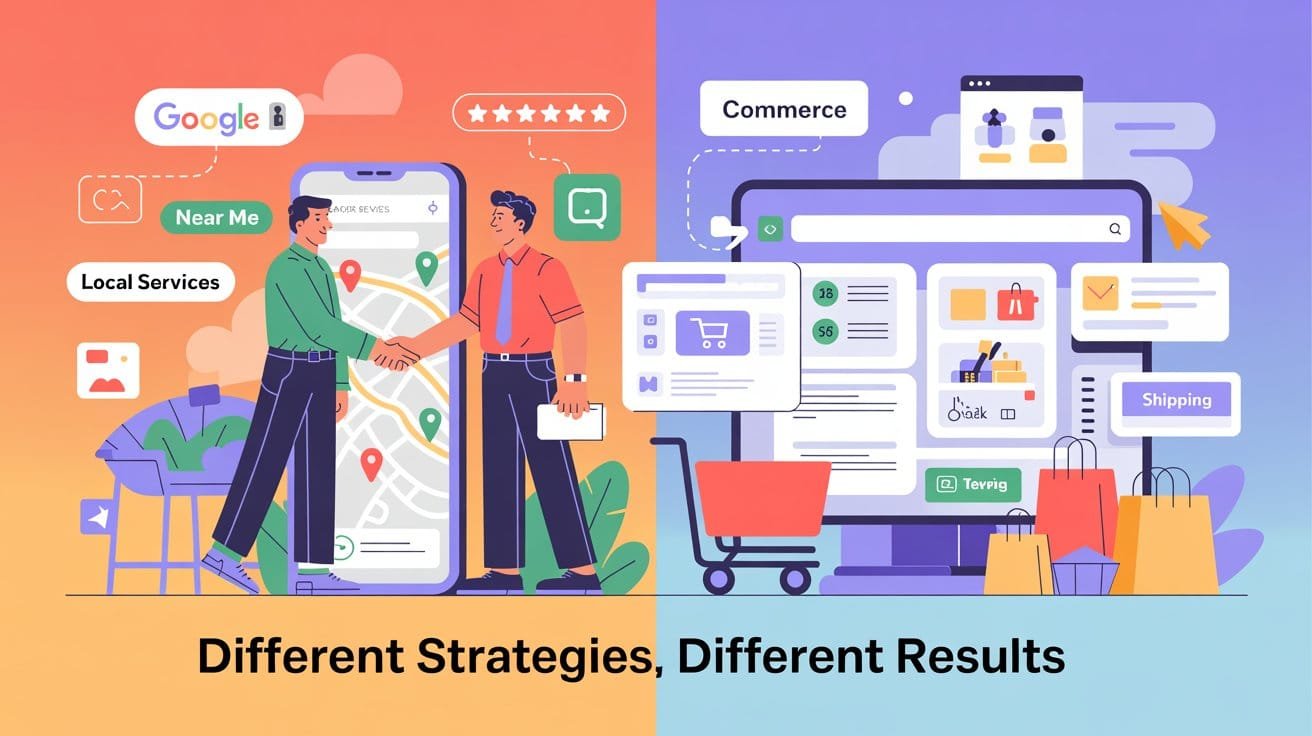
If you run a service-based business, SEO advice meant for eCommerce can quietly sabotage your growth.
Why?
Because it is built around trust, local intent, and lead generation—not product catalogs and checkout flows.
Yet many local businesses still follow SEO strategies designed for online stores… and end up ranking for traffic that never converts.
Let’s break down how service business SEO differs from eCommerce SEO, and what local businesses actually need to focus on to rank and win clients.
The Core Difference: Service Business SEO vs eCommerce SEO
The biggest difference comes down to how people search.
eCommerce SEO
- Goal: Sell products at scale
- Searchers compare prices, features, and reviews
- High traffic volume matters
- Conversions are often instant
Service Business SEO
- Goal: Generate qualified leads
- Searchers look for expertise, trust, and proximity
- Lower traffic volume—but much higher value
- Conversions happen through calls, forms, or consultations
Therefore, it prioritizes quality over quantity.
Search Intent:
Search intent is key in order to achieve more traffic.
Examples of Service Business SEO Searches
- “Service business SEO consultant”
- “Local SEO agency for small businesses”
- “Best HVAC company near me”
- “Personal injury lawyer in Chicago”
These searches show:
- High urgency
- High emotional stakes
- Strong intent to contact someone
Your SEO content must answer:
“Can I trust this business with my problem?”
That’s a very different job than ranking a product page.
How Service Business SEO Targets Buyers, Not Browsers
eCommerce SEO often targets hundreds or thousands of keywords.
Therefore, it works best when it focuses on:
- Service-specific keywords
- Location-based keywords
- Problem-aware searches
Examples:
- “Service business SEO services”
- “SEO for service-based businesses”
- “Local SEO for service companies”
These keywords attract decision-makers, not casual readers.
Content Strategy: Authority Beats Volume in Service Business SEO
eCommerce SEO Content
- Product pages
- Category pages
- Comparison content
- Reviews
Service Business SEO Content
- Core service pages
- Location pages
- Authority blog posts
- Case studies and proof content
Content must have to:
- Demonstrate expertise
- Address objections
- Show results and credibility
- Clearly explain next steps
Ranking without authority doesn’t convert.
Local SEO: The Secret Weapon for Service Businesses
Local SEO is where service business SEO dominates.
Key local SEO factors include:
- Optimized Google Business Profile
- Consistent NAP (name, address, phone)
- Location-based service pages
- Reviews and reputation signals
When someone searches for a service business SEO provider near them, Google wants to show a trusted local expert—not a generic national site.
Link Building for Service Business SEO:
This doesn’t need massive link volume.
It needs:
- Local backlinks
- Industry-relevant publications
- Partnerships and PR
- Thought leadership content
One strong, relevant backlink can outperform dozens of low-quality links.
Conversion Optimization Is Non-Negotiable in Service Business SEO
SEO traffic only matters if it turns into leads.
Service business SEO must align with:
- Clear positioning
- Strong calls-to-action
- Trust signals above the fold
- Simple contact or booking flows
If visitors don’t convert, it’s rarely an SEO issue—it’s a messaging and trust issue.
Which SEO Strategy Fits Your Business?
- Selling products online → eCommerce SEO
- Selling expertise, services, or outcomes → Service business SEO
Trying to apply eCommerce SEO tactics to a service business usually leads to:
- Low-quality traffic
- Weak conversion rates
- Missed local opportunities
Final Consideration!
It really requires a Different Playbook
This isn’t about ranking for everything.
It’s about ranking for high-intent searches, building trust quickly, and turning visibility into inquiries.
Local businesses that understand this don’t just get traffic—they get clients. Unlike eCommerce SEO, success comes from targeting high-intent searches, building local authority, and earning trust before the first conversation ever happens. When your SEO strategy aligns with how service buyers actually search and decide, rankings turn into leads, and leads turn into long-term clients. For local businesses, that’s where real SEO ROI lives.
At Revolute X Digital, we don’t use only one-size-fits-all SEO approaches. We specialize in service business SEO, helping companies attract high-intent traffic that actually converts into leads and revenue. From keyword research built around buyer intent to local SEO optimization, our approach is designed to support how service businesses grow in the real world. If you’re ready to stop chasing vanity traffic and start ranking for searches that bring in clients, our devoted team is here to assist you build the SEO systems that make it happen. Reach us now!
Frequently Asked Questions
What is the difference between service business SEO and eCommerce SEO?
Service business SEO focuses on generating qualified leads through trust, expertise, and local visibility.
eCommerce SEO focuses on selling products at scale through product pages, category optimization, and high-volume traffic.
The key difference:
- Service SEO = lead generation and trust-building
- eCommerce SEO = product sales and transaction optimization
Local service businesses need strategies centered around buyer intent, not product catalogs.
Is SEO different for service businesses?
Yes. Service businesses rely heavily on:
- Local search intent
- Reputation and reviews
- Authority content
- Conversion optimization
Unlike eCommerce sites, service businesses must convince users to contact, book, or schedule a consultation. That requires trust-focused SEO rather than volume-focused SEO.
Why doesn’t eCommerce SEO work for local service businesses?
eCommerce SEO strategies prioritize:
- Large keyword lists
- Product comparisons
- High traffic volume
- Instant online purchases
Local service businesses typically convert through calls and inquiries. Using eCommerce tactics often leads to traffic that doesn’t convert because it targets browsers instead of buyers.
What is service business SEO?
Service business SEO is a strategy designed to help service providers rank for high-intent, local, and solution-based searches.
It focuses on:
- Service-specific keywords
- Location-based optimization
- Google Business Profile optimization
- Authority-building content
- Strong calls-to-action
The goal is to generate leads, not just website visits.
What keywords should a service business target?
Service businesses should prioritize:
- Service + location keywords (e.g., “HVAC company in Dallas”)
- “Near me” searches
- Problem-based searches (e.g., “AC not cooling repair”)
- Comparison and “best” keywords
These keywords signal urgency and buying intent.
Is local SEO more important for service businesses?
In most cases, yes.
Local SEO is critical because service businesses operate within geographic areas. Ranking in local search results and Google Maps often drives more qualified leads than national rankings.
Core local SEO elements include:
- Optimized Google Business Profile
- Consistent NAP (Name, Address, Phone)
- Local backlinks
- Customer reviews
How does content strategy differ between service SEO and eCommerce SEO?
eCommerce content focuses on:
- Product descriptions
- Category pages
- Reviews and comparisons
Service business SEO content focuses on:
- Core service pages
- Location landing pages
- Case studies
- Authority blog posts
- Trust-building content
Authority and credibility matter more than content volume.
How do service businesses convert SEO traffic into leads?
Conversion optimization is essential.
Service businesses must include:
- Clear positioning
- Strong trust signals
- Testimonials and reviews
- Prominent calls-to-action
- Easy contact forms or booking systems
SEO brings visibility. Trust and clarity turn that visibility into clients.
Can a local service business use eCommerce SEO tactics?
Some technical SEO principles overlap, but the overall strategy should differ.
Applying eCommerce SEO tactics to service businesses often results in:
- Low-quality traffic
- Weak engagement
- Poor conversion rates
Service businesses need a lead-generation SEO model, not a product-sales model.
How long does service business SEO take to show results?
Most local service businesses see:
- Initial movement in 3–4 months
- Stronger lead flow within 6–9 months
- Long-term stability after 12 months
Because the focus is on high-intent searches, rankings typically produce higher conversion rates once established.

Jason
We are an Affordable Digital Marketing Agency in Shawnee with budget-friendly solutions to amplify your brand. Elevate your business without compromising quality or cost.