
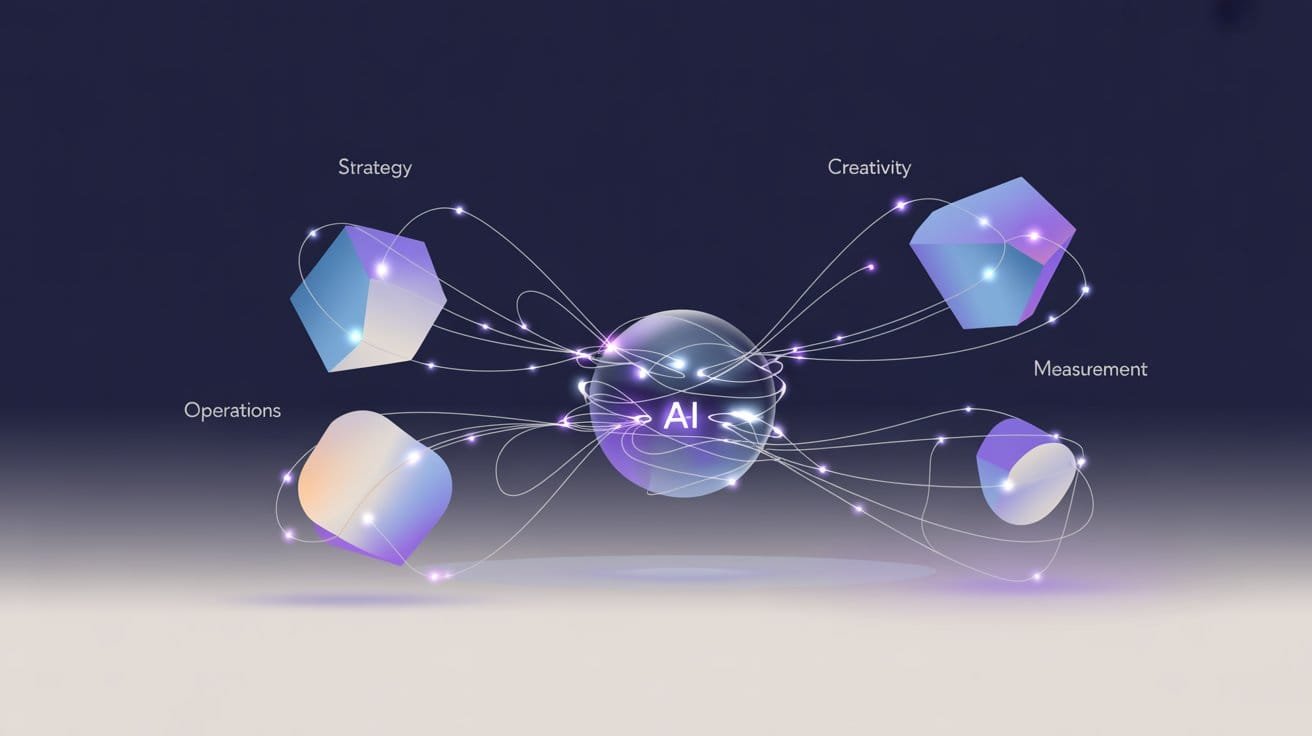
AI is not “another channel”. It is a force multiplier that is quietly rewiring how marketing works across strategy, creativity, operations, and measurement.
Budgets are not just shifting from offline to online anymore. They are moving from manual work to automated, AI-driven systems. The brands that win are the ones that treat AI as infrastructure, not a side project.
Let us break down where the impact is real right now.
How AI is Rewiring the Marketing Ecosystem?
Hyper Precise Audience Targeting
Marketing used to work on broad assumptions. Today, AI can build micro-segments based on behaviour, context, and intent.
Ad platforms use machine learning to analyse signals like browsing history, engagement patterns, device type, and time of day to predict which user is most likely to convert. That is why modern campaigns are increasingly “goal based” instead of manually choosing every target. You set a business outcome: leads, purchases, app installs. The AI optimises delivery in real time.
Impact on the ecosystem.
- Media buying becomes less about manual tweaks, more about setting clear objectives and feeding high-quality data.
- Small teams can compete with large ones because algorithms do the heavy lifting of optimisation.
- Agencies that only sell “we manage your ads” without a deeper data and strategy layer are getting squeezed.
Content Creation at Industrial Scale
Content is both easier and harder now. Easier, because AI tools can generate drafts for blogs, emails, social posts, landing pages, and ad copy in seconds. Harder, because the volume of content in the market explodes, and mediocre material gets ignored faster.
AI’s impact here is more about scale and speed than “magic creativity.” Smart teams use AI to:
- Turn one core message into multiple formats: threads, carousels, short scripts, newsletter sections.
- Localise content into new languages and markets.
- A/B test variations in subject lines, hooks, and CTAs without burning out the human team.
The ecosystem shifts.
- Creative bottlenecks move from “writing” to “deciding what is worth saying.” Strategy becomes more valuable than copy alone.
- Brands that rely on generic, unedited AI text start to sound identical. The winners layer strong positioning and human insight on top of AI-generated drafts.
- Content calendars move from monthly planning to continuous, data-driven iteration.
Smarter Customer Journeys and Personalisation
Personalisation used to mean dropping a first name into an email. Now AI can help build dynamic experiences across channels.
Examples.
- Email flows that adjust based on how a user behaves on your site.
- Product recommendations that adapt in real-time as a user browses.
- Website copy that changes for different audience segments based on referral source or campaign.
AI models take in behavioural data, purchase history, and real-time interactions to predict what each user is most likely to care about next. Done well, this feels helpful, not creepy, and drives higher lifetime value.
Ecosystem Effect:
- Marketing and product become more intertwined. The “experience” is the marketing.
- CRMs and CDPs that cannot integrate AI-driven segmentation and scoring will be phased out.
- Teams need people who understand both data and narrative (translating model outputs into meaningful experiences).
Automation of Low-Level Tasks
A massive but less glamorous impact of AI is the removal of repetitive grunt work from marketing operations.
Think about tasks like.
- Tagging and categorising leads
- Cleaning up contact lists
- Generating performance summaries from analytics
- Drafting routine reports and performance emails
- Auto routing support questions to the right team or knowledge base
AI agents and automations can handle a huge part of this. The upside.
- Marketers reclaim hours each week to focus on strategy, creative thinking, and experiments
- Ops becomes leaner, with fewer manual errors
- Smaller teams can run complex multi-channel setups that used to require big headcounts
The ecosystem response is visible – marketing tools are rushing to bolt AI features into dashboards, CRMs, ad managers, and analytics. The platforms that win are the ones that truly reduce manual work, not just sprinkle “AI” on top as a buzzword.
Analytics, Attribution, and Decision Making
Data is not the problem anymore. Interpreting it is.
AI helps by.
- Spotting patterns humans might miss (drops, anomalies, and emerging opportunities)
- Predicting likely outcomes of campaigns or budget shifts
- Generating plain language explanations of what happened and why metrics moved
You go from staring at dashboards to asking direct questions.
- “Which campaigns are generating the highest LTV by channel?”
- “What content topics are leading to demo requests in the last 90 days?”
- “If I move 20 percent of the budget from Meta to search, what is the likely impact?”
This pushes the ecosystem towards decision intelligence instead of just dashboarding. Agencies and in-house teams that can connect these insights to bold, testable decisions pull ahead. Those that only report on what has already happened fall behind.
New risks. Brand, Ethics, and Dependency
It is not all upside down. AI also introduces real risks into the marketing ecosystem.
- Brand Erosion. Overuse of generic AI content makes brands sound identical and forgettable.
- Misinformation and Deepfakes. Visual and audio tools can be abused, damaging trust if brands are not careful about verification and disclosure.
- Data and Privacy. Poorly handled data flows into third-party AI tools can create compliance and trust issues.
- Over Dependency. Teams that stop thinking and only follow AI suggestions become slow, reactive, and easy to outcompete.
Serious players respond by setting clear AI guardrails: what can be automated, what must remain human, how data is handled, and how outputs are checked before going live.
What does this mean for the Future Marketer?
The role of the marketer is shifting from “doer” to designer of systems.
In an AI-powered marketing ecosystem, the most valuable skills look like this.
- Clear strategic thinking – deciding what to aim for, not just running campaigns.
- Strong positioning and messaging – what you say still matters more than how many variations you generate.
- Ability to orchestrate tools and workflows – connecting AI capabilities into a coherent pipeline.
- Critical judgment – knowing when the AI is wrong, off-brand, or misaligned with the goal.
The tools will keep changing. The fundamentals of good marketing: understanding people, markets, and value.
Final Thought!
AI will not magically fix broken offers, weak positioning, or unclear strategy. It amplifies whatever is already there: good or bad.
Revolute X Digital helps brands use AI to amplify the right things. We design marketing ecosystems where AI supports sharper strategy, faster execution, and measurable growth instead of random experiments and shiny tool chasing. If you are ready to turn AI from a buzzword into a competitive edge in your marketing, Revolute X Digital can help you architect, implement, and scale that system. Contact us today!
Frequently Asked Questions (FAQs)
How is AI changing the marketing ecosystem?
AI is changing marketing by automating data analysis, audience targeting, content creation, personalization, and reporting. Instead of manually managing campaigns and content, marketers now design systems where AI handles optimization and pattern detection. This shifts marketing from manual execution to strategic orchestration.
Is AI just another marketing channel?
No. AI is not a channel like social media or email. It is infrastructure that powers targeting, automation, analytics, personalization, and content workflows across all channels. Brands that treat AI as a core system rather than a side tool gain a competitive advantage.
How does AI improve audience targeting?
AI improves audience targeting by analyzing behavioral signals such as browsing history, engagement patterns, device usage, and timing. It builds micro-segments and optimizes campaigns in real time based on conversion probability. This allows teams to focus on goals rather than manual targeting settings.
Can AI replace human marketers?
No. AI automates repetitive tasks and surfaces insights, but it does not replace strategic thinking, positioning, or creative direction. Human marketers remain responsible for defining goals, shaping messaging, and ensuring brand alignment.
How does AI affect content marketing?
AI accelerates content production by generating drafts, repurposing core ideas into multiple formats, localizing messaging, and testing variations. However, brands that rely solely on unedited AI content risk sounding generic. Strong positioning and human refinement remain essential.
What role does AI play in marketing automation?
AI enhances automation by:
- Routing leads intelligently
- Cleaning and segmenting contact lists
- Generating performance summaries
- Predicting campaign outcomes
- Personalizing user journeys in real time
This reduces manual workload and allows smaller teams to operate efficiently at scale.
How does AI improve marketing analytics and decision-making?
AI improves analytics by detecting patterns, forecasting outcomes, and translating complex data into plain language insights. Instead of only reporting past performance, AI enables predictive decision-making and scenario modeling for budget shifts and campaign strategy.
What are the risks of using AI in marketing?
Risks include:
- Brand erosion from generic content
- Over-automation without strategy
- Data privacy and compliance issues
- Dependency on tools without critical oversight
AI should be governed by clear guidelines and human review processes.
What skills do marketers need in an AI-driven ecosystem?
Modern marketers need:
- Strategic thinking
- Strong positioning and messaging
- Ability to integrate tools and workflows
- Data literacy
- Critical judgment to validate AI outputs
The role shifts from task execution to system design and oversight.
Will AI eliminate marketing jobs?
AI will change marketing roles rather than eliminate them. Repetitive tasks will decrease, while demand for strategic, analytical, and creative skills will increase. Marketers who understand how to leverage AI will become more valuable.
How should businesses integrate AI into marketing?
Businesses should:
- Identify repetitive tasks that consume time.
- Select a focused AI tool stack.
- Define clear brand and compliance rules.
- Measure results based on business outcomes.
- Adjust workflows based on performance data.
AI should amplify strategy, not replace it.

Jason
We are an Affordable Digital Marketing Agency in Shawnee with budget-friendly solutions to amplify your brand. Elevate your business without compromising quality or cost.