
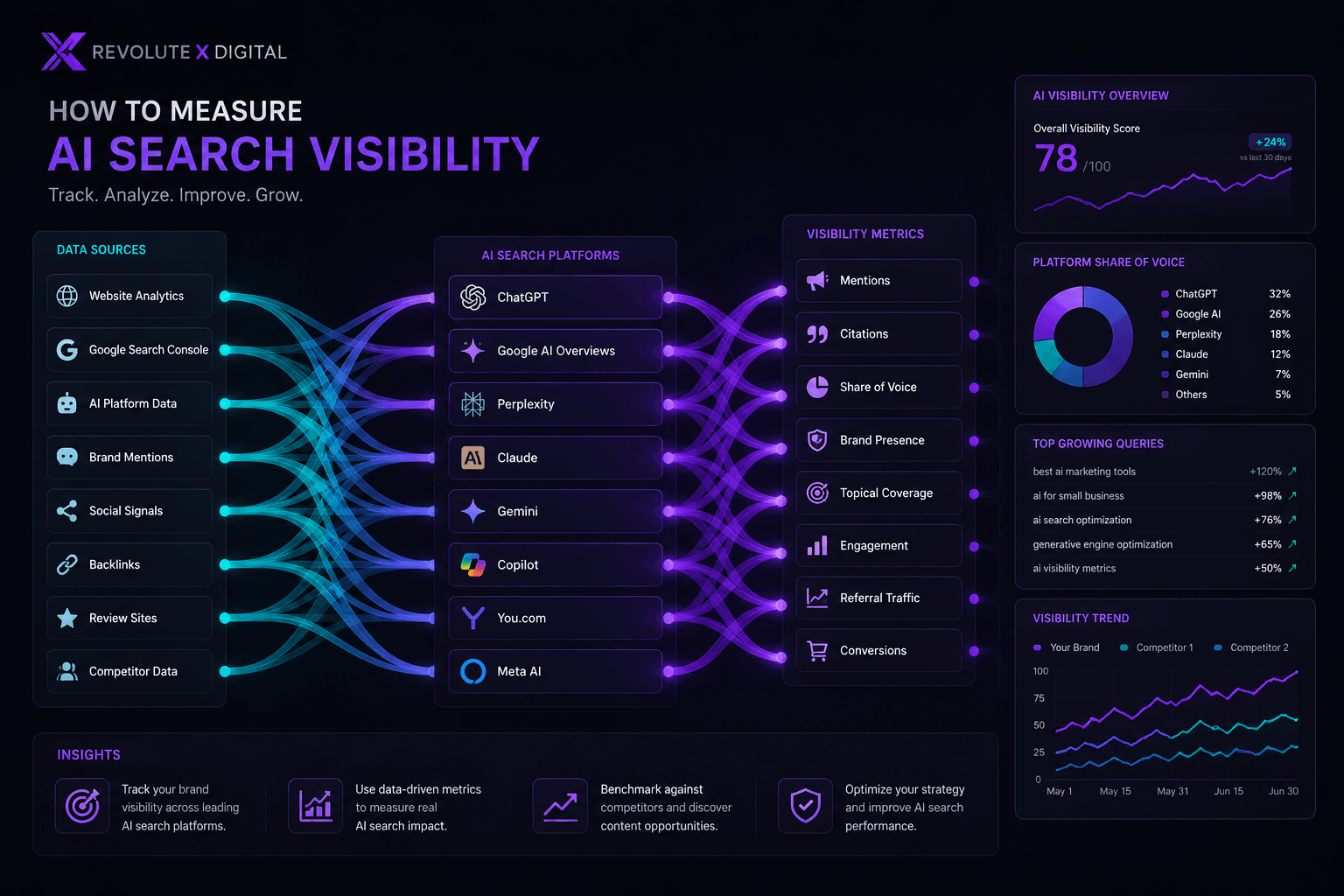
Artificial intelligence is reshaping how people discover businesses online. Instead of scrolling through pages of search results, users are asking questions directly in ChatGPT, Google AI Overviews, Claude, Gemini, Perplexity, and other AI-powered search platforms.
This shift has created a new challenge for businesses. Traditional SEO reports can tell you how many visitors come from Google or which keywords you rank for, but they don’t show whether AI platforms recognize your brand as a trusted source.
That’s why understanding how to measure AI search visibility has become essential for modern digital marketing.
Whether you’re an SEO professional, business owner, marketer, or agency, measuring your AI visibility helps you understand how often AI platforms recommend, cite, or mention your business when answering user questions. Without the right data, it’s difficult to know whether your AI Search Optimization efforts are making an impact.
Before exploring the measurement process, it’s important to understand which metrics actually matter.
Related Reading: Learn about the complete AI Search Visibility KPI Framework in our AI Search Visibility Metrics KPIs guide. This comprehensive resource explains the core metrics businesses should monitor to improve their visibility across AI-powered search experiences.
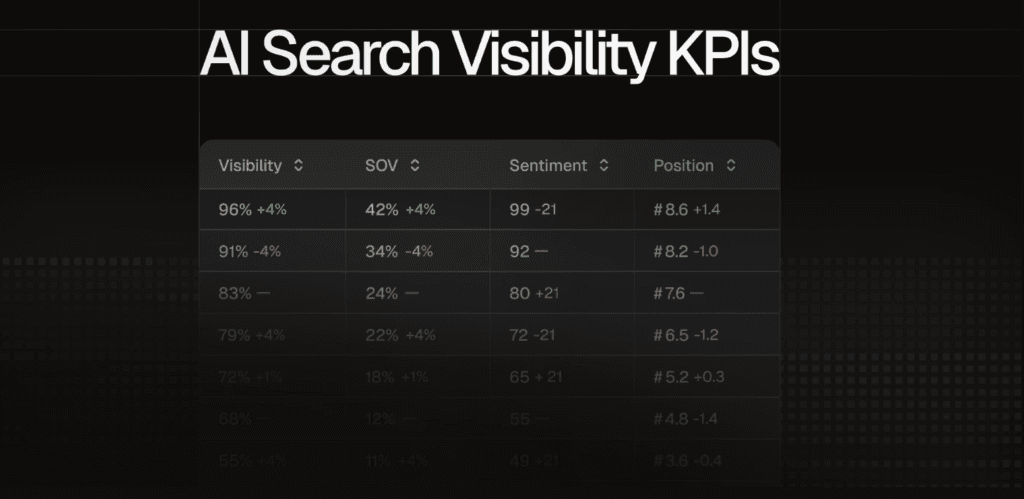
What Is AI Search Visibility?
AI search visibility refers to how often your business, website, products, or content appear in AI-generated answers across modern search platforms.
Unlike traditional search engines that display a list of webpages, AI assistants generate direct answers by analyzing information from multiple trusted sources.
For example, a user might ask:
- Which SEO agencies specialize in AI Search Optimization?
- What are the most important AI search visibility metrics?
- How can small businesses improve their AI visibility?
Instead of returning ten blue links, an AI platform generates a summarized response that may recommend businesses, reference articles, or cite authoritative sources.
If your brand consistently appears in these answers, your AI search visibility is strong.
If competitors are being recommended while your business is absent, there is an opportunity to improve your authority, content quality, and overall AI Search Optimization strategy.
Why Measuring AI Search Visibility Matters
Many businesses still evaluate success using only traditional SEO metrics such as rankings, impressions, and organic traffic.
While those metrics remain valuable, they no longer provide a complete picture of online visibility.
For example, your website may receive fewer clicks because users find their answers directly within Google’s AI Overviews or another AI assistant. Even if traffic decreases slightly, your brand may still be gaining significant exposure through AI-generated recommendations.
Measuring AI search visibility helps answer questions such as:
- Is my business appearing in AI-generated responses?
- Which AI platforms recognize my content?
- How often is my website being cited?
- Which competitors receive more AI recommendations?
- Which topics increase my visibility?
These insights help businesses make smarter decisions about content, SEO, and digital marketing investments.
Traditional SEO vs AI Search Measurement
Traditional SEO focuses on how webpages perform in search engines.
Typical SEO metrics include:
- Organic rankings
- Click-through rate (CTR)
- Impressions
- Organic traffic
- Backlinks
- Domain authority
These indicators remain important because they measure search engine performance.
However, AI-powered search introduces new measurement opportunities.
Instead of focusing only on webpages, AI systems evaluate:
- Brand authority
- Entity recognition
- Citation quality
- Content trustworthiness
- Prompt relevance
- Topical expertise
This means businesses must expand their reporting beyond traditional SEO dashboards.
Rather than asking, “Where do I rank?”, the more important question becomes:
“How often does AI recommend my business?”
What Should You Measure?
Before choosing tools or building dashboards, define what success looks like.
Effective AI search measurement should evaluate four core areas:
Visibility
How often does your brand appear across AI platforms?
Authority
Do AI systems recognize your website as a trusted source?
Engagement
Are AI-generated recommendations leading users to your website?
Business Impact
Are AI-driven visitors becoming leads, customers, or clients?
Together, these areas provide a more complete understanding of your AI search performance than rankings alone.
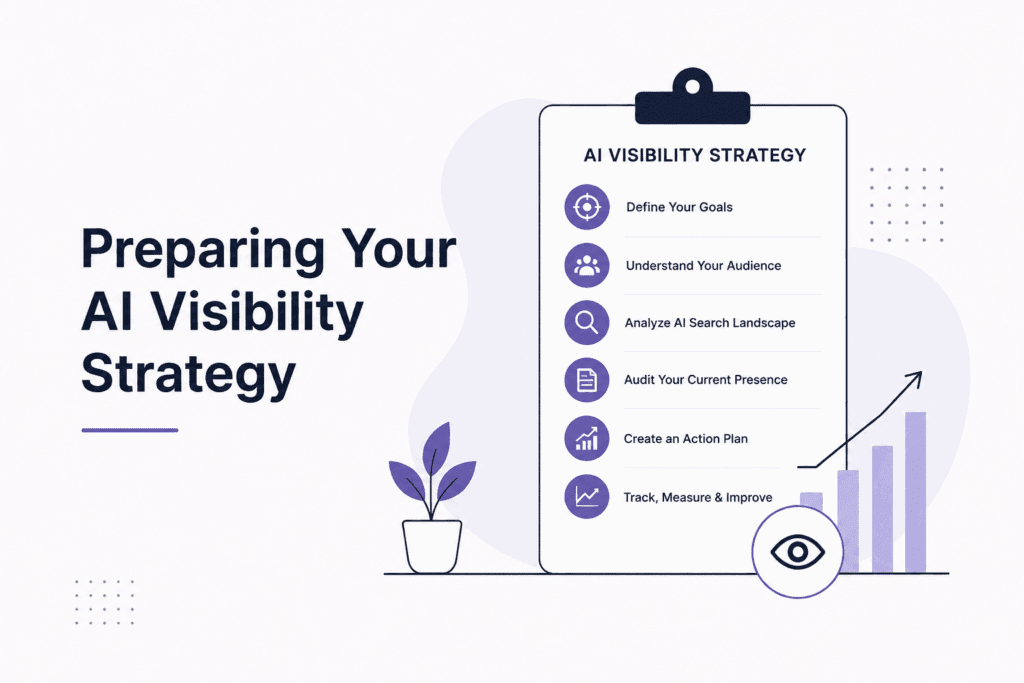
Preparing Your AI Visibility Strategy
Measuring AI search visibility isn’t about checking one report once a month.
It’s an ongoing process that combines SEO, content strategy, entity optimization, and performance analysis.
Start by identifying the questions your customers ask most often. Then compare how different AI platforms answer those questions and whether your business appears in the responses.
As your content library grows, you’ll begin to identify patterns that reveal where your brand is gaining authority and where additional optimization is needed.
In the next section, we’ll build a practical measurement framework using key metrics such as AI Share of Voice, Citation Rate, Prompt Coverage, Entity Presence, and Brand Mentions. These metrics form the foundation of a successful AI Search Optimization strategy.
Continue Reading: Metrics like AI Share of Voice, Citation Rate, Prompt Coverage, and Entity Presence are explained in detail in our complete AI Search Visibility Metrics & KPIs guide. Understanding these KPIs will help you measure, benchmark, and continuously improve your AI visibility across modern search platforms.
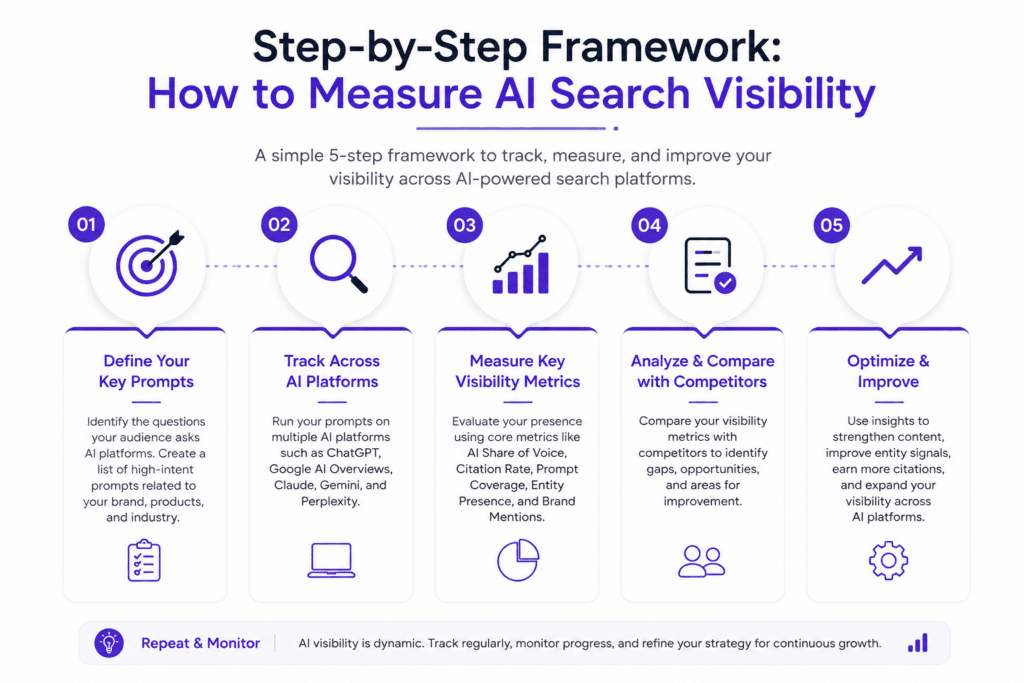
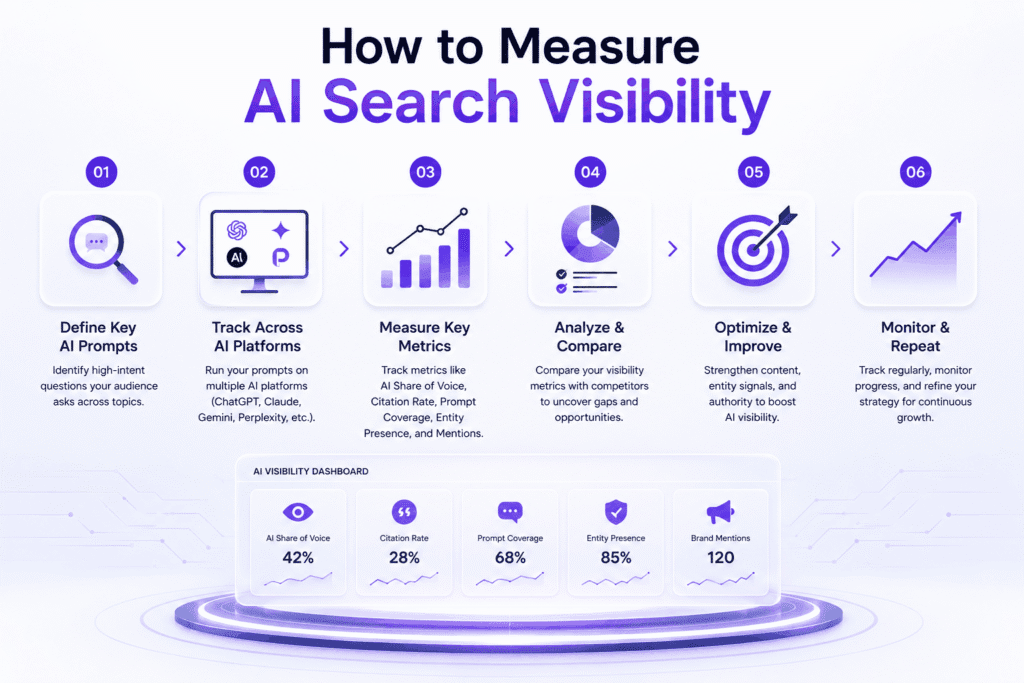
Step-by-Step Framework: How to Measure AI Search Visibility
Understanding how to measure AI search visibility requires more than checking keyword rankings. AI-powered search platforms evaluate your content differently than traditional search engines, which means your reporting framework must also evolve.
Rather than focusing on a single metric, successful businesses monitor a combination of visibility, authority, citations, and entity recognition to understand how AI platforms perceive their brand.
Below are the first five metrics every business should track.
1. AI Share of Voice (AI SOV)
AI Share of Voice measures how often your brand appears in AI-generated responses compared to your competitors.
Think of it as the AI equivalent of search visibility.
If ten people ask AI assistants:
- Best AI Search Optimization agency
- Best Local SEO company
- Best AI marketing agency
Which businesses are consistently recommended?
The companies appearing most frequently generally have stronger topical authority, better entity recognition, and higher trust.
Why It Matters
AI platforms rarely recommend dozens of businesses. Most responses highlight only a handful of trusted sources.
Increasing your AI Share of Voice means increasing your opportunities to be discovered by potential customers.
How to Measure It
Create a list of 50–100 high-intent prompts related to your industry.
Examples:
- Best Local SEO agency
- AI Search Optimization services
- Google Business Profile experts
- AI automation company
Run these prompts across:
- Google AI Overviews
- ChatGPT
- Claude
- Gemini
- Perplexity
Track:
- Does your business appear?
- How frequently?
- Which competitors appear more often?
- Which prompts generate recommendations?
Repeat this process monthly to monitor growth.
2. AI Citation Rate
AI assistants often cite trusted websites when generating answers.
AI Citation Rate measures how frequently your website or content is referenced.
Being cited demonstrates that AI platforms recognize your content as authoritative and trustworthy.
Why Citation Rate Matters
A citation carries more weight than a simple mention.
It tells users—and AI systems—that your content contributed to the answer.
Strong citations also reinforce your topical authority over time.
What to Track
Monitor:
- Which pages receive citations
- Citation frequency
- Citation growth month over month
- Topics receiving the most citations
- Competitor citation trends
For example, if your article about AI Search Visibility Metrics is consistently referenced while competitors are not, it’s a positive signal that your content is becoming an authoritative resource.
Related Reading: Our AI Search Visibility Metrics & KPIs guide explains how Citation Rate fits into a broader AI visibility strategy.
3. Prompt Coverage
Prompt Coverage measures the number of relevant AI prompts where your brand appears.
This is one of the fastest ways to identify content gaps.
Imagine your customers asking AI assistants questions every day.
Examples include:
- What is AI Search Optimization?
- How do I improve AI visibility?
- Best SEO agency for small businesses
- What are AI search metrics?
Your goal is to appear across as many relevant prompts as possible.
Why Prompt Coverage Is Important
Appearing for one prompt is useful.
Appearing across hundreds of related prompts signals that your website has strong topical authority.
The broader your prompt coverage, the more opportunities AI systems have to recommend your business.
Improve Prompt Coverage By
- Publishing comprehensive topic clusters
- Answering People Also Ask questions
- Creating detailed FAQs
- Covering related subtopics
- Updating older content regularly
4. Brand Entity Presence
Large Language Models understand entities, not just keywords.
An entity represents a recognizable business, person, organization, service, or product.
For AI platforms to recommend your business confidently, they first need to understand:
- Who you are
- What services you provide
- Where you operate
- Which industries you specialize in
Strengthen Your Entity Presence
Improve consistency across:
- Your website
- Google Business Profile
- Social media profiles
- Business directories
- Industry websites
Also implement structured data such as:
- Organization Schema
- LocalBusiness Schema
- Service Schema
- FAQ Schema
- Breadcrumb Schema
Strong entity signals make it easier for AI systems to connect your content with relevant user queries.
5. Brand Mention Frequency
Your business may appear in AI-generated responses without receiving a direct citation.
Brand Mention Frequency measures how often AI assistants reference your company across different topics.
Even when users don’t click your website, repeated mentions strengthen brand awareness and build credibility.
Questions to Ask
- How often is my company mentioned?
- Which services trigger AI recommendations?
- Which competitors are mentioned more frequently?
- Which AI platforms mention my brand most often?
Tracking these trends helps identify areas where your authority is growing and where additional optimization is needed.
Bringing the Metrics Together
No single KPI tells the complete story of AI visibility.
Instead, these five foundational metrics work together:
- AI Share of Voice shows how often your brand is recommended.
- AI Citation Rate measures how frequently your content is referenced.
- Prompt Coverage reveals the breadth of your visibility across AI queries.
- Brand Entity Presence evaluates how well AI understands your business.
- Brand Mention Frequency tracks your overall recognition across AI platforms.
When monitored consistently, these metrics provide a clear picture of how AI-powered search engines perceive your brand and where improvements can deliver the greatest impact.
As your strategy matures, you’ll also want to monitor advanced metrics such as AI referral traffic, recommendation rate, topical authority, engagement, and conversions.
How to Measure AI Search Visibility: The Complete Guide
Best Tools to Measure AI Search Visibility
Tracking AI visibility manually is possible when you’re just getting started. However, as your content grows, using the right tools helps you monitor performance more efficiently and identify new optimization opportunities.
No single platform currently measures every aspect of AI Search Visibility. The best approach is to combine several tools, each providing insights into different parts of your strategy.
Google Search Console
Google Search Console remains one of the most valuable tools for understanding how users discover your website through Google Search.
Although it doesn’t currently report AI Overviews separately, it helps you monitor:
- Organic impressions
- Clicks
- Average position
- Queries
- Click-through rate (CTR)
Pay close attention to queries with high impressions but low CTR. These often indicate searches where AI-generated answers may satisfy users before they click a website.
Google Analytics 4 (GA4)
Google Analytics helps measure what happens after users visit your website.
Track important engagement metrics such as:
- Sessions
- Users
- Engagement Rate
- Average Engagement Time
- Conversions
- Lead Form Submissions
- Revenue
As AI-powered search evolves, monitoring referral traffic from AI platforms will become increasingly important.
AI Visibility Platforms
Several emerging platforms focus specifically on AI visibility.
Popular options include:
- Semrush AI Toolkit
- Peec AI
- Profound
- Otterly.AI
- Scrunch AI
- ZipTie.dev
These tools can help monitor:
- AI mentions
- Citation frequency
- Prompt tracking
- Competitor comparisons
- Brand visibility
Since AI search is still evolving, expect these platforms to continue adding new reporting capabilities.
Build an AI Search Visibility Dashboard
Instead of checking dozens of reports individually, create a dashboard that brings your most important metrics together.
A monthly dashboard allows you to monitor trends, identify opportunities, and evaluate the impact of your optimization efforts.
Recommended Dashboard Sections
Visibility Metrics
Track how often your brand appears across AI-powered search platforms.
Include:
- AI Share of Voice
- Prompt Coverage
- AI Recommendation Rate
- Citation Rate
Authority Metrics
These metrics measure how trustworthy AI systems consider your business.
Track:
- Brand Mentions
- Entity Presence
- Topical Authority
- High-quality Backlinks
- Structured Data Health
Traffic Metrics
Understanding how AI visibility impacts website performance is essential.
Monitor:
- Organic Traffic
- AI Referral Traffic
- Returning Visitors
- Average Engagement Time
- Pages Per Session
Business Metrics
Ultimately, visibility should contribute to business growth.
Track:
- Leads
- Contact Form Submissions
- Phone Calls
- Consultation Requests
- Sales
- Revenue
- Conversion Rate
The goal isn’t simply to appear in AI-generated answers—it is to generate meaningful business results.
Common Mistakes When Measuring AI Search Visibility
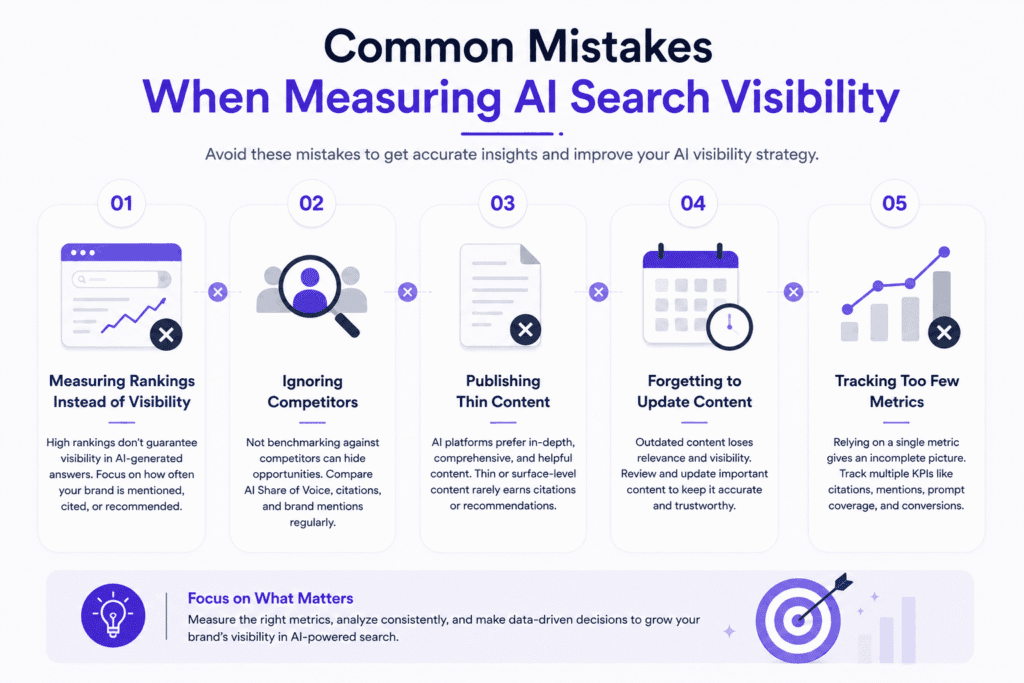
Many businesses invest in AI Search Optimization but track the wrong metrics.
Avoid these common mistakes.
Measuring Rankings Instead of Visibility
A business can rank well in Google Search while rarely appearing in AI-generated responses.
Traditional rankings are only one part of the picture.
Measure how often AI platforms recommend or cite your business.
Ignoring Competitors
Tracking your own visibility isn’t enough.
Compare your AI Share of Voice with competitors.
Ask:
- Which brands appear more frequently?
- Which websites receive the most citations?
- Which topics do competitors dominate?
Competitive analysis helps uncover opportunities to strengthen your content.
Publishing Thin Content
AI platforms favor comprehensive, trustworthy resources.
Instead of publishing ten short articles, create one exceptional guide that completely answers a topic.
For example, your AI Search Visibility Metrics & KPIs guide should remain the most comprehensive resource on your website and serve as the central pillar of your AI Search content hub.
Forgetting to Update Content
AI Search evolves rapidly.
Review important articles every few months by:
- Updating statistics
- Adding new AI platforms
- Expanding FAQs
- Improving examples
- Refreshing screenshots
Fresh content signals that your information remains relevant.
How Revolute X Digital Measures AI Search Visibility
At Revolute X Digital, we believe AI Search Optimization goes beyond traditional SEO reporting.
Our strategy combines technical SEO, semantic SEO, entity optimization, and AI-specific measurement to understand how businesses perform across modern AI-powered search experiences.
When evaluating AI visibility, we monitor:
- AI Share of Voice
- Citation Rate
- Prompt Coverage
- Entity Recognition
- Brand Mentions
- AI Recommendation Frequency
- Content Authority
- Structured Data
- Organic Performance
- Conversion Metrics
By combining these insights, businesses can make smarter decisions that improve both search visibility and long-term growth.
Future Trends in AI Search Measurement
The way businesses measure search performance will continue to evolve.
In the coming years, expect AI platforms and analytics tools to introduce new reporting capabilities, including:
- AI Conversation Share
- Citation Quality Score
- Entity Authority Score
- AI Trust Index
- Multi-Model Visibility Score
- AI-Assisted Conversion Rate
Businesses that begin tracking AI visibility today will be better prepared as these metrics become industry standards.
Conclusion
Learning how to measure AI search visibility is becoming an essential part of modern digital marketing.
Traditional SEO metrics remain important, but they no longer provide a complete picture of how customers discover businesses through AI-powered search.
By monitoring metrics such as AI Share of Voice, Citation Rate, Prompt Coverage, Brand Entity Presence, and Brand Mention Frequency, businesses can better understand how AI platforms perceive their authority and identify opportunities for growth.
The future of search isn’t just about ranking webpages—it’s about becoming a trusted source that AI platforms confidently recommend.
As AI continues to reshape online discovery, businesses that measure, optimize, and continuously improve their AI visibility will be better positioned to earn trust, attract qualified leads, and stay ahead of the competition.
Frequently Asked Questions
What is AI Search Visibility?
AI Search Visibility measures how often your business appears, is cited, or is recommended across AI-powered platforms like ChatGPT, Google AI Overviews, Claude, Gemini, and Perplexity.
Why is measuring AI Search Visibility important?
It helps businesses understand whether AI platforms recognize their content as trustworthy and recommend it to users, providing insights beyond traditional SEO rankings.
Which metrics should I track?
The most important metrics include:
- AI Share of Voice
- Citation Rate
- Prompt Coverage
- Brand Entity Presence
- Brand Mention Frequency
- AI Recommendation Rate
- AI Referral Traffic
- Conversions
What tools can measure AI Search Visibility?
Popular tools include Google Search Console, Google Analytics 4, Semrush AI Toolkit, Peec AI, Profound, Otterly.AI, Scrunch AI, and ZipTie.dev.
Can traditional SEO metrics measure AI visibility?
No. Traditional SEO metrics provide valuable insights into search engine performance, but they don’t show how AI platforms recommend, cite, or understand your brand.

Jason
We are an Affordable Digital Marketing Agency in Shawnee with budget-friendly solutions to amplify your brand. Elevate your business without compromising quality or cost.