
Artificial intelligence is rapidly changing how people search for information online.
Instead of clicking through multiple websites, users now ask questions directly in ChatGPT, Google AI Overviews, Claude, Gemini, Perplexity, and other AI-powered search platforms. These systems generate answers by combining information from trusted sources, changing how businesses earn visibility and attract potential customers.
This shift means traditional SEO metrics alone no longer tell the full story.
While rankings, impressions, and clicks remain valuable, they don’t reveal whether AI platforms recognize your brand, recommend your services, or reference your content when answering user questions.
That’s where AI search visibility metrics KPIs become essential.
Businesses that monitor the right AI metrics gain a clearer understanding of how visible they are across modern search experiences and can identify opportunities to improve their authority, content strategy, and online presence.
In this guide, you’ll learn what AI search visibility means, why it matters, how it differs from traditional SEO, and which key performance indicators should be part of every AI Search Optimization strategy.
What Is AI Search Visibility?
AI search visibility measures how often your brand, website, products, or services appear within AI-generated answers instead of only traditional search results.
Unlike conventional SEO, where success is measured by webpage rankings, AI visibility focuses on whether large language models recognize your business as a trusted source of information.
For example, if someone asks:
“Who are the best local SEO agencies for small businesses?”
An AI platform may recommend several agencies based on its understanding of authority, expertise, online reputation, and content quality.
If your business is consistently mentioned, cited, or referenced, your AI search visibility is strong.
If your competitors appear while your business does not, there is likely an opportunity to strengthen your AI Search Optimization strategy.
Simply put, AI visibility measures your presence within AI-generated answers—not just search engine rankings.
Why AI Search Visibility Matters More Than Ever
Consumer search behavior is evolving rapidly.
People increasingly ask conversational questions instead of typing short keyword phrases.
Examples include:
- Which AI automation tools are best for small businesses?
- Who offers reliable local SEO services?
- What is the best AI marketing agency?
- How can I improve my Google Business Profile rankings?
AI platforms answer these questions directly, often without users clicking through multiple websites.
As a result, businesses must compete not only for Google’s first page but also for inclusion in AI-generated responses.
Greater AI visibility can help your business:
- Increase brand awareness
- Build trust and authority
- Generate qualified leads
- Expand reach across multiple AI platforms
- Stay competitive as search continues to evolve
Businesses that adapt early will be better positioned as AI-powered search becomes a larger part of how customers discover products and services.
Traditional SEO vs AI Search
Traditional SEO and AI Search Optimization share many similarities, but they measure success differently.
Traditional SEO Focuses On
- Keyword rankings
- Organic traffic
- Click-through rate
- Backlinks
- Domain authority
- Page experience
- Technical optimization
The goal is to rank webpages as highly as possible in search engine results.
AI Search Focuses On
- Brand mentions
- AI citations
- Entity recognition
- Topical authority
- Prompt coverage
- AI recommendation frequency
- Knowledge consistency
- Trust signals
Instead of ranking pages, AI systems evaluate whether your content is reliable enough to reference when answering user questions.
This makes content quality, expertise, semantic relevance, and entity optimization more important than ever.
Understanding SEO, AEO, GEO & AI Search Optimization
One of the biggest misconceptions is that AI Search Optimization replaces SEO.
It doesn’t.
Instead, modern search strategies combine several disciplines.
Search Engine Optimization (SEO)
SEO focuses on improving website visibility in traditional search engines like Google and Bing.
Success is typically measured through rankings, traffic, impressions, and conversions.
Answer Engine Optimization (AEO)
AEO focuses on creating content that directly answers user questions.
This improves visibility in:
- Featured Snippets
- Voice Search
- AI-generated answers
- Knowledge panels
Well-structured FAQs, concise definitions, and helpful content are essential for AEO.
Generative Engine Optimization (GEO)
Generative Engine Optimization focuses on improving how AI platforms understand and reference your business.
Rather than targeting rankings alone, GEO emphasizes:
- Entity recognition
- Semantic relationships
- Brand authority
- Consistent business information
- Trusted citations
The goal is to increase the likelihood that AI systems recommend your brand when responding to relevant prompts.
AI Search Optimization
AI Search Optimization combines the strengths of SEO, AEO, GEO, semantic SEO, technical SEO, and entity optimization into one unified strategy.
Rather than optimizing only for search engines, businesses now optimize for both search engines and AI systems.
At Revolute X Digital, we view AI Search Optimization as the next evolution of digital marketing. A strong strategy helps businesses improve visibility across traditional search results while also increasing the likelihood of being referenced in AI-powered experiences such as ChatGPT, Google AI Overviews, Claude, Gemini, and Perplexity.
Why Businesses Need New AI KPIs
Traditional SEO dashboards cannot fully measure AI visibility.
For example, your website may receive fewer clicks because users find their answers directly within an AI-generated response. However, your brand could still be gaining significant exposure through citations and recommendations.
This shift means businesses need new ways to evaluate success.
Instead of asking only:
“How many visitors came from Google?”
Businesses should also ask:
- How often is our brand mentioned by AI?
- Which AI platforms cite our content?
- How frequently do we appear for important prompts?
- Are competitors receiving more AI citations?
- Is our content becoming a trusted source?
Answering these questions requires a new generation of AI search visibility metrics and KPIs.
In the next section, we’ll explore the core AI KPIs that every business should track, including AI Share of Voice, Citation Rate, Prompt Coverage, Entity Presence, Brand Mentions, and other metrics that reveal how visible your business truly is in AI-powered search.
The AI Search Visibility KPI Framework
Now that you understand why AI visibility matters, the next step is learning which AI search visibility metrics and KPIs actually matter.
Many businesses still rely only on traditional SEO reports, tracking impressions, rankings, and organic traffic. While these metrics remain important, they don’t reveal whether AI platforms trust your content enough to recommend it.
The following KPIs provide a more complete picture of your brand’s visibility across AI-powered search experiences.
1. AI Share of Voice (AI SOV)
AI Share of Voice measures how often your brand appears in AI-generated responses compared to your competitors.
Think of it as the AI equivalent of traditional search visibility.
Why It Matters
If users ask:
- Best Local SEO Agency
- Best AI Automation Company
- Best Digital Marketing Agency
Which businesses appear consistently?
The brands mentioned most often usually have stronger authority and entity recognition.
How to Measure It
Track:
- ChatGPT responses
- Google AI Overviews
- Claude
- Gemini
- Perplexity
Monitor how frequently your business appears for high-value prompts.
Example
Suppose you monitor 100 important prompts.
- Revolute X Digital appears 41 times
- Competitor A appears 32 times
- Competitor B appears 18 times
Your AI Share of Voice is significantly stronger.
The higher your AI Share of Voice, the greater your potential brand exposure.
2. AI Citation Rate
Being mentioned is valuable.
Being cited as a trusted source is even better.
AI Citation Rate measures how frequently AI platforms reference your website or content when generating answers.
Why It Matters
AI systems prefer trustworthy, authoritative sources.
Frequent citations indicate your content is considered reliable.
Track Metrics Like
- Number of citations
- Citation growth
- Most cited pages
- Citation frequency by topic
Example
A guide about Google Business Profile Optimization may become one of your most cited resources.
That indicates Google and AI systems recognize it as a trusted reference.
3. Prompt Coverage
Prompt Coverage measures how many important AI search queries your brand appears in.
This KPI helps identify visibility gaps.
Example Prompt Categories
- Local SEO
- AI Automation
- Google Business Profile
- Website Design
- Technical SEO
- AI Search Optimization
The more relevant prompts your brand appears for, the stronger your overall AI visibility becomes.
Why Prompt Coverage Matters
Ranking for one prompt is useful.
Appearing consistently across dozens or hundreds of related prompts demonstrates topical authority.
Businesses with broad prompt coverage are more likely to become trusted AI recommendations.
4. Brand Entity Presence
Large Language Models understand entities—not just keywords.
An entity represents a recognizable business, person, product, organization, or location.
For AI systems to recommend your company, they first need to understand:
- Who you are
- What you do
- Where you operate
- Which services you provide
- Which industries you specialize in
Strong Entity Signals Include
- Consistent business information
- Structured data
- Organization Schema
- LocalBusiness Schema
- Author profiles
- Brand mentions across trusted websites
Entity optimization strengthens AI confidence.
5. Brand Mention Frequency
Not every AI recommendation includes a direct citation.
Sometimes your business is simply mentioned.
Tracking Brand Mention Frequency helps measure how often AI references your company across different search platforms.
Questions to monitor include:
- How often is your brand recommended?
- Which competitors appear more frequently?
- Which services trigger brand mentions?
- Which industries recognize your expertise?
Increasing mention frequency generally leads to stronger brand awareness.
6. AI Recommendation Rate
Being mentioned is different from being recommended.
Recommendation Rate measures how frequently AI platforms actively recommend your business as one of the best options.
Example prompt:
“What are the best AI automation agencies for small businesses?”
If your company consistently appears in recommended lists, your AI authority is growing.
This KPI often becomes one of the strongest indicators of future lead generation.
7. AI Search Impression Score
Traditional SEO measures impressions inside Google Search Console.
AI Search Impression Score estimates how often your brand appears inside AI-generated answers—even when users never click your website.
This helps businesses understand exposure beyond traditional traffic metrics.
Although no universal AI impression report exists today, businesses can estimate this through prompt monitoring and AI visibility platforms.
8. Topical Authority Score
AI systems prefer specialists over generalists.
Topical Authority measures how completely your website covers a specific subject.
For example, instead of publishing one article about AI automation, a business might build an entire content cluster covering:
- AI Automation
- AI Agents
- AI Search Optimization
- AI Marketing
- AI Workflows
- AI Customer Service
- AI Content Strategy
The broader and deeper your expertise becomes, the more likely AI platforms will recognize your business as an authority.
9. AI Trust Signals
Trust plays a major role in AI recommendations.
AI evaluates multiple trust indicators before using content.
Important trust signals include:
- Original research
- Expert-written content
- Author biographies
- Customer reviews
- Case studies
- Brand consistency
- Industry citations
- Secure website (HTTPS)
- Updated content
The stronger these trust signals become, the greater your likelihood of being referenced.
10. AI Visibility Growth Rate
Like traditional SEO, AI visibility should improve over time.
Rather than looking only at today’s performance, monitor monthly growth.
Track trends such as:
- Increase in AI mentions
- Citation growth
- Prompt coverage expansion
- Recommendation frequency
- New AI platforms referencing your content
Businesses that consistently improve these KPIs build long-term authority rather than relying on short-term wins.
Bringing These KPIs Together
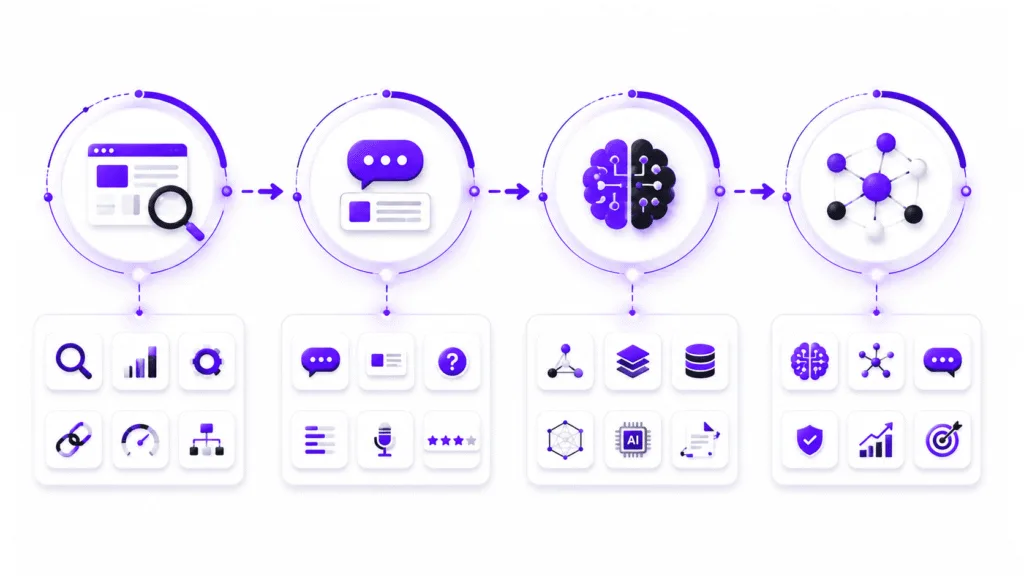
No single metric tells the full story of your AI visibility.
Instead, successful businesses monitor a combination of:
- AI Share of Voice
- Citation Rate
- Prompt Coverage
- Brand Entity Presence
- Brand Mention Frequency
- AI Recommendation Rate
- AI Search Impression Score
- Topical Authority
- Trust Signals
- Visibility Growth
Together, these metrics provide a comprehensive view of how AI platforms perceive your brand and where opportunities exist to strengthen your authority.
How to Measure AI Search Visibility Metrics & KPIs
Understanding the right KPIs is only half the equation. The next step is building a repeatable system to measure, analyze, and improve your AI search performance over time.
Unlike traditional SEO, there isn’t a single dashboard that tracks every AI platform. Instead, businesses need to combine multiple data sources to understand how often they’re mentioned, cited, and recommended across AI-powered search experiences.
Here’s a practical framework to help you get started.
Step 1: Identify Your Most Valuable AI Search Prompts
Start by listing the questions your ideal customers are most likely to ask AI assistants.
For example, if you’re a local SEO agency, your prompts might include:
- Best local SEO agency for small businesses
- How to improve Google Business Profile rankings
- AI search optimization services
- SEO agency near me
- How does AI affect local SEO?
If you’re an eCommerce business, your prompts will look different.
The goal is to create a master list of high-intent prompts that directly relate to your products, services, and expertise.
Step 2: Test Across Multiple AI Platforms
Don’t rely on a single AI model.
Each platform retrieves, processes, and presents information differently.
Regularly test your prompts across:
- Google AI Overviews
- ChatGPT
- Claude
- Gemini
- Perplexity AI
- Microsoft Copilot
Record:
- Whether your brand appears
- Where it appears in the answer
- Whether your website is cited
- Which competitors are mentioned
- The quality of the response
Over time, you’ll begin to identify trends and opportunities for improvement.
Step 3: Track AI Referral Traffic
Although many AI interactions happen without a click, referral traffic still provides valuable insights.
Monitor your analytics platform for visits originating from AI-powered platforms whenever referral information is available.
Look for metrics such as:
- Sessions
- Users
- Engagement rate
- Average engagement time
- Conversions
- Assisted conversions
Traffic alone doesn’t tell the complete story, but it helps measure business impact.
Step 4: Measure Business Outcomes
Ultimately, visibility should contribute to business growth.
Track KPIs such as:
- Leads generated
- Contact form submissions
- Phone calls
- Consultation bookings
- Demo requests
- Sales
- Revenue
The goal isn’t simply to appear in AI answers—it is to generate qualified customers.
Build an AI Search Visibility Dashboard
Create a monthly dashboard to monitor your progress.
Your dashboard should include:
Visibility Metrics
- AI Share of Voice
- Prompt Coverage
- AI Recommendation Rate
- Citation Rate
Authority Metrics
- Brand Mentions
- Entity Presence
- Topical Authority
- Backlink Growth
Traffic Metrics
- Organic Traffic
- AI Referral Traffic
- Returning Visitors
- Engagement Rate
Business Metrics
- Leads
- Conversion Rate
- Revenue
- Customer Acquisition Cost (CAC)
Tracking these metrics together provides a complete picture of your AI search performance.
Recommended Tools for Measuring AI Visibility
While AI search reporting is still evolving, several tools can help businesses monitor their performance.
Popular options include:
- Google Search Console
- Google Analytics 4
- Google Business Profile Performance
- Semrush
- Ahrefs
- Peec AI
- Profound
- Scrunch AI
- ZipTie.dev
- Otterly.AI
- AlsoAsked
- AnswerThePublic
No single platform measures every AI metric today, so combining multiple tools often provides the most comprehensive insights.
Common AI Search Measurement Mistakes
Many businesses focus on the wrong metrics.
Avoid these common mistakes:
Measuring Rankings Only
High rankings don’t always translate into AI visibility.
A business may rank well in Google Search while rarely appearing in AI-generated answers.
Ignoring Brand Mentions
Your brand can influence purchasing decisions even when users never click your website.
Track visibility beyond website traffic.
Publishing Thin Content
AI models favor comprehensive, well-structured, authoritative content.
Publishing dozens of shallow articles is unlikely to improve your AI visibility.
Instead, focus on creating in-depth resources that fully answer user questions.
Neglecting Structured Data
Schema markup helps AI systems understand your content, organization, services, and authors.
Implementing structured data strengthens your entity signals and improves machine readability.
Measuring Too Infrequently
AI search evolves rapidly.
Review your AI visibility metrics at least once a month to identify new opportunities and monitor competitor performance.
How Revolute X Digital Measures AI Visibility
At Revolute X Digital, we believe AI Search Optimization requires more than traditional SEO reporting.
Our approach focuses on measuring how businesses perform across both search engines and AI-powered search experiences.
We evaluate factors such as:
- AI Share of Voice
- Prompt Coverage
- Brand Entity Recognition
- Citation Opportunities
- Topical Authority
- Structured Data Implementation
- Technical SEO Health
- Content Quality
- Local Search Signals
- Conversion Performance
By combining these insights, we help businesses identify opportunities to strengthen their visibility, improve authority, and adapt to the future of AI-driven search.
The Future of AI Search Measurement
AI search is still in its early stages.
Over the next few years, businesses can expect more advanced reporting tools, deeper integrations with analytics platforms, and improved visibility metrics.
Future KPIs may include:
- AI Conversation Share
- Citation Quality Score
- Entity Authority Index
- AI Trust Score
- Cross-Platform Visibility Score
- AI-Assisted Conversion Rate
- Multi-Model Brand Visibility
Organizations that begin measuring AI performance today will be better prepared as these standards continue to evolve.
Final Thoughts
Search is changing from ranking web pages to delivering trusted answers.
That shift means businesses must rethink how they measure online success.
Traditional SEO metrics remain important, but they no longer provide the complete picture.
By tracking AI search visibility metrics and KPIs—such as AI Share of Voice, Citation Rate, Prompt Coverage, Brand Entity Presence, and AI Recommendation Rate—you can better understand how AI platforms perceive your business and where improvements are needed.
As AI becomes a primary discovery channel, businesses that monitor these metrics, publish authoritative content, strengthen their entities, and continuously refine their strategy will be well-positioned for long-term success.
The future of digital marketing isn’t just about ranking on Google—it’s about becoming the trusted source AI chooses to recommend.
Frequently Asked Questions
What are AI search visibility metrics?
AI search visibility metrics measure how often your brand appears, is cited, or is recommended across AI-powered search platforms such as ChatGPT, Google AI Overviews, Claude, Gemini, and Perplexity.
What is the most important AI search KPI?
There isn’t a single KPI that tells the full story. Most businesses should monitor AI Share of Voice, Citation Rate, Prompt Coverage, Brand Mentions, Entity Presence, and Conversion Rate together.
How do you measure AI search visibility?
AI visibility is measured by monitoring prompt performance, AI citations, brand mentions, referral traffic, engagement, and business outcomes across multiple AI platforms.
Is AI search replacing traditional SEO?
No. AI Search Optimization complements traditional SEO. Businesses still need strong technical SEO, high-quality content, and authoritative websites while optimizing for AI-generated search experiences.
Why is AI Share of Voice important?
AI Share of Voice measures how frequently your brand appears compared to competitors in AI-generated answers. A higher share often indicates stronger authority and greater visibility.
Can structured data improve AI visibility?
Yes. Structured data helps search engines and AI systems better understand your business, services, authors, and website content, improving entity recognition and trust.
Which AI platforms should businesses monitor?
Businesses should regularly evaluate their visibility across Google AI Overviews, ChatGPT, Claude, Gemini, Perplexity AI, and Microsoft Copilot.
How often should AI search KPIs be reviewed?
Monthly reporting is recommended for most businesses. Regular monitoring helps identify changes in visibility, track progress, and adjust your strategy as AI search evolves.

Jason
We are an Affordable Digital Marketing Agency in Shawnee with budget-friendly solutions to amplify your brand. Elevate your business without compromising quality or cost.