
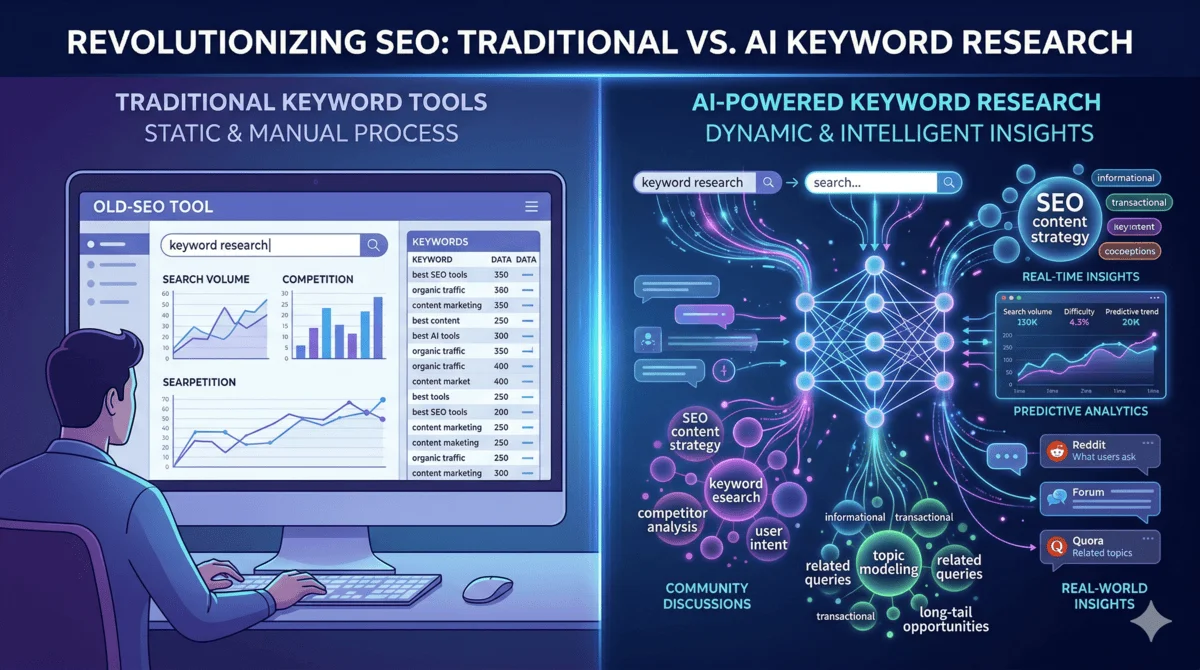
Keyword research has always been the backbone of SEO—but traditional tools alone are no longer enough. With the rise of artificial intelligence, marketers are shifting toward smarter, faster, and more intuitive methods of discovering keywords.
So the real question is: Can AI keyword research outperform traditional SEO tools?
The short answer is yes—when used correctly.
In this guide, we’ll walk through a practical, high-value AI keyword research workflow, focusing on brainstorming, clustering, and real-world insights (including how marketers actually use AI in communities like Reddit).
Why Traditional Keyword Tools Fall Short
Most SEO tools are built around databases. They show:
- Search volume
- Keyword difficulty
- CPC (cost-per-click)
While useful, they have limitations:
- They miss emerging trends
- They lack context and intent depth
- They don’t think creatively
For example, a tool might give you “AI keyword research” and a few variations—but it won’t naturally suggest angles like:
- “AI keyword research workflow for beginners”
- “How to cluster keywords using AI”
- “AI vs traditional keyword tools”
That’s where AI steps in.
Step 1: AI Brainstorming — Expanding Beyond Obvious Keywords
The first strength of AI keyword research is idea generation.
Instead of relying on static databases, AI can:
- Generate long-tail keyword ideas instantly
- Explore multiple angles of a topic
- Adapt to different audiences and intents
How to Brainstorm with AI
Start with a seed keyword like:
“AI keyword research”
Then prompt AI to expand:
- Related questions
- Beginner vs advanced queries
- Problem-based keywords
- Comparison keywords
Example Output
AI might generate:
- How to use AI for keyword research step by step
- Best AI keyword research workflow
- AI keyword research vs traditional SEO tools
- Free AI keyword research methods
- AI keyword clustering strategies
This is exactly how many SEO professionals on Reddit describe using AI—as a brainstorming partner, not just a data tool.
“AI is amazing for ideation. I use it to generate keyword angles I’d never think of, then validate them with tools.”
This hybrid approach is becoming the new standard.
Step 2: Intent Mapping — Understanding the “Why” Behind Keywords
AI doesn’t just generate keywords—it helps you understand search intent, which is critical for ranking.
Types of search inten
- Informational (learn something)
- Navigational (find a specific site)
- Transactional (buy or act)
- Commercial (compare options)
AI can automatically group keywords based on intent. For example:
Cluster: Informational
- What is AI keyword research
- How does AI help SEO
Cluster: Commercial
- Best AI keyword research tools
- AI SEO tools comparison
This saves hours of manual sorting and ensures your content aligns with what users actually want.
Step 3: Keyword Clustering — Building Topic Authority
This is where AI truly outperforms traditional tools.
Instead of targeting individual keywords, AI groups them into clusters based on:
- Semantic similarity
- Search intent
- Contextual meaning
Example Cluster
Primary Topic: AI Keyword Research
- AI keyword research workflow
- AI keyword clustering
- AI SEO automation
- AI content strategy
Rather than writing separate articles for each keyword, you create one comprehensive piece that covers the entire topic.
Why This Matters
- Google favors topic authority over isolated pages
- Reduces keyword cannibalization
- Improves internal linking strategy
Reddit marketers often highlight this as a game-changer:
“Clustering with AI helped me rank faster because my content covered everything users were searching for in one place.”
Step 4: Validation — Combining AI with SEO Tools
Here’s the truth: AI doesn’t replace SEO tools—it enhances them.
After brainstorming and clustering, you should validate keywords using tools like:
- Search volume
- Keyword difficulty
- Trends
The Hybrid Workflow
- Use AI for ideation and clustering
- Use tools to validate demand
- Prioritize based on opportunity
This approach gives you the best of both worlds:
- Creativity from AI
- Data accuracy from tools
Step 5: Competitor Analysis with AI
AI can also analyze top-ranking pages and extract insights such as:
- Common keywords used
- Content structure
- Missing gaps you can target
Instead of manually reviewing 10+ articles, AI can summarize:
- What competitors are doing well
- What they’re missing
- How you can outperform them
This turns keyword research into a strategic advantage, not just a checklist task.
Step 6: Turning Keywords into Content Strategy
Once your keywords are clustered and validated, the next step is building a content plan.
Example Content Plan
Pillar Page
- AI keyword research (main guide)
Supporting Content
- AI keyword clustering explained
- Best AI tools for SEO
- AI SEO workflow step-by-step
This structure:
- Strengthens topical authority
- Improves internal linking
- Helps search engines understand your site
AI can even suggest this structure automatically.
Is AI Better Than Keyword Research Tools?
Let’s be clear: AI is not a replacement—it’s an upgrade.
Where AI Wins
- Brainstorming ideas
- Finding long-tail keywords
- Clustering topics
- Understanding intent
- Speed and scalability
Where Tools Still Matter
- Accurate search volume
- Competition analysis
- SERP data
The Real Advantage
The real power comes from combining both.
Think of it this way:
- AI = strategy + creativity
- Tools = data + validation
Together, they create a complete keyword research system.
Common Mistakes to Avoid
Even with AI, it’s easy to go wrong if you’re not careful.
1. Relying Only on AI
AI-generated keywords need validation. Otherwise, you risk targeting terms with no traffic.
2. Ignoring search intent
Ranking isn’t just about keywords—it’s about matching user intent.
3. Overproducing Low-Quality Content
AI makes content creation fast—but quality still matters more than quantity.
4. Skipping Clustering
Targeting single keywords instead of clusters limits your growth potential.
Final Consideration!
AI keyword research is transforming how SEO works. It shifts the focus from manual data gathering to intelligent strategy building.
By using AI for:
- Brainstorming
- Intent mapping
- Clustering
and combining it with traditional tools for validation, you create a workflow that is faster, smarter, and far more effective.
If you’re still relying only on traditional keyword tools, you’re missing out on one of the biggest advantages in modern SEO.
At RevoluteX Digital, we comprehend that
The future isn’t about choosing between AI and tools—it’s about using both together to build a system that consistently finds opportunities, creates better content, and ranks higher.
FAQs:
1. What is AI keyword research?
AI keyword research is a way to find and organize keywords using intelligence. This process looks at what people’re searching for, how relevant the keywords are and how people behave when they search. It does more than what traditional tools can do because it adds meaning and new ideas.
2. How is AI keyword research different from SEO tools?
Traditional tools just look at numbers and data like how many people search for something and how hard it is to rank. AI keyword research on the hand helps come up with new ideas, understands what people are looking for and groups similar keywords together. AI keyword research adds a plan and creativity while traditional tools just give you facts to check.
3. Can AI keyword research replace SEO tools?
No AI keyword research does not replace SEO tools. The best way to do things is to use AI keyword research for coming up with ideas and grouping keywords and then use SEO tools to check if those keywords are popular if there is a lot of competition and what is trending.
4. How does AI help with keyword brainstorming?
AI keyword research quickly comes up with a lot of keyword ideas like phrases, questions, comparisons and different topics. It helps find keyword ideas that traditional tools might not find.
5. What is keyword clustering in AI keyword research?
Keyword clustering is when you group similar keywords together based on what people’re looking for and how similar they are, in meaning. AI keyword research automates this process so you can create content that targets keywords at the same time.

Jason
We are an Affordable Digital Marketing Agency in Shawnee with budget-friendly solutions to amplify your brand. Elevate your business without compromising quality or cost.