
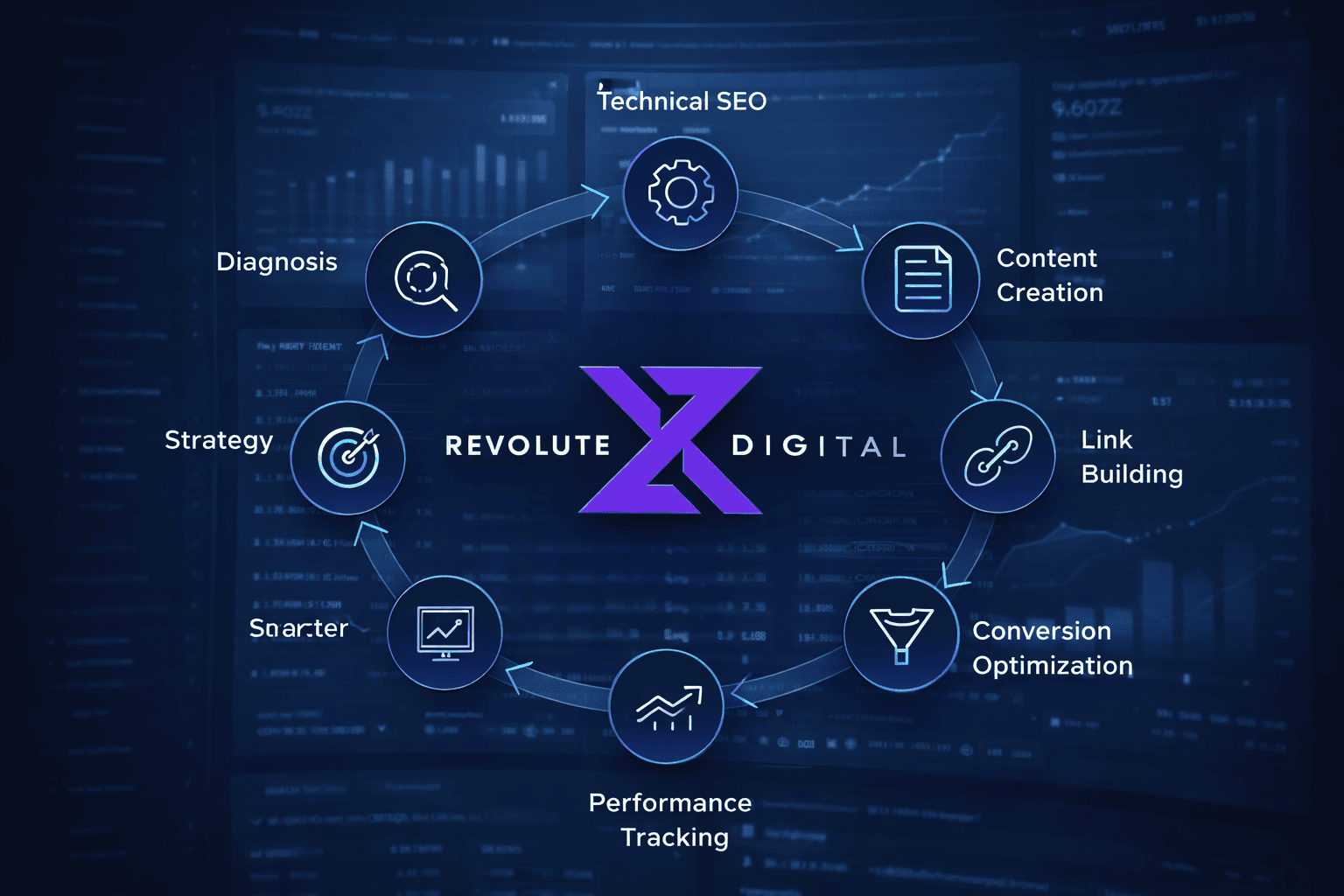
Most SEO pitches sound the same – more traffic, better rankings, technical fixes, content, and backlinks.
The difference is never in the buzzwords. It is in the process. A clear SEO agency process tells you how an idea becomes a measurable result. It explains who does what, in what order, and how decisions are made when things change.
This is the RevoluteX Digital SEO framework, broken into the stages we actually run for clients. No magic, no black box. Just a structured way to turn search into a reliable growth channel.
The 7 Phases Behind Our Proven SEO agency process
Phase 1: Diagnose Before You Prescribe
We do not touch keywords or content until we know what is really happening. The first part of our SEO agency process is diagnosis.
We look at it.
- Business model and goals: what “success” in SEO actually means for you
- Current analytics and search data: where traffic and leads come from now
- Technical health: crawl issues, indexation, speed, mobile, site structure
- Existing content: what gets traffic, what converts, what is dead weight
- Competitive landscape: who you are really up against in search
The goal is simple: define the gap between where you are and where you need to be, in numbers, not feelings.
Phase 2: Build a Focused SEO Strategy, not a Wish List
Once we understand the baseline, we turn findings into a plan.
This is the strategy stage of our SEO agency process.
We decide.
- Which audiences matter most, and how they search
- Which products or services should get SEO priority
- Which keywords and topics have the right mix of volume and intent
- Which pages need to exist: Service, product, location, resource, and support content
- What success looks like in the next 3, 6, and 12 months
The output is a roadmap, not a vague promise. You see the key projects, the order we will tackle them in, and the metrics we expect to move.
Phase 3: Fix the Foundation so Growth has Somewhere to Land
If your site is slow, messy, or confusing to crawl, all the content in the world will underperform. That is why the next step in the RevoluteX Digital SEO framework is technical and structural cleanup.
Typical work here includes.
- Cleaning crawl and indexation issues
- Fixing broken links and redirect chains
- Improving site speed and Core Web Vitals
- Ensuring mobile usability and responsive layouts
- Tightening site architecture so that important pages are easy to reach
We are not chasing vanity scores. We are removing friction that stops Google and real visitors from understanding and using your site.
Phase 4: Rebuild and Expand the Content that Sells
Now we focus on the pages that actually drive business. This is where a lot of SEO programs drift. They produce random blog posts. We build a content system tied to revenue.
Our content work usually follows this order.
- Rewrite or build core money pages – home, top services or products, key categories, location pages
- Create supporting content that answers real buying questions – comparisons, pricing, “how it works”, FAQs
- Develop educational content that builds authority and attracts the right top-of-funnel traffic
Each piece of content has a defined job – rank for specific intent, move the user one step closer, and support your broader long-term strategy.
Phase 5: Strengthen Authority with the Right Links and Signals
Links are still a big part of SEO, but random link buying is a fast way to burn trust. Our SEO agency process focuses on authority that makes sense in the real world.
That means.
- Building content that is actually worth linking to
- Earning placements from relevant sites in your industry or region
- Leveraging partnerships, PR, and digital assets you already have
- Cleaning up spammy or low-quality links when necessary
Authority becomes a byproduct of doing good work in your niche and showing it off properly, not a separate shady project.
Phase 6: Turn Traffic into Leads and Customers
Traffic without conversion is an expensive hobby. A key part of the RevoluteX Digital SEO framework is conversion optimization on the pages we grow.
We look at it.
- Headlines and above-the-fold messaging
- CTAs and contact flows
- Proof elements – testimonials, case snippets, reviews, guarantees
- Form friction and mobile experience
Then we make straightforward improvements so more of your organic visitors become leads, calls, demos, or sales. That is where SEO stops being an abstract metric and starts showing up in your pipeline.
Phase 7: Measure, Learn, and Iterate
SEO is not set and forget. Markets change, competitors move, and Google updates how it ranks results.
Our ongoing process includes.
- Monthly performance reviews against the roadmap
- Tracking rankings, traffic, leads, and assisted conversions
- Identifying what worked better than expected and why
- Spotting new opportunities and retiring what no longer makes sense
You get a clear picture of what your investment is doing, and we keep refining based on real data.
Conclusion
Strong results come from a strong process. The RevoluteX Digital SEO framework is designed to turn SEO from a vague marketing spend into a structured growth engine. Diagnose, plan, fix, build, earn authority, convert, and keep iterating.
Revolute X Digital uses this SEO agency process to help businesses move beyond vanity metrics and into predictable search-driven revenue. If you want an SEO partner with a clear framework rather than a bundle of tactics, click Start With Us, and we will walk you through how this process would look for your business specifically.
FAQs
What is an SEO agency process?
An SEO agency process is a structured approach used to improve a website’s visibility in search engines. It typically includes research, strategy development, technical optimization, content creation, link building, and ongoing performance tracking to drive traffic and conversions.
How does an SEO agency actually work?
An SEO agency works in stages. First, it analyzes your website and competitors. Then it builds a strategy, fixes technical issues, creates optimized content, improves authority with backlinks, and continuously tracks results to refine performance.
What are the key steps in an SEO strategy?
Most effective SEO strategies follow these steps:
- Website audit and analysis
- Keyword and audience research
- Technical SEO fixes
- Content creation and optimization
- Link building and authority growth
- Conversion optimization
- Ongoing tracking and improvements
Each step builds on the previous one to create long-term growth.
How long does it take to see SEO results?
SEO usually takes 3 to 6 months to show noticeable improvements. Stronger results like consistent traffic, leads, and rankings typically develop over 6 to 12 months, depending on competition and strategy execution.
Why is a structured SEO process important?
A structured process ensures that SEO efforts are aligned with business goals. Without a clear plan, businesses often waste time on random tactics that don’t produce consistent results. A defined process creates predictable growth.
What makes a good SEO agency different?
A good SEO agency focuses on:
- Clear strategy, not guesswork
- Transparent reporting
- Business-focused metrics (leads, revenue)
- Consistent communication
- Long-term growth, not shortcuts
The difference is in execution and accountability.
What is technical SEO and why does it matter?
Technical SEO focuses on how well your website performs behind the scenes. It includes site speed, mobile usability, indexing, and structure. A technically strong site helps search engines crawl and rank your content more effectively.
How does SEO content improve rankings?
SEO content improves rankings by matching search intent. When content answers real user questions, includes relevant keywords, and provides value, search engines are more likely to rank it higher.
What role do backlinks play in SEO?
Backlinks act as trust signals. When other credible websites link to your content, it tells search engines that your site is authoritative and worth ranking higher.
How do you turn SEO traffic into leads?
To convert traffic into leads, you need:
- Clear calls-to-action (CTAs)
- Strong messaging
- Trust signals (reviews, case studies)
- Easy contact or booking forms
- Optimized landing pages
SEO works best when traffic and conversion strategy are aligned.
How do you measure SEO success?
SEO success is measured through:
- Organic traffic growth
- Keyword rankings
- Lead generation (calls, forms, demos)
- Conversion rates
- Revenue from organic search
Focusing only on traffic without conversions gives an incomplete picture.
Is SEO a one-time process or ongoing?
SEO is an ongoing process. Search engines update algorithms, competitors improve their strategies, and user behavior changes. Continuous optimization is necessary to maintain and grow rankings.

Jason
We are an Affordable Digital Marketing Agency in Shawnee with budget-friendly solutions to amplify your brand. Elevate your business without compromising quality or cost.