
A lot of people thought AI would make SEO easier.
In one sense, it did. You can now research topics faster, build outlines faster, draft content faster, and even refresh old pages without the same time drain as before. That part is real.
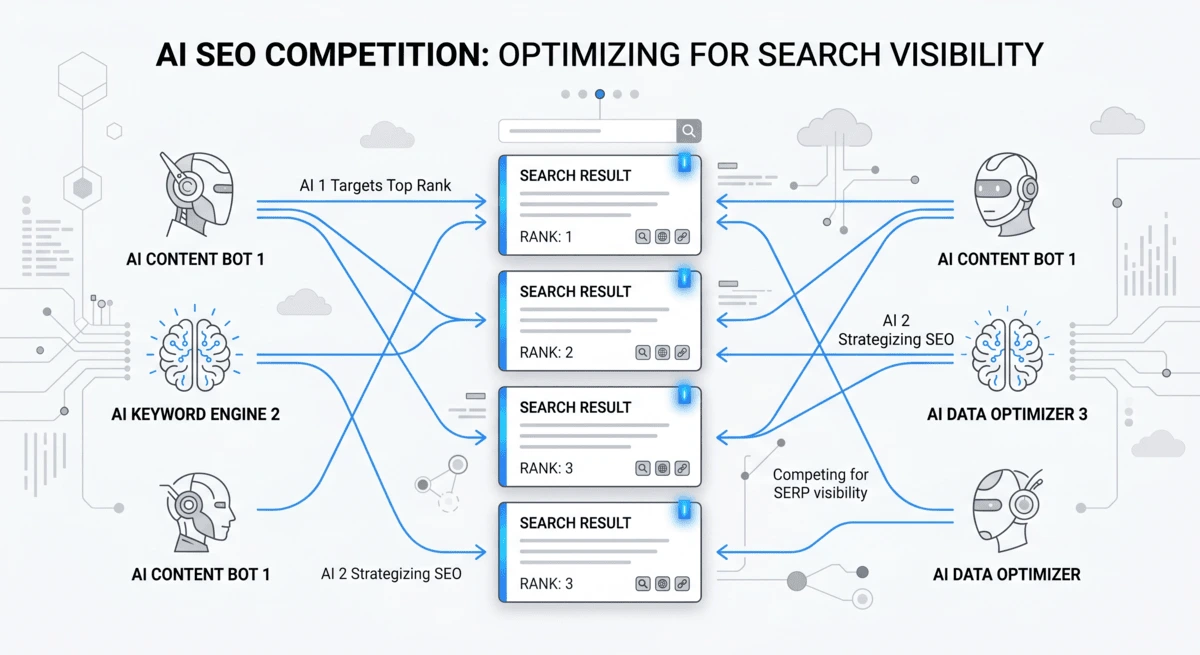
But there is another side to it, and this is the side that a lot of businesses are feeling right now. If everyone can move faster, then everyone can flood the same space faster, too. That is why AI SEO competition is getting harder, not softer.
The internet does not just have more content now. It has more similar content. That is the problem.
AI Lowered the Cost of Publishing, not the Cost of Standing Out
This is the shift most people miss.
AI made it cheaper to produce pages. It did not make it cheaper to be memorable. In fact, it did the opposite. Once every brand in your space can push out “optimized” articles and service pages at speed, the advantage stops being volume and becomes distinction.
That is where a lot of teams get trapped. They think they are building momentum because they are publishing more. What they are actually doing is adding another handful of decent-looking pages to a pile of decent-looking pages no one will remember.
Search is crowded enough already. AI made that crowd louder.
More Content Now Often Means More Sameness
You can see it everywhere. Open five articles on the same topic, and they often feel like cousins. Same structure. Same advice. Same examples. Same safe wording. Maybe one has better formatting, but not much more.
That is bad for search, and it is bad for readers.
Search engines do not need ten versions of the same article. Readers do not either. If your content sounds like it came from the same machine-assisted workflow as everyone else, then you are not competing on value anymore. You are competing on who can blend in most efficiently.
That is not a strategy.
Search Engines are Getting Less Patient with Bland Content
This is where AI SEO competition gets real. The flood of generic content forces search engines to become more selective.
They need to separate pages that are merely “fine” from pages that are actually useful. That means stronger filtering. More emphasis on trust. More reward for clarity, directness, and real expertise. Less room for padded content that says the obvious in a prettier way.
A lot of AI-assisted pages fail here. They are not terrible. They are just forgettable.
Forgettable content is dangerous because it gives you the illusion of progress. The page exists. It is indexed. It may even get impressions. But it does not build real authority, and it does not move the market toward you.
The Brands Winning with AI are not Using it Like a Shortcut
This is the good news. AI is not the enemy. It is just being used badly by a lot of people.
The teams getting the most out of it are not asking it to “do SEO” for them. They are using it for the mechanical parts of the process, then layering strategy and judgment on top.
That usually looks like this:
- Use AI to gather rough topic ideas
- Use AI to summarize gaps in existing content
- Use AI to help with outlines or first drafts
- Then rewrite with actual market knowledge, stronger examples, and clearer positioning
That last part is where the win is. AI can speed up production. It cannot decide what your buyers actually care about more than your competitors understand.
The Real Battle Now is Specificity
Generic content used to be mediocre. Now it is everywhere.
So if you want to compete, you need sharper edges. More specificity. More reality.
That means:
- using the exact questions buyers ask, not broad “awareness” fluff
- writing from actual client experience, not recycled advice
- naming tradeoffs, not pretending every answer is simple
- building pages around clear commercial intent, not random topic volume
This is one of the easiest ways to beat weak AI-heavy content. Be more concrete than it is. Be more useful than it is. Be more honest than it is.
Authority Matters More Because Content is Cheaper
When content was expensive to create, volume signaled effort. That signal is weaker now.
As content becomes easier to produce, authority matters more. Search engines need stronger ways to separate brands that know their space from brands that are just assembling pages quickly.
That is why the AI SEO competition is not only about content production. It is also about brand strength.
Do people mention you?
Do other sites reference you?
Does your site feel coherent?
Do your pages support one another?
Does your content sound like it came from actual work?
Those are the things that become more valuable when production gets cheap.
How to Win from Here
The answer is not “publish less.” It is “publish better and use AI more carefully.”
A few moves matter more now than they used to:
- Stop chasing volume for its own sake
- refresh strong pages instead of constantly creating average new ones
- Tighten your service pages and commercial content first
- Add examples, proof, and specifics that generic content cannot fake well
- build topic depth around your real business, not whatever trend feels easy to spin into an article
The brands that win in this environment will not be the fastest typers. They will be the clearest thinkers.
Final Thought
AI did not kill SEO. It exposed weak SEO.
It made it obvious which brands were relying on bulk content and which ones actually understood their market. That gap is only going to widen. The easier it becomes to produce content, the more valuable clarity, trust, and originality become.
RevoluteX Digital helps brands compete in that environment by building SEO systems around authority, structure, and conversion, not just publishing speed. If your rankings feel stuck while the web gets noisier, the problem may not be effort. It may be that your strategy still looks too much like everyone else’s. Contact us today to learn more!
FAQs
Why is AI SEO Competition Increasing so Quickly?
Because more businesses can now create content at speed. That makes search results more crowded and pushes generic pages closer together.
Does AI Make SEO Easier or Harder for Brands?
It makes production easier, but differentiation harder. You can move faster, but so can your competitors, which means strategy matters even more.
Can AI-Generated Content Still Rank?
Yes, but not because it exists. It still needs editing, relevance, clarity, and something specific enough to separate it from the rest of the field.
What is the Biggest Mistake Businesses Make with AI SEO?
They assume more output automatically means more authority. In reality, too much average content can dilute a site instead of strengthening it.
How can a Smaller Business Win in an AI SEO Competition?
By being narrower, clearer, and more specific than bigger competitors. Strong niche authority often beats broad but generic content..

Jason
We are an Affordable Digital Marketing Agency in Shawnee with budget-friendly solutions to amplify your brand. Elevate your business without compromising quality or cost.