
Artificial intelligence is rapidly changing how people discover brands, products, and services online. Instead of clicking through multiple search results, users are asking questions directly in ChatGPT, Google AI Overviews, Claude, Gemini, Perplexity, and other AI-powered search platforms.
This shift has introduced a new way to measure online visibility.
Traditional SEO focuses on rankings, impressions, and organic traffic. While these metrics remain valuable, they don’t reveal how frequently AI platforms recommend or mention your business when answering user questions.
That’s where AI Share of Voice (AI SOV) comes in.
AI Share of Voice measures how often your brand appears in AI-generated responses compared to your competitors. It helps businesses understand whether they are becoming trusted sources within AI-powered search experiences.
As AI continues to influence buying decisions, AI Share of Voice is quickly becoming one of the most important performance indicators for modern SEO, Answer Engine Optimization (AEO), and Generative Engine Optimization (GEO).
Whether you’re a business owner, marketer, SEO professional, or agency, understanding this metric will help you identify opportunities to improve your AI visibility, strengthen your authority, and generate more qualified leads.
Before learning how to calculate AI Share of Voice, it’s important to understand why this metric has become a central part of AI Search Optimization.
Related Guide: Before diving deeper into AI Share of Voice, explore our AI Search Visibility Metrics & KPIs guide. It explains the complete framework for measuring AI visibility, including Citation Rate, Prompt Coverage, Entity Presence, Brand Mentions, Recommendation Rate, and other essential AI search metrics.
What Is AI Share of Voice?
AI Share of Voice (AI SOV) measures how frequently your business, brand, website, or content appears in AI-generated responses compared to competing businesses.
Instead of measuring keyword rankings, AI Share of Voice evaluates your visibility across conversations generated by Large Language Models (LLMs).
For example, imagine someone asks:
- What are the best AI Search Optimization agencies?
- Which companies specialize in Local SEO?
- What are the best AI marketing tools?
- How do I improve AI Search Visibility?
Each AI platform generates its own response using trusted sources, entities, and contextual understanding.
If your business appears consistently while competitors rarely do, your AI Share of Voice is strong.
If competitors dominate these AI-generated answers, your AI Share of Voice is low, indicating opportunities to strengthen your authority and content strategy.
Unlike traditional search rankings, AI Share of Voice focuses on recommendation frequency rather than webpage position.
In simple terms:
The more often AI recommends your business, the greater your AI Share of Voice.
Why AI Share of Voice Matters
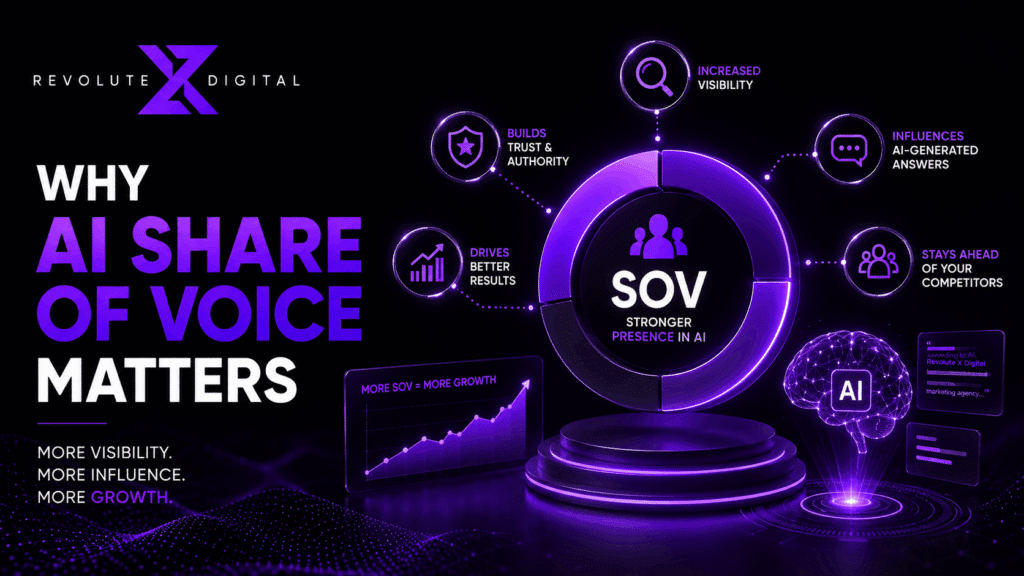
AI-generated answers are becoming one of the primary ways people discover businesses online.
Instead of visiting multiple websites, users increasingly trust AI assistants to summarize information and recommend companies that appear authoritative.
This means businesses must think beyond traditional keyword rankings.
A website can rank well on Google yet rarely appear in AI-generated answers.
Likewise, a business with moderate organic rankings may achieve exceptional AI visibility because AI systems recognize its expertise, topical authority, and trusted content.
Monitoring AI Share of Voice helps answer important questions such as:
- How often does AI recommend my business?
- Which competitors appear more frequently?
- Which topics generate the highest AI visibility?
- Which AI platforms mention my brand most often?
- How does my visibility change over time?
These insights help businesses prioritize content creation, strengthen authority, and improve overall AI Search Optimization.
As AI-powered search continues to evolve, businesses that actively monitor AI Share of Voice will gain a significant competitive advantage over those relying solely on traditional SEO metrics.
How AI Share of Voice Differs from Traditional SEO
Traditional SEO answers questions like:
- What keywords do I rank for?
- How much organic traffic do I receive?
- What is my average search position?
AI Share of Voice answers a different question:
“When users ask AI assistants about my industry, how often is my business recommended?”
This shift represents one of the biggest changes in digital marketing over the past decade.
Businesses are no longer competing only for page-one rankings—they’re competing for inclusion in AI-generated answers.
Success increasingly depends on trust, authority, structured content, entity recognition, and topical expertise rather than rankings alone.
Who Should Measure AI Share of Voice?
AI Share of Voice isn’t limited to large brands.
Businesses of every size can benefit from tracking this metric, including:
- SEO agencies
- Local businesses
- SaaS companies
- eCommerce brands
- Healthcare providers
- Law firms
- Financial services
- Marketing agencies
- Technology companies
- B2B organizations
If customers search for your products or services through AI-powered platforms, AI Share of Voice deserves a place in your reporting dashboard.
Preparing to Measure AI Share of Voice
Before calculating AI Share of Voice, define the topics and prompts most relevant to your business.
Instead of tracking random AI conversations, focus on the questions your ideal customers actually ask.
Examples include:
- Best AI Search Optimization agency
- Best Local SEO company
- AI marketing services
- Google Business Profile optimization
- Technical SEO experts
Over time, monitoring these prompts will reveal how your visibility changes as your authority grows.
In the next section, we’ll explore exactly how AI Share of Voice is calculated, the factors that influence it, and the practical methods businesses can use to measure it across ChatGPT, Google AI Overviews, Claude, Gemini, Perplexity, and other AI-powered search platforms.
How AI Share of Voice Works
Unlike traditional SEO metrics that focus on rankings and website traffic, AI Share of Voice (AI SOV) measures how frequently AI-powered search platforms recommend, mention, or cite your brand compared to your competitors.
Every time a user asks an AI assistant a question, the model analyzes trusted sources, entities, structured information, and contextual relevance before generating a response.
For example, a user might ask:
- What are the best AI Search Optimization agencies?
- Which companies specialize in Local SEO?
- What are the best AI marketing tools?
- Who offers AI automation services for small businesses?
Rather than displaying a list of webpages, AI platforms generate a conversational answer that may recommend only a few businesses.
Each recommendation increases that company’s AI Share of Voice.
Over time, businesses that consistently appear across hundreds or thousands of relevant prompts establish stronger visibility, greater authority, and increased brand recognition.
Simply put:
The more frequently AI recommends your business compared to competitors, the higher your AI Share of Voice.
Unlike keyword rankings, AI Share of Voice reflects overall brand presence across an entire topic rather than a single search query.
How to Calculate AI Share of Voice
There is currently no universal AI Share of Voice standard because every AI platform uses different models and data sources.
However, the measurement process remains consistent.
Step 1 — Identify Your Core Topics
Start by listing the services, products, or topics most important to your business.
For example, if you’re an SEO agency, your topics might include:
- AI Search Optimization
- Local SEO
- Technical SEO
- Google Business Profile
- AI Automation
- Digital Marketing
These become the foundation of your measurement strategy.
Step 2 — Create a Prompt Library
Instead of monitoring keywords alone, build a collection of prompts your ideal customers would ask AI assistants.
Examples:
- Best AI Search Optimization agency
- How do I improve AI visibility?
- Best Local SEO company
- What are AI Search Visibility Metrics?
- Best Google Business Profile experts
- AI automation services for small businesses
A mature AI visibility strategy typically tracks 100–500 relevant prompts across different customer intents.
Step 3 — Test Across Multiple AI Platforms
Run your prompt library through multiple AI assistants, including:
- Google AI Overviews
- ChatGPT
- Claude
- Gemini
- Perplexity
Record:
- Which brands appear
- Position within the response
- Number of mentions
- Citations
- Competitors
Over time, these results reveal how visible your brand is across the AI ecosystem.
Step 4 — Measure Consistently
AI Search Visibility changes frequently.
Track your prompts every month—or even weekly for highly competitive industries—to identify trends, monitor improvements, and adjust your strategy.
Consistency matters more than a single snapshot.
Manual Measurement
Businesses just beginning with AI Search Optimization don’t need expensive software immediately.
A manual tracking spreadsheet provides valuable insights.
Your spreadsheet might include columns for:
| Prompt | ChatGPT | Google AI | Claude | Gemini | Perplexity | Your Brand Mentioned | Competitors |
|---|
For every prompt, record:
- Was your business mentioned?
- Which competitors appeared?
- Were you cited?
- Were you recommended first?
- Which AI platform generated the response?
After tracking enough prompts, patterns quickly emerge.
You may discover that your business performs well in ChatGPT but rarely appears in Google AI Overviews—or that one competitor consistently dominates multiple AI platforms.
These insights help prioritize future content and optimization efforts.
AI Share of Voice Formula
Although different tools calculate AI Share of Voice differently, a practical formula is:
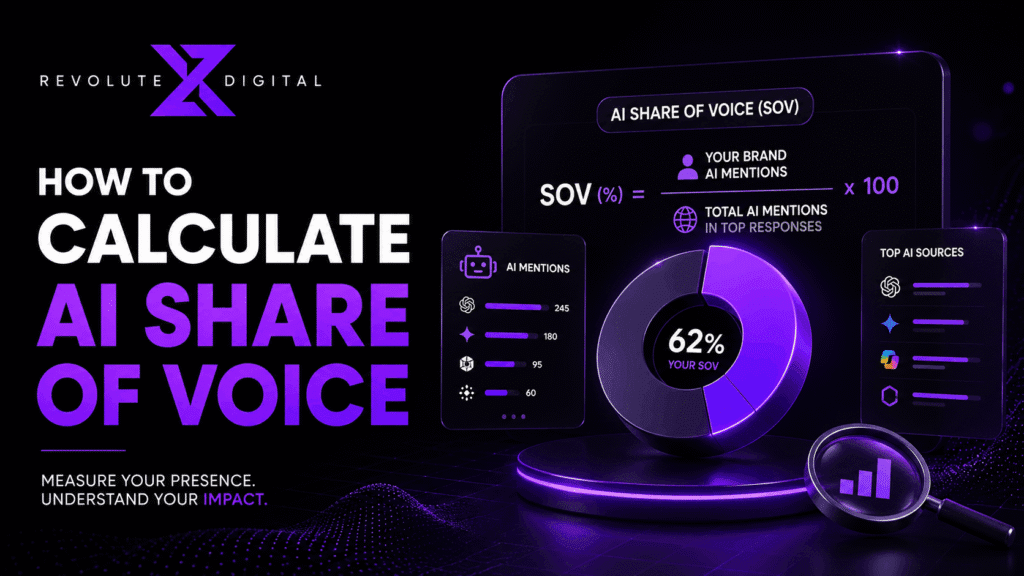
AI Share of Voice (%) = (Your Brand Mentions ÷ Total Brand Mentions Across All Tracked Prompts) × 100
Example
Suppose you monitor 100 AI prompts.
Across all AI responses:
- Your Brand: 42 mentions
- Competitor A: 31 mentions
- Competitor B: 18 mentions
- Competitor C: 9 mentions
Total mentions = 100
Your AI Share of Voice:
42 ÷ 100 × 100 = 42%
This means your business appears in 42% of all tracked AI responses, making it the most visible brand in your competitive set.
Rather than chasing individual keyword rankings, AI Share of Voice helps you evaluate your overall presence across an entire market.
Factors That Influence AI Share of Voice
Improving AI Share of Voice requires more than publishing blog posts.
AI systems evaluate a combination of authority, trust, semantic relevance, and content quality.
The most influential factors include:
Topical Authority
Businesses covering a subject comprehensively are more likely to be recommended.
This is why building an AI Search content hub is more effective than publishing isolated articles.
High-Quality Content
AI models favor content that is:
- Accurate
- Helpful
- Well-structured
- Comprehensive
- Regularly updated
Detailed guides, original research, and practical examples generally perform better than thin or repetitive articles.
Strong Entity Recognition
AI platforms need to clearly understand:
- Your business
- Your services
- Your expertise
- Your industry
- Your location
Consistent branding across your website, Google Business Profile, social profiles, and business directories strengthens entity recognition.
Structured Data
Schema markup helps AI systems interpret your content more effectively.
Implementing schemas such as:
- Organization
- Article
- FAQ
- Breadcrumb
- Service
can improve content understanding and reinforce authority.
Backlinks & Brand Mentions
High-quality backlinks remain an important trust signal.
Mentions from respected industry websites, publications, podcasts, and authoritative resources strengthen your credibility in both traditional search and AI-generated results.
Real-World Example
Imagine three SEO agencies competing in the AI Search space.
Each agency publishes content about AI Search Optimization.
Agency A
- One AI article
- Limited internal linking
- Minimal structured data
- Few backlinks
Result:
AI assistants rarely recommend the business.
Agency B
- Ten interconnected AI Search guides
- Comprehensive topic coverage
- Strong entity optimization
- Regular content updates
- High-quality backlinks
Result:
The agency appears consistently in ChatGPT, Google AI Overviews, Claude, Gemini, and Perplexity responses.
Its AI Share of Voice grows steadily over time.
Revolute X Digital Approach

At Revolute X Digital, we focus on building topical authority instead of chasing individual rankings.
Rather than publishing isolated blog posts, we create interconnected content hubs that answer every major question within a topic.
For example, this AI Share of Voice guide connects directly with our AI Search Visibility Metrics & KPIs pillar article and related resources such as How to Measure AI Search Visibility.
This approach helps search engines and AI platforms understand the relationship between our content while providing readers with a comprehensive learning experience.
Over time, this strategy strengthens entity authority, increases AI recommendations, and improves overall AI Share of Voice across multiple AI-powered search platforms.
Best AI Share of Voice Tools
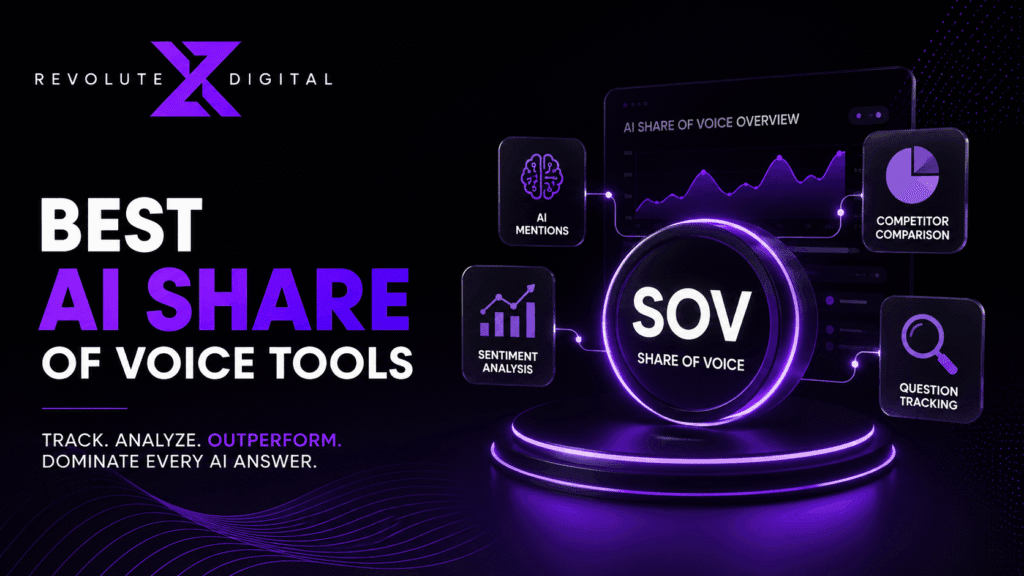
As AI-powered search continues to evolve, more platforms are helping businesses monitor how often their brands appear in AI-generated answers. While no single tool provides a complete view of AI visibility, combining several solutions gives you a much clearer understanding of your AI Share of Voice.
Below are some of the most useful tools available today.
1. Semrush AI Toolkit
Semrush has expanded beyond traditional SEO by introducing AI-focused visibility reporting. It helps businesses understand how often their brands appear across AI-generated search experiences and compares their visibility with competitors.
Useful for tracking:
- AI Share of Voice
- Competitor visibility
- Brand mentions
- AI citation trends
- Content opportunities
For businesses already using Semrush, it’s a natural starting point for AI visibility analysis.
2. Peec AI
Peec AI specializes in AI search analytics and brand monitoring.
It focuses on how frequently AI assistants recommend businesses across different prompts.
Features include:
- Prompt monitoring
- Brand visibility tracking
- AI recommendations
- Citation analysis
- Competitive benchmarking
This makes it particularly valuable for businesses investing heavily in AI Search Optimization.
3. Profound
Profound helps enterprise brands understand how AI platforms perceive and recommend their content.
It offers deeper insights into:
- AI-generated answers
- Brand mentions
- Competitor comparisons
- Prompt performance
Large organizations often use Profound to monitor visibility across multiple markets.
4. Google Search Console
Although Google Search Console doesn’t directly report AI Share of Voice, it remains one of the most valuable supporting tools.
Monitor:
- High-impression queries
- Organic visibility
- Click-through rate
- Search performance
These insights help identify topics where stronger AI visibility may also improve traditional search performance.
5. Google Analytics 4
Google Analytics complements AI visibility reporting by measuring user behavior after visitors reach your website.
Track:
- Sessions
- Engagement
- Lead generation
- Conversion rate
- Revenue
Ultimately, AI Share of Voice should contribute to meaningful business outcomes—not just increased visibility.
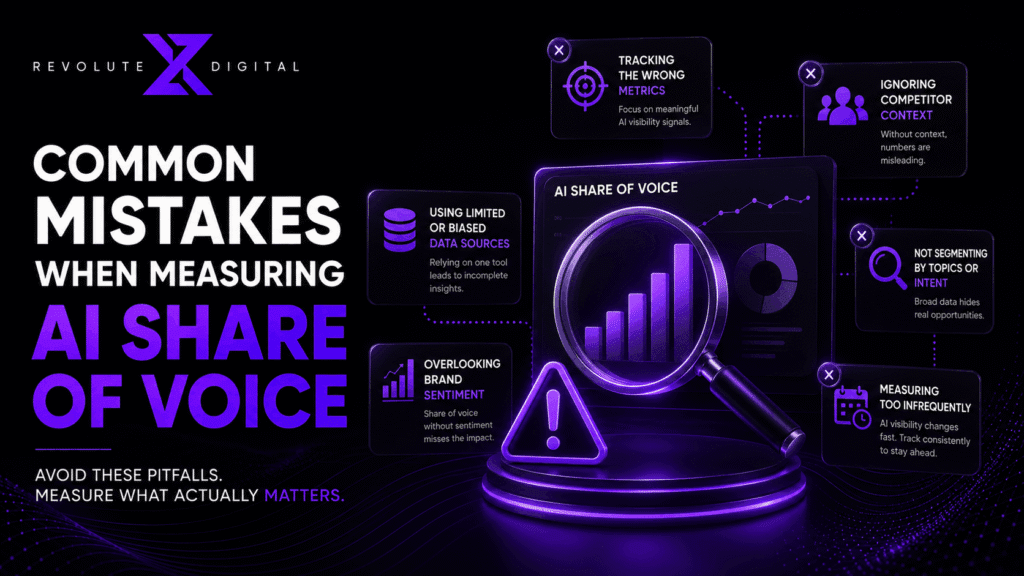
Common Mistakes When Measuring AI Share of Voice
Many businesses begin tracking AI visibility but focus on the wrong metrics or use inconsistent processes.
Avoid these common mistakes.
Measuring Too Few Prompts
Tracking only five or ten prompts doesn’t provide enough data.
Instead, build a library of 100 or more high-intent prompts covering your products, services, and customer questions.
A larger sample produces more reliable insights.
Focusing on One AI Platform
Each AI platform retrieves and presents information differently.
A business that performs well in ChatGPT may have limited visibility in Google AI Overviews or Perplexity.
Always monitor multiple platforms to build a complete picture of your AI Share of Voice.
Ignoring Competitor Performance
Your own visibility tells only part of the story.
Compare your AI Share of Voice against competitors to understand who dominates conversations within your industry.
Questions to ask include:
- Which competitors appear most frequently?
- Which topics generate the highest visibility?
- Which businesses receive the most citations?
Competitive benchmarking helps uncover new opportunities.
Publishing Thin Content
AI assistants prioritize comprehensive, authoritative content.
Publishing dozens of short articles rarely improves AI Share of Voice.
Instead, create detailed resources that answer user questions thoroughly and support them with related articles.
Neglecting Entity Optimization
Even exceptional content may struggle if AI systems don’t clearly understand your business.
Strengthen your entity signals by maintaining consistent branding, structured data, and accurate business information across your website, Google Business Profile, and trusted directories.
How to Improve AI Share of Voice
Improving AI Share of Voice isn’t about manipulating AI platforms—it’s about becoming a more authoritative and trustworthy source.
The following strategies consistently contribute to stronger AI visibility.
Build Topical Authority
Instead of publishing isolated blog posts, create interconnected content clusters around a central topic.
For example, this article supports a broader AI Search knowledge hub that includes:
- AI Search Visibility Metrics & KPIs
- How to Measure AI Search Visibility
- AI Citation Rate
- Prompt Coverage
- AI Search Analytics
This structure helps search engines and AI systems understand your expertise.
Create Comprehensive Content
The best-performing AI content answers questions completely.
Include:
- Definitions
- Examples
- Comparisons
- FAQs
- Actionable advice
- Updated statistics
Comprehensive resources are more likely to be referenced and recommended by AI assistants.
Strengthen EEAT Signals
Google and AI platforms increasingly evaluate:
- Experience
- Expertise
- Authoritativeness
- Trustworthiness
Improve these signals by:
- Publishing expert-written content
- Including author information
- Showcasing case studies
- Updating articles regularly
- Referencing reliable sources where appropriate
Improve Structured Data
Schema markup helps AI systems understand your content.
Implement structured data such as:
- Article
- FAQPage
- Organization
- Service
- BreadcrumbList
These schemas improve machine readability and reinforce entity recognition.
Earn High-Quality Mentions
Backlinks remain valuable, but broader brand mentions also matter.
Look for opportunities to contribute:
- Industry publications
- Podcasts
- Research reports
- Guest articles
- Expert roundups
The more often your brand is referenced across trusted websites, the stronger your authority becomes.
Revolute X Digital’s Approach
At Revolute X Digital, we believe AI Share of Voice is not a standalone metric—it’s the result of a well-executed AI Search Optimization strategy.
Rather than focusing solely on keyword rankings, we build content ecosystems that help businesses become trusted entities within their industries.
Our approach combines:
- Comprehensive topic clusters
- Technical SEO improvements
- Structured data implementation
- Entity optimization
- AI-focused content strategy
- Internal linking
- Ongoing performance monitoring
Instead of chasing short-term ranking gains, we focus on creating sustainable authority that benefits both traditional search engines and AI-powered search platforms.
For example, this AI Share of Voice guide is intentionally connected to our AI Search Visibility Metrics & KPIs pillar article and How to Measure AI Search Visibility guide. Together, these resources form part of a larger AI Search knowledge hub that helps readers understand the topic in depth while reinforcing topical authority.
As AI search continues to evolve, businesses that invest in authoritative content, semantic relationships, and continuous optimization will be better positioned to increase their AI Share of Voice and earn more visibility across the next generation of search.

The Future of AI Share of Voice
Artificial intelligence is changing how people search, compare businesses, and make purchasing decisions. As AI-powered platforms continue to evolve, AI Share of Voice (AI SOV) will become one of the most valuable performance indicators for measuring digital visibility.
In the past, businesses focused almost entirely on keyword rankings and website traffic. Today, users increasingly ask AI assistants for recommendations instead of browsing multiple search results. This means brands must compete not only for search rankings but also for inclusion in AI-generated answers.
Over the next few years, AI Share of Voice is expected to become a standard reporting metric alongside organic traffic, conversions, and keyword rankings.
Businesses should also expect AI platforms and analytics providers to introduce more advanced measurements, including:
- AI Recommendation Rate
- Citation Quality Score
- Entity Authority Score
- AI Trust Index
- Multi-Platform AI Visibility
- AI Conversation Share
- AI-Assisted Conversion Tracking
- Brand Knowledge Graph Strength
These emerging metrics will provide a deeper understanding of how AI systems perceive businesses and recommend them to users.
Another important trend is the growing role of entity-based search. Instead of relying solely on keywords, AI models increasingly evaluate relationships between businesses, products, authors, industries, and trusted sources. Organizations with strong entity recognition, comprehensive topical authority, and consistent branding will have a significant advantage.
Businesses that begin investing in AI Search Optimization today will be better prepared for the next generation of search, while those relying only on traditional SEO may struggle to maintain visibility as AI adoption continues to accelerate.
Conclusion
AI Share of Voice is becoming one of the most important metrics for measuring online visibility in the age of AI-powered search.
Unlike traditional SEO metrics that focus primarily on rankings and traffic, AI Share of Voice reveals how often your brand is recommended, mentioned, or cited when users interact with platforms such as ChatGPT, Google AI Overviews, Claude, Gemini, and Perplexity.
Improving AI Share of Voice requires more than publishing content. It demands a long-term strategy built around topical authority, high-quality content, structured data, strong entity signals, and a well-connected internal linking structure.
Businesses that consistently publish helpful resources, answer real customer questions, and build trust across the web are far more likely to become the brands AI assistants recommend.
If you’re serious about future-proofing your digital marketing strategy, monitoring and improving your AI Share of Voice should become a regular part of your SEO reporting process.
Continue Learning: For a broader understanding of AI Search performance, explore our complete AI Search Visibility Metrics KPIs guide. It explains how AI Share of Voice works alongside Citation Rate, Prompt Coverage, Entity Presence, Brand Mentions, and other essential metrics used to measure AI Search Visibility.
Frequently Asked Questions
What is AI Share of Voice?
AI Share of Voice measures how often your business is mentioned, recommended, or cited in AI-generated responses compared to your competitors across platforms like ChatGPT, Google AI Overviews, Claude, Gemini, and Perplexity.
Why is AI Share of Voice important?
AI Share of Voice helps businesses understand how visible they are in AI-powered search. A higher Share of Voice indicates that AI platforms recognize your brand as a trusted and authoritative source.
How do you calculate AI Share of Voice?
A common approach is to divide your brand mentions by the total mentions across all tracked AI prompts and multiply the result by 100. Monitoring a broad set of relevant prompts provides more reliable results.
Which AI platforms should I monitor?
Businesses should monitor visibility across major AI search platforms, including:
- ChatGPT
- Google AI Overviews
- Claude
- Gemini
- Perplexity AI
- Microsoft Copilot
Tracking multiple platforms provides a more accurate picture of your AI Share of Voice.
What factors influence AI Share of Voice?
Several factors contribute to stronger AI visibility, including:
- Topical authority
- High-quality content
- Structured data
- Strong entity recognition
- Brand mentions
- Quality backlinks
- Internal linking
- Regular content updates
Together, these elements improve your chances of being recommended by AI systems.
Can small businesses improve their AI Share of Voice?
Yes. Small businesses can compete effectively by focusing on niche expertise, creating helpful content, optimizing their Google Business Profile, implementing structured data, and building topical authority within their industry.
How often should AI Share of Voice be measured?
Most businesses should review AI Share of Voice monthly. Competitive industries may benefit from more frequent monitoring to identify changes in AI recommendations and adjust their content strategy accordingly.
Which tools help track AI Share of Voice?
Several platforms support AI visibility monitoring, including Semrush AI Toolkit, Peec AI, Profound, Google Search Console, Google Analytics 4, and other AI Search analytics tools. Combining multiple tools provides the most comprehensive insights.
How can I improve my AI Share of Voice?
The most effective approach is to build topical authority through comprehensive content, strengthen entity signals, implement structured data, earn authoritative mentions, maintain a strong internal linking structure, and publish content that directly answers users’ questions.
Does AI Share of Voice replace traditional SEO metrics?
No. AI Share of Voice complements traditional SEO metrics rather than replacing them. Businesses should continue tracking rankings, traffic, and conversions while adding AI-specific metrics to better understand how AI-powered search platforms recognize and recommend their brand.

Zack
Zack Robinson is a Digital Marketing Specialist at Revolute X Digital, specializing in SEO, Local SEO, Google Business Profile optimization, AI automation, and lead generation. He helps businesses improve their online visibility, attract qualified customers, and achieve sustainable growth through data-driven digital marketing strategies.