

AI Citation Rate: Why It Matters & How to Improve It
Artificial intelligence is rapidly changing how people discover information online. Instead of browsing through multiple webpages, users now ask questions directly in platforms like ChatGPT, Google AI Overviews, Claude, Gemini, and Perplexity. These AI systems generate answers by analysing and summarising information from trusted sources across the web.
This shift has introduced a new performance metric for businesses and marketers: AI Citation Rate.
Unlike traditional SEO, where rankings and clicks were the primary indicators of success, AI-powered search places increasing importance on which websites AI systems choose to reference when generating answers. If your content is consistently cited, it signals that AI platforms recognise your website as trustworthy, authoritative, and valuable.
Whether you’re a business owner, marketer, SEO professional, or content creator, understanding AI Citation Rate is becoming essential for improving your visibility in modern search experiences.
In this guide, you’ll learn what AI Citation Rate is, why it matters, how AI platforms decide which sources to cite, and the practical steps you can take to increase your chances of becoming a trusted AI reference.
Related Guide: Before diving into AI Citation Rate, we recommend reading our complete AI Search Visibility Metrics & KPIs guide. It explains how Citation Rate works alongside other important metrics such as AI Share of Voice, Prompt Coverage, Entity Presence, Brand Mentions, and AI Recommendation Rate to measure your overall AI Search performance.
What Is AI Citation Rate?
AI Citation Rate measures how frequently your website, content, or brand is referenced by AI-powered search platforms when generating responses to user questions.
Think of it as the AI equivalent of earning a trusted recommendation.
When someone asks an AI assistant:
- What is AI Search Optimization?
- How do you measure AI Search Visibility?
- What are the best local SEO strategies?
The AI model evaluates multiple trusted sources before creating its answer.
If your article, research, or website is consistently used as one of those sources, your AI Citation Rate increases.
Unlike traditional search rankings, where success is measured by your position on a search results page, AI Citation Rate measures how often AI systems rely on your expertise to answer questions accurately.
Why AI Citation Rate Matters
As AI-powered search becomes more common, citations are becoming one of the strongest indicators of digital authority.
Being cited means more than simply appearing in search results. It demonstrates that AI systems trust your content enough to include it when responding to users.
This offers several long-term benefits.
Increased Brand Authority
When AI platforms repeatedly reference your content, your brand becomes associated with expertise in that topic.
Over time, this strengthens your authority not only with AI systems but also with users who repeatedly encounter your business in trusted responses.
Greater AI Search Visibility
Many AI-generated answers contain only a small number of references.
If your website becomes one of those selected sources, your visibility can increase significantly even when users never perform a traditional Google search.
This is why businesses are increasingly investing in AI Search Optimization alongside traditional SEO.
Improved User Trust
Users naturally trust information that AI assistants choose to reference.
Consistent citations signal that your content is reliable, accurate, and useful.
That trust can influence purchasing decisions long before someone visits your website.
Better Long-Term Search Performance
Although AI Citation Rate is different from traditional rankings, the two often complement each other.
High-quality content that earns AI citations frequently demonstrates characteristics Google also values:
- Helpful information
- Topical depth
- Strong EEAT signals
- Clear structure
- Accurate information
- High-quality references
Building content that deserves AI citations can strengthen your overall digital presence.
AI Citation Rate vs Traditional SEO
Traditional SEO focuses primarily on helping webpages rank higher in search engines.
Success is typically measured through metrics such as:
- Organic rankings
- Website traffic
- Click-through rate
- Impressions
- Backlinks
AI-powered search introduces another layer of measurement.
Instead of asking:
“Where does my page rank?”
Businesses should also ask:
“How often does AI trust my content enough to cite it?”
That difference is important.
A webpage may rank well in traditional search but rarely be referenced by AI assistants if it lacks depth, authority, or trustworthy information.
Likewise, comprehensive resources that answer user questions clearly may become valuable AI references even before reaching the number one position in Google.
The future of search requires businesses to optimise for both search engines and AI-generated search experiences.
Preparing Your AI Citation Strategy
Improving AI Citation Rate isn’t about adding more keywords or publishing large amounts of content.
Instead, it’s about creating information that deserves to be referenced.
Successful AI citations are built on:
- Expert knowledge
- Original insights
- Clear explanations
- Well-structured content
- Strong entity signals
- Consistent brand authority
Businesses should also focus on answering real customer questions rather than creating content solely for search engines.
The more useful your content becomes, the more likely AI systems are to recognise it as a reliable source.
In the next section, we’ll explore how AI platforms evaluate content, how source attribution works, and the practical strategies businesses can use to improve their AI Citation Rate across ChatGPT, Google AI Overviews, Claude, Gemini, and other AI-powered search platforms.
Continue Reading: AI Citation Rate is only one part of measuring AI performance. Explore our comprehensive AI Search Visibility Metrics & KPIs guide to understand how metrics such as AI Share of Voice, Prompt Coverage, Entity Presence, and Brand Mentions work together to build a successful AI Search Optimization strategy.
How AI Platforms Decide Which Sources to Cite
Understanding AI Citation Rate begins with knowing how AI-powered search platforms select the information they trust.
Unlike traditional search engines that rank webpages primarily by relevance and authority, AI assistants evaluate multiple signals before referencing a source in their responses. These systems don’t simply choose the highest-ranking page—they aim to generate the most accurate, balanced, and trustworthy answer possible.
Whether a user asks ChatGPT, Google AI Overviews, Claude, Gemini, or Perplexity a question, the AI model attempts to identify content that demonstrates expertise, credibility, and topical depth.
This means businesses must optimise not only for search engines but also for how AI systems interpret information.
Understanding Source Attribution
One of the strongest trust signals in AI-powered search is source attribution.
Source attribution is the process of identifying and referencing the websites, publications, or organisations that contributed information to an AI-generated response.
For example, if someone asks:
- What is AI Search Optimization?
- How do you measure AI Search Visibility?
- What are the best local SEO strategies?
The AI model analyses trusted sources before generating an answer. If your article provides clear, well-structured, and authoritative information, it has a higher chance of being cited.
Unlike traditional backlinks, AI citations are based on the perceived usefulness and reliability of your content rather than simply its popularity.
What Makes Content Worth Citing?
AI models generally prefer content that demonstrates expertise and provides genuine value.
Characteristics of highly citable content include:
Comprehensive Topic Coverage
Rather than answering only part of a question, comprehensive guides explain the topic from multiple perspectives.
For example, an article about AI Citation Rate should include:
- Definitions
- Why it matters
- How AI citations work
- Measurement methods
- Best practices
- Common mistakes
- Practical examples
- Frequently Asked Questions
The more complete the resource, the more useful it becomes for both readers and AI systems.
Original Insights
AI platforms increasingly favour content that adds something unique.
Examples include:
- Proprietary frameworks
- Original diagrams
- Case studies
- Research findings
- Industry analysis
- Practical workflows
Creating original resources makes your content more valuable than simply summarising existing information.
Clear Content Structure
AI models process well-organised content more effectively.
Use:
- Clear H2 and H3 headings
- Short paragraphs
- Bullet points
- Comparison tables
- Numbered steps
- FAQs
- Structured data (Schema Markup)
Good structure improves readability for both humans and AI.
Citation Frequency
Citation Frequency measures how often your website is referenced across AI-generated responses.
Think of it as consistency rather than a one-time success.
Being cited once is valuable.
Being cited repeatedly across dozens or hundreds of related prompts demonstrates growing authority.
For example, if your content appears whenever users ask about:
- AI Search Visibility
- AI Search Metrics
- AI SEO
- AI Search Optimization
- AI Analytics
your Citation Frequency continues to increase.
Citation Quality Matters More Than Quantity
Not every citation carries the same value.
A single citation from an in-depth, authoritative article is often more meaningful than multiple citations from thin or repetitive content.
Businesses should focus on creating pages that deserve to be referenced.
Characteristics of high-quality citations include:
- Accurate information
- Expert-written content
- Clear explanations
- Strong EEAT signals
- Updated information
- Helpful examples
- Logical structure
Publishing more articles is beneficial only when each article genuinely improves your topical authority.
Building AI Trust Signals
AI Citation Rate is closely connected to trust.
The more consistently your website demonstrates expertise, the more likely AI platforms are to reference it.
Some of the strongest AI trust signals include:
Topical Authority
Cover an entire subject instead of publishing isolated articles.
For example, rather than writing one article about AI Search, create an entire content hub that includes:
- AI Search Visibility
- AI Citation Rate
- AI Share of Voice
- Prompt Coverage
- Entity SEO
- AI Search Analytics
This interconnected structure helps AI systems understand that your website specialises in the topic.
Strong Entity Recognition
AI platforms identify businesses as entities rather than collections of keywords.
Maintain consistent information across your:
- Website
- Google Business Profile
- Social media profiles
- Business directories
Consistent entity signals strengthen trust.
Structured Data
Schema Markup helps search engines and AI systems understand your content.
Consider implementing:
- Article Schema
- FAQ Schema
- Organization Schema
- Breadcrumb Schema
- Service Schema
Although Schema doesn’t guarantee citations, it improves content interpretation.
Common Factors That Reduce AI Citation Rate
Many businesses unknowingly make mistakes that reduce their chances of being referenced.
Avoid:
- Thin or repetitive content
- Outdated statistics
- Poor content structure
- Keyword stuffing
- Weak internal linking
- Missing author information
- Inconsistent branding
- Lack of original insights
AI systems increasingly prioritise trustworthy, people-first content over pages created primarily for search rankings.
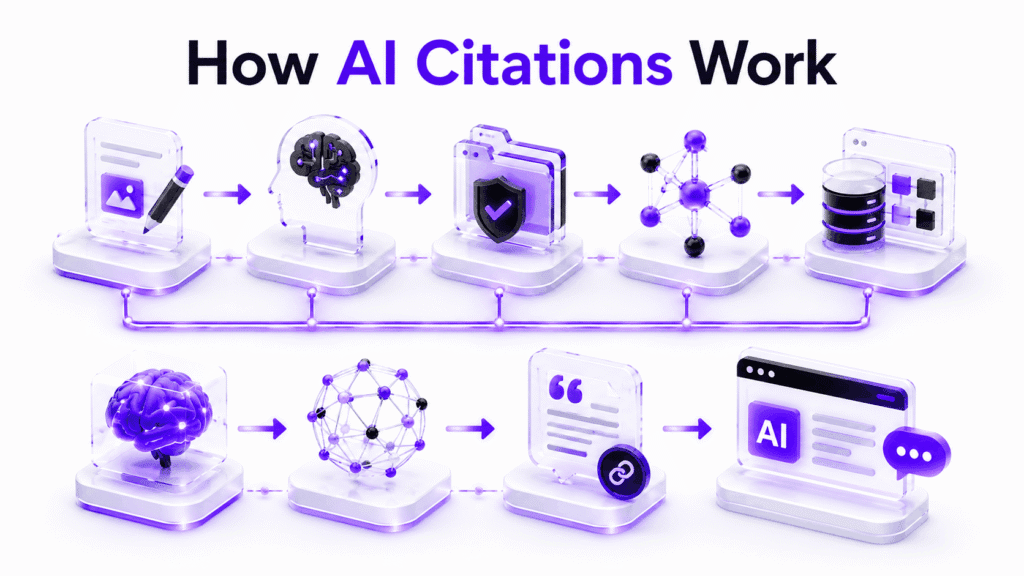
How AI Citations Work
AI-powered search engines don’t simply copy information from a single webpage. Instead, they analyse multiple trusted sources, identify common patterns, evaluate credibility, and generate a comprehensive response that best answers the user’s question.
When someone asks an AI assistant:
- What is AI Search Optimization?
- How do you improve AI Search Visibility?
- What is AI Citation Rate?
The AI system searches its available knowledge, identifies authoritative content, and determines which sources deserve to influence its answer.
This entire process is known as AI citation.
Unlike traditional search engines that display a ranked list of webpages, AI assistants focus on selecting the most reliable information rather than simply presenting the highest-ranking page.
Businesses that consistently publish accurate, comprehensive, and trustworthy content are far more likely to become part of these AI-generated responses.
Understanding Source Attribution
Source attribution is the process by which AI platforms recognise and reference the original source of information used in an answer.
Think of it as earning a recommendation rather than simply ranking in search results.
When AI assistants generate responses, they evaluate several trust signals before deciding which content to reference, including:
- Topical expertise
- Content depth
- Accuracy
- Freshness
- Website authority
- Brand reputation
- Entity recognition
- Structured content
For example, if several websites explain AI Search Visibility, the AI system is more likely to reference the page that provides:
- A complete explanation
- Original examples
- Clear structure
- Updated information
- Demonstrated expertise
rather than a short article containing only basic definitions.
This is why creating genuinely helpful resources has become one of the most effective long-term AI Search Optimization strategies.
Citation Frequency: Why Consistency Matters
Being cited once is valuable.
Being cited consistently across hundreds of AI prompts is far more powerful.
Citation Frequency measures how often your website appears as a trusted source across multiple AI-generated responses.
For example, your website might be referenced when users search for:
- AI Search Visibility
- AI Search Metrics
- AI Citation Rate
- AI Share of Voice
- Prompt Coverage
- AI SEO
- AI Search Optimization
If your content repeatedly appears across these related topics, AI platforms begin to recognise your website as an authority in that subject area.
This is exactly why building a topical authority hub is more effective than publishing isolated articles.
Instead of writing one article about AI Search, create a connected ecosystem of content that covers every important topic in depth.
Citation Quality Is More Important Than Citation Quantity
Many businesses assume that more citations automatically mean better AI visibility.
In reality, citation quality matters far more than citation quantity.
A single citation from a comprehensive, expert-written resource carries significantly more value than multiple citations from thin, repetitive, or low-quality content.
AI systems increasingly prioritise information that demonstrates:
- Experience
- Expertise
- Authoritativeness
- Trustworthiness (EEAT)
Content that combines these qualities naturally becomes more valuable to both AI systems and users.
To improve citation quality, focus on creating content that includes:
- Original research
- Practical frameworks
- Custom graphics
- Real-world examples
- Step-by-step tutorials
- Case studies
- Industry insights
- Updated statistics
When your content offers something unique, AI assistants have stronger reasons to reference it.
Building AI Trust
Trust is becoming one of the strongest ranking signals in AI-powered search.
AI assistants are designed to minimise misinformation by favouring sources that consistently demonstrate credibility.
Building AI trust requires a long-term strategy rather than quick SEO tactics.
Some of the strongest AI trust signals include:
Demonstrating Topical Authority
Rather than publishing unrelated articles, build comprehensive topic clusters.
For example, an AI Search content hub might include:
- AI Search Visibility Metrics & KPIs
- How to Measure AI Search Visibility
- AI Citation Rate
- AI Share of Voice
- Prompt Coverage
- AI Search Analytics
- Entity SEO
- AI Search Optimization
This interconnected structure helps AI systems understand that your website specialises in AI Search rather than simply mentioning it occasionally.
Publishing Original Content
AI systems increasingly reward original information over recycled content.
Create resources such as:
- Proprietary frameworks
- Industry research
- Custom workflows
- Infographics
- Comparison tables
- Expert insights
Original content not only improves citation opportunities but also increases the likelihood of earning backlinks and brand mentions.
Maintaining Consistent Brand Entities
AI platforms recognise organisations as entities.
Keep your business information consistent across:
- Website
- Google Business Profile
- Social media profiles
- Business directories
- Author profiles
Strong entity consistency improves both traditional SEO and AI Search visibility.
Improving Technical Quality
Technical optimisation still plays an important role.
Ensure your website includes:
- Fast loading speeds
- Mobile-friendly design
- Clear navigation
- Internal linking
- Structured data
- Secure HTTPS
- Crawlable content
A technically sound website makes it easier for search engines and AI systems to understand your content.
Why AI Citation Rate Should Be Part of Your SEO Strategy
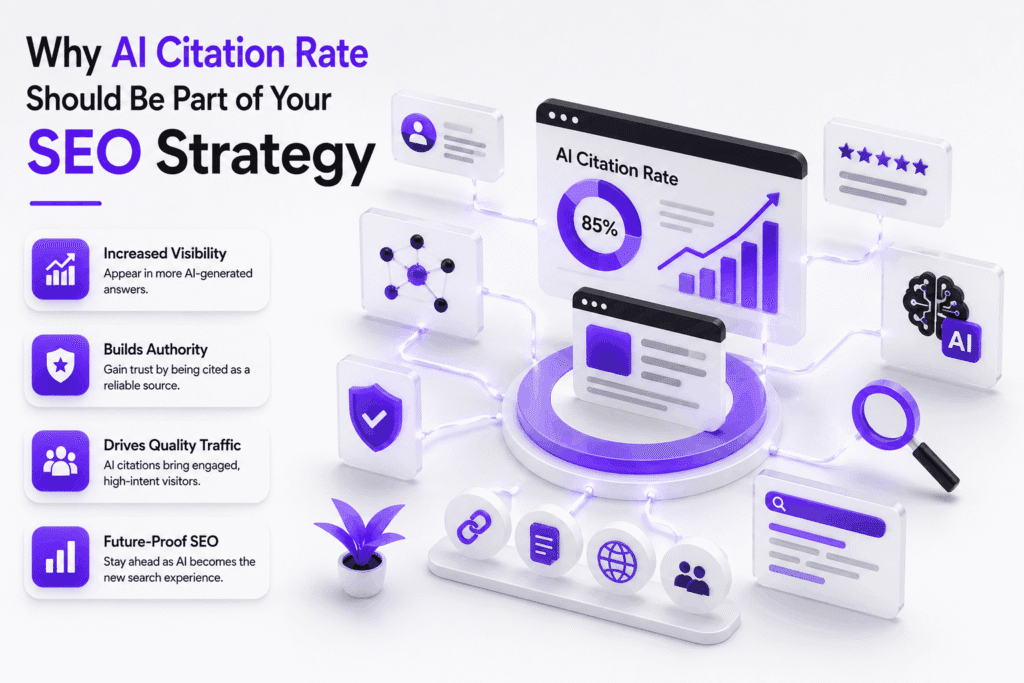
Traditional SEO focuses on rankings and traffic.
Modern AI Search Optimization expands that focus to include how frequently AI systems trust, reference, and recommend your content.
Businesses that consistently improve their AI Citation Rate often strengthen other important performance metrics as well, including:
- Brand visibility
- AI Share of Voice
- Organic authority
- Content discoverability
- User trust
- Long-term search performance
As AI-powered search continues to evolve, earning citations will become one of the clearest indicators that your content is recognised as an authoritative source.
How to Improve AI Citation Rate
Improving your AI Citation Rate isn’t about chasing algorithms or publishing more content than your competitors. Instead, it’s about becoming one of the most trustworthy and authoritative sources that AI platforms choose to reference.
AI assistants such as Google AI Overviews, ChatGPT, Claude, Gemini, and Perplexity prioritize content that demonstrates expertise, provides complete answers, and helps users solve real problems. Businesses that consistently create this type of content naturally increase their opportunities to earn AI citations.
Here are the most effective strategies to improve your AI Citation Rate in 2026 and beyond.
1. Build Comprehensive Topic Clusters
One standalone article rarely establishes enough authority for AI systems.
Instead, build a complete content hub around a topic.
For example, if your focus is AI Search, your content cluster could include:
- AI Search Visibility Metrics and KPIs
- How to Measure AI Search Visibility
- AI Citation Rate
- AI Share of Voice
- Prompt Coverage
- Entity SEO
- AI Search Optimization
- AI Search Analytics
- AI Brand Mentions
Every article should naturally link back to your pillar guide while also connecting to related supporting content.
This interconnected structure helps AI systems understand that your website specializes in the subject rather than mentioning it occasionally.
Related Guide: Our AI Search Visibility Metrics & KPIs pillar explains how AI Citation Rate works alongside AI Share of Voice, Prompt Coverage, Entity Presence, Brand Mentions, Recommendation Rate, and other essential AI Search metrics.
2. Create Original, Experience-Based Content
AI models increasingly favour original information instead of recycled summaries.
Rather than rewriting existing articles, publish content that includes:
- Original frameworks
- Practical workflows
- Industry research
- Case studies
- Comparison tables
- Custom illustrations
- Real client experiences
- Expert opinions
Original content provides unique value that AI systems cannot easily find elsewhere.
3. Demonstrate Strong EEAT Signals
Google’s Helpful Content System and modern AI models both reward content that demonstrates:
- Experience
- Expertise
- Authoritativeness
- Trustworthiness
Improve your EEAT by including:
- Author information
- Company details
- Last updated dates
- Reliable references
- Expert insights
- Transparent methodology
Readers and AI platforms are more likely to trust content written by recognised experts than anonymous articles with little supporting information.
4. Strengthen Your Entity Signals
AI assistants understand entities better than keywords.
Your business should appear consistently across:
- Website
- Google Business Profile
- Social media profiles
- Business directories
- Industry listings
Use structured data to reinforce your entity information.
Recommended schema includes:
- Organization
- Article
- FAQ
- Breadcrumb
- Service
- WebSite
These signals help AI systems understand who you are, what you do, and why your content deserves to be cited.
5. Keep Content Fresh
AI Search changes quickly.
Review important articles every few months by:
- Updating statistics
- Expanding explanations
- Adding new AI platforms
- Refreshing examples
- Improving FAQs
- Including new screenshots
- Updating internal links
Fresh, well-maintained content has a better chance of remaining relevant in AI-generated responses.
Best Practices for Increasing AI Citation Rate
Businesses that consistently earn AI citations typically follow these best practices:
✅ Publish comprehensive guides rather than short articles.
✅ Answer real customer questions using natural language.
✅ Include original graphics, diagrams, and comparison tables.
✅ Build topical authority through interconnected content.
✅ Use descriptive headings and logical page structure.
✅ Implement structured data to improve content understanding.
✅ Regularly update important pages.
✅ Maintain consistent branding across all digital platforms.
These practices not only improve AI Citation Rate but also strengthen traditional SEO performance.
Common Mistakes That Reduce AI Citation Rate
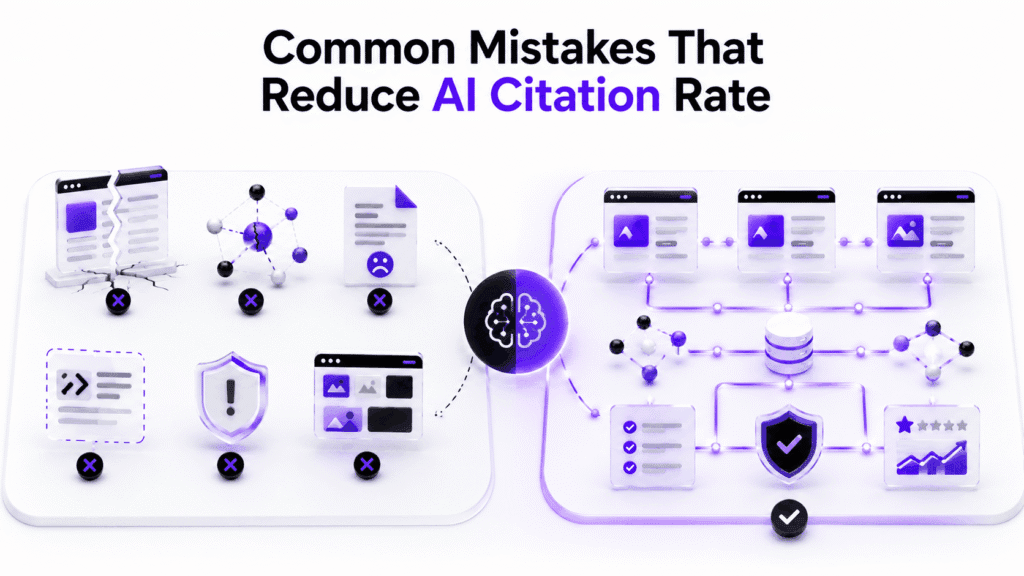
Many businesses unknowingly make decisions that reduce their chances of being referenced by AI systems.
Avoid these common mistakes.
Publishing Thin Content
Articles that only provide basic definitions rarely become trusted references.
Aim to create complete resources that fully answer the user’s question.
Writing Only for Keywords
Keyword stuffing no longer works.
Instead, focus on solving problems and covering topics naturally.
AI systems evaluate usefulness rather than keyword density.
Ignoring Internal Linking
Disconnected articles make it harder for AI systems to understand your topical authority.
Every supporting article should naturally connect back to your pillar guide while linking to related resources.
Missing Structured Data
Schema Markup helps AI systems interpret your content more accurately.
Without it, valuable context may be lost.
Never Updating Content
Outdated statistics, broken links, and obsolete examples reduce trust.
Refreshing important articles demonstrates that your information remains current.
Real-World Example
Imagine two digital marketing agencies publish an article about AI Search Visibility.
Agency A
- 900-word article
- Generic advice
- No examples
- No internal links
- No structured data
Agency B
- 3,000-word comprehensive guide
- Original diagrams
- Practical frameworks
- Case studies
- FAQ section
- Schema Markup
- Supporting topic cluster
- Regular updates
Over time, AI assistants are far more likely to reference Agency B because its content provides greater depth, stronger expertise, and a better user experience.
This illustrates an important principle:
AI doesn’t simply reward content that exists—it rewards content that genuinely helps users.
Conclusion
AI Citation Rate is quickly becoming one of the most valuable indicators of authority in AI-powered search.
While traditional SEO focuses on rankings and traffic, AI Citation Rate measures something even more meaningful—how often AI systems trust your content enough to use it when answering user questions.
By publishing original content, building topical authority, strengthening entity signals, implementing structured data, and continuously improving your resources, you can significantly increase your opportunities to earn AI citations across platforms like Google AI Overviews, ChatGPT, Claude, Gemini, and Perplexity.
Businesses that begin optimizing for AI citations today will be better positioned as AI Search continues to reshape how people discover information online.
Frequently Asked Questions About AI Citation Rate
What is AI Citation Rate?
AI Citation Rate measures how often AI-powered platforms like ChatGPT, Google AI Overviews, Claude, Gemini, and Perplexity reference or cite your website when generating responses. A higher citation rate indicates that AI systems recognize your content as trustworthy and authoritative.
Why is AI Citation Rate important?
AI Citation Rate is important because it reflects your brand’s visibility in AI-generated search results. Businesses with higher citation rates are more likely to be recommended by AI assistants, increasing brand awareness, authority, and opportunities to attract qualified traffic.
How do AI platforms choose which websites to cite?
AI platforms evaluate multiple factors, including content quality, topical authority, accuracy, freshness, structured data, entity recognition, and overall trustworthiness. Comprehensive, well-organized, and experience-driven content has a better chance of being cited.
Can small businesses improve AI Citation Rate?
Yes. Small businesses can compete by creating high-quality niche content, answering customer questions, building topical authority, and consistently publishing valuable resources. AI systems reward expertise and usefulness, not just brand size.
How often should I update content to improve AI citations?
Review and update important content every three to six months. Refresh statistics, add new examples, expand FAQs, improve internal linking, and update structured data to maintain relevance for both users and AI systems.
Is AI Citation Rate a Google ranking factor?
Businesses can monitor AI Citation Rate using a combination of Google Search Console, Google Analytics 4, Semrush AI Toolkit, Peec AI, Profound, Otterly.AI, and other AI visibility platforms that track mentions, citations, and AI-generated recommendations.
Which tools can help measure AI Citation Rate?
AI Citation Rate measures how often your content is referenced by AI platforms, while AI Share of Voice measures how frequently your brand appears in AI-generated responses compared to competitors. Together, they provide a more complete picture of AI Search Visibility.
What is the difference between AI Citation Rate and AI Share of Voice?
No. A high Google ranking does not automatically guarantee AI citations. AI systems prioritize helpful, authoritative, and well-structured content rather than relying solely on traditional search rankings.

Zack
Zack Robinson is a Digital Marketing Specialist at Revolute X Digital, specializing in SEO, Local SEO, Google Business Profile optimization, AI automation, and lead generation. He helps businesses improve their online visibility, attract qualified customers, and achieve sustainable growth through data-driven digital marketing strategies.