
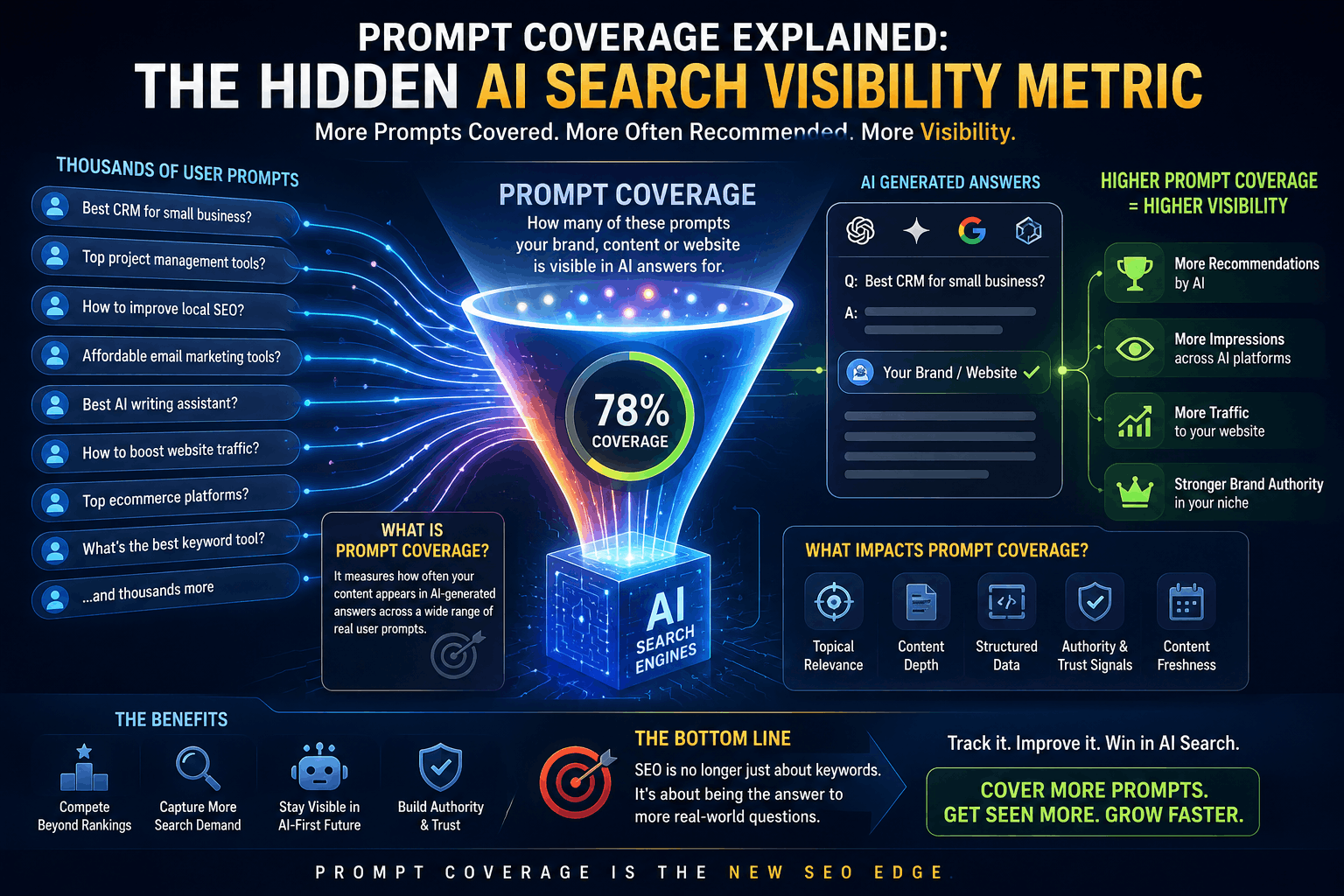
For over two decades, SEO success has been measured by one familiar metric: search engine rankings. Businesses invested countless hours trying to secure the number one position on Google for their most valuable keywords, believing that higher rankings would naturally lead to more visibility, traffic, and customers.
That approach still matters—but the way people search is changing rapidly.
Today, millions of users no longer begin their journey with a simple keyword. Instead, they ask complete questions using AI-powered search platforms like Google AI Overviews, ChatGPT, Claude, Gemini, and Perplexity. These AI assistants don’t just display a list of websites—they generate direct answers by selecting information from trusted sources across the web.
This shift has introduced an entirely new challenge for businesses.
A website may rank first for an important keyword yet never appear when someone asks an AI assistant a closely related question. Conversely, another website with lower traditional rankings may frequently be recommended because its content better answers conversational prompts.
This is where Prompt Coverage becomes one of the most valuable AI Search Visibility metrics.
Instead of asking:
“Where do I rank?”
Businesses now need to ask:
“How many relevant AI prompts does my brand appear in?”
Prompt Coverage measures exactly that.
It evaluates how often your website, brand, products, or services appear across the hundreds—or even thousands—of prompts your target audience may ask AI assistants.
For example, if you own an AI Search Optimization agency, your visibility isn’t limited to a single keyword like AI SEO. Potential customers may ask dozens of different questions, such as:
- What is AI Search Optimization?
- Best AI SEO agency
- How do I rank in ChatGPT?
- How can my business appear in Google AI Overviews?
- Best Generative Engine Optimization company
- AI visibility consultant
- How do I improve AI citations?
- AI Search marketing services
Every one of these prompts represents a separate opportunity for your brand to be discovered.
The more prompts your business successfully appears in, the stronger your Prompt Coverage becomes.
Unlike traditional keyword tracking, Prompt Coverage reflects how well your content performs in the conversational search environment that increasingly defines modern search behavior.
As AI-powered search continues to evolve, businesses that optimize for Prompt Coverage will gain a significant competitive advantage—not only by improving visibility across AI platforms but also by strengthening topical authority, brand recognition, and long-term trust.
What Is Prompt Coverage?
Prompt Coverage is the percentage or number of relevant AI prompts in which your brand, website, product, or content appears as a cited, recommended, or referenced source.
Rather than measuring performance for a handful of keywords, Prompt Coverage evaluates your visibility across an entire ecosystem of conversational searches.
Every time someone interacts with an AI assistant, they submit a prompt—a natural language question or request. These prompts can vary significantly even when they relate to the same topic.
For example, someone researching AI Search might ask:
- What is AI Search Visibility?
- How do AI search engines work?
- Best AI Search Optimization agency
- How do I rank in AI search?
- What are AI Search KPIs?
- How do I measure AI visibility?
Although each prompt is different, they all relate to the same core topic.
Prompt Coverage measures how many of these relevant prompts your business successfully appears in.
A higher Prompt Coverage means your content is visible across a broader range of user questions, increasing the likelihood that potential customers will discover your brand through AI-powered search experiences.
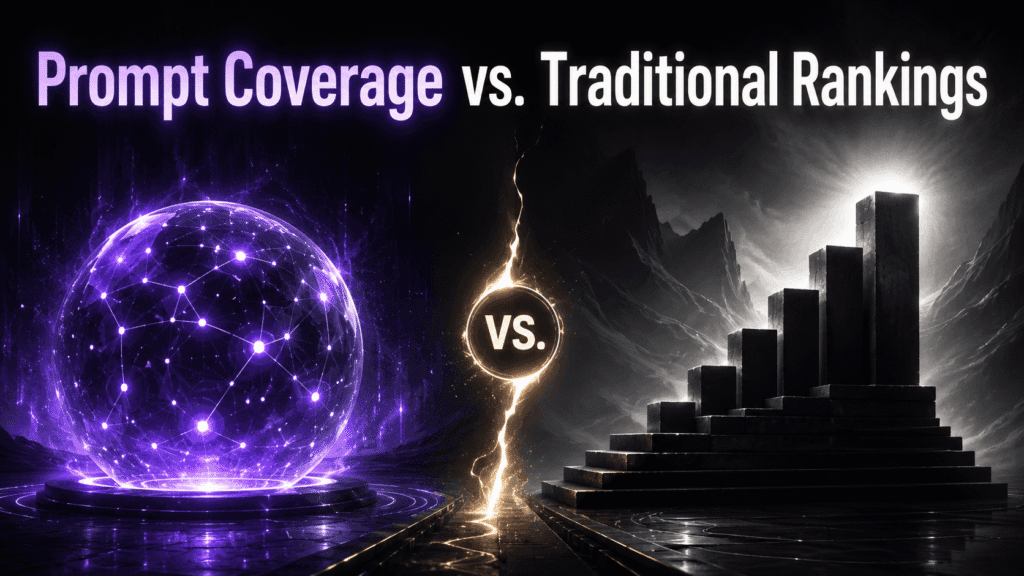
Prompt Coverage vs. Traditional Rankings
Traditional SEO measures your position for specific keywords.
For example:
- AI SEO Agency → Position #2
- AI Search Optimization → Position #4
Prompt Coverage looks beyond rankings.
Instead, it asks:
How many AI conversations include your brand?
Even if your website ranks well in Google Search, your brand may be absent from AI-generated answers if your content doesn’t fully address the variety of questions users ask.
This makes Prompt Coverage a broader and more meaningful measure of AI visibility.
Prompt Coverage vs. Website Traffic
Traffic measures the number of visitors who arrive on your website.
Prompt Coverage measures the number of opportunities your brand has to appear before those visitors ever click a link.
A business with excellent Prompt Coverage can influence purchasing decisions, build brand awareness, and establish authority even when users don’t immediately visit its website.
In AI Search, visibility often begins before the click.
Prompt Coverage vs. AI Share of Voice
These two metrics are closely related but measure different aspects of AI visibility.
Prompt Coverage answers:
In how many relevant prompts does my brand appear?
AI Share of Voice answers:
How often does my brand appear compared to competitors across those prompts?
Think of Prompt Coverage as measuring the breadth of your AI visibility, while AI Share of Voice measures your competitive presence within that visibility.
Together, they provide a more complete understanding of how your brand performs in AI-powered search.
Why Prompt Coverage Matters
As AI assistants become a primary way people discover information, businesses need new ways to measure visibility beyond traditional rankings.
Prompt Coverage provides that perspective.
AI Search Behavior Has Changed
Modern users rarely search using one or two keywords.
Instead, they ask complete, conversational questions that reflect their specific needs.
AI assistants analyze these prompts, understand the intent behind them, and generate personalized responses.
If your content doesn’t address the full range of relevant questions, your business may miss valuable opportunities to be recommended.
Conversational Search Creates More Opportunities
A single topic can generate hundreds of unique prompts.
People naturally phrase questions differently based on their goals, experience, and context.
By creating content that answers these variations, businesses increase the number of AI conversations in which they can appear.
Broader Prompt Coverage means broader visibility.
AI Recommendations Influence Buying Decisions
When AI assistants recommend businesses, products, or services, users often view those recommendations as trustworthy.
Appearing consistently across relevant prompts strengthens your credibility and positions your brand as an authority within your industry.
Increased Visibility Across AI Platforms
Strong Prompt Coverage helps your business appear across multiple AI-powered experiences, including:
- Google AI Overviews
- ChatGPT
- Claude
- Gemini
- Perplexity
Rather than depending on a single search engine, your visibility expands across the growing AI search ecosystem.
Stronger Brand Awareness
Every appearance in an AI-generated response introduces your brand to potential customers.
Even if users don’t click immediately, repeated exposure builds familiarity and trust over time.
The more relevant prompts your business covers, the more opportunities you have to become the recognized authority in your niche.
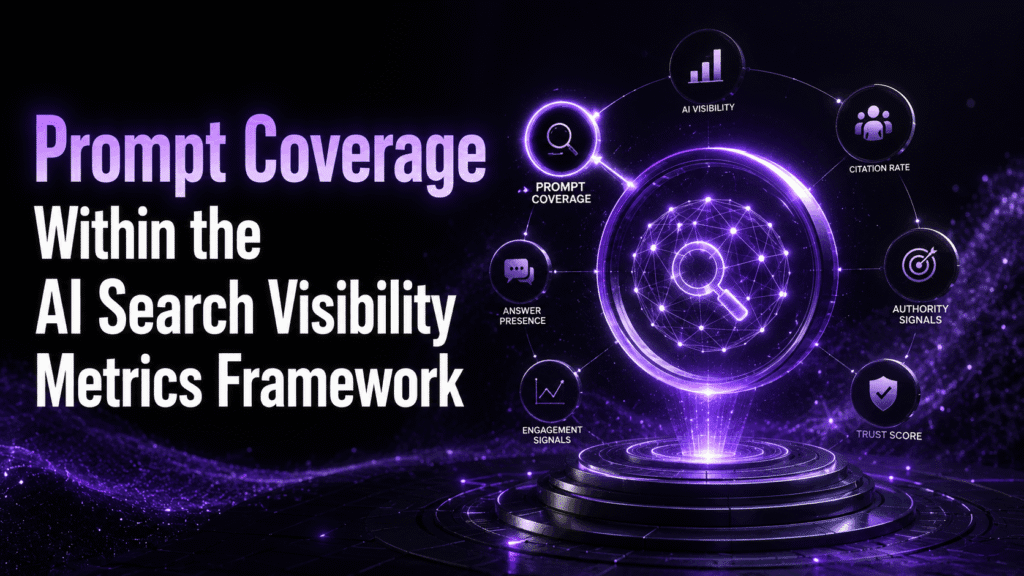
Prompt Coverage Within the AI Search Visibility Metrics Framework
Prompt Coverage is not a standalone metric—it is one component of a broader AI Search Visibility Metrics & KPIs framework.
While traditional SEO focuses primarily on rankings and organic traffic, AI Search requires a more comprehensive measurement approach.
A complete AI visibility strategy evaluates several key performance indicators, including:
- AI Citation Rate
- AI Share of Voice
- Prompt Coverage
- Entity Visibility
- Brand Mentions
- Recommendation Rate
- AI Traffic
- AI Conversions
Among these metrics, Prompt Coverage answers one of the most important questions:
“Across all the questions my audience asks AI platforms, how often does my brand appear?”
When combined with the other AI Search KPIs, Prompt Coverage provides valuable insight into the reach, discoverability, and overall effectiveness of your AI Search Optimization strategy.
In the next section, we’ll explore how Prompt Coverage works, why prompt clusters matter, and how businesses can systematically increase their visibility across thousands of AI-powered conversations.
How to Improve Prompt Coverage
Ranking for a handful of keywords is no longer enough to succeed in AI-powered search. Today’s users ask questions in natural language, and AI assistants generate answers based on context, intent, and authority—not just keyword matches.
This means your goal should not be to rank for one keyword. Your goal should be to appear in as many relevant AI conversations as possible.
That’s exactly what improving Prompt Coverage is all about.
The following strategies will help your business increase its visibility across ChatGPT, Google AI Overviews, Claude, Gemini, Perplexity, and future AI search platforms.
1. Build Topical Content Clusters
The most effective way to improve Prompt Coverage is to build topical authority.
Instead of publishing isolated blog posts, organize your content into a structured content hub consisting of one comprehensive pillar page supported by multiple in-depth articles.
For example, if your primary topic is AI Search Visibility, your cluster could include:
- AI Search Visibility Metrics & KPIs (Pillar)
- Prompt Coverage
- AI Citation Rate
- AI Share of Voice
- Entity SEO
- AI Search Analytics
- AI Search Optimization
- AI Brand Mentions
Every supporting article should naturally link back to the pillar while also linking to related resources within the cluster.
This interconnected structure helps AI systems understand that your website is an authoritative source on the topic rather than a collection of unrelated articles.
2. Answer Real Customer Questions
AI assistants are designed to answer questions—not match keywords.
Your content should focus on the questions your audience actually asks.
For example, instead of writing only about:
AI Search Visibility
Also answer questions like:
- What is AI Search Visibility?
- How do I appear in ChatGPT?
- How do AI assistants choose websites?
- Why isn’t my brand appearing in Google AI Overviews?
- How do I increase AI citations?
- How can I improve Prompt Coverage?
Each answered question becomes another opportunity for your brand to appear in AI-generated responses.
3. Cover Semantic Variations
People rarely ask identical questions.
A business searching for AI SEO services might use any of the following prompts:
- Best AI SEO Agency
- Best Generative Engine Optimization Agency
- AI Search Optimization Company
- AI Search Consultant
- AI Visibility Expert
- AI Marketing Agency
- ChatGPT SEO Services
Although the intent is similar, the wording is different.
AI models understand semantic relationships, making it essential to cover multiple variations naturally throughout your content rather than repeating the same keyword.
4. Add Comprehensive FAQ Sections
Frequently Asked Questions are one of the most effective ways to expand Prompt Coverage.
Each FAQ represents another conversational prompt that AI assistants can use when generating answers.
Strong FAQ sections should:
- Answer one question per section
- Use natural language
- Provide concise but complete answers
- Address related follow-up questions
- Match real customer intent
A well-written FAQ can dramatically increase the number of prompts your content covers without making the article feel repetitive.
5. Strengthen Entity Signals
AI platforms rely heavily on entities to understand who you are and what your business represents.
Your brand information should remain consistent across:
- Website
- Google Business Profile
- Social media profiles
- Industry directories
- Knowledge panels
- Author profiles
Adding structured data such as Organization, Article, FAQ, Breadcrumb, and WebSite schema further strengthens these entity signals.
The clearer your entity relationships are, the easier it is for AI systems to recommend your brand.
6. Create Comprehensive Pillar Pages
Every important topic should have one definitive resource.
Your pillar page should explain the entire subject while linking to specialized supporting articles.
For example:
AI Search Visibility Metrics & KPIs
↓
AI Citation Rate
↓
Prompt Coverage
↓
AI Share of Voice
↓
Entity SEO
↓
Recommendation Rate
↓
AI Analytics
This structure improves both user experience and AI understanding of your content ecosystem.
7. Publish Supporting Articles Regularly
AI platforms reward websites that demonstrate depth and consistency.
Instead of publishing one article and moving on, continue expanding your content library with related resources.
Supporting articles answer more questions, target more prompts, and increase your overall Prompt Coverage across AI search platforms.
8. Monitor AI Answers Regularly
Prompt Coverage is not a one-time measurement.
AI models evolve continuously, and recommendations change over time.
Review how AI assistants answer important industry questions every month.
Track:
- Which prompts include your brand
- Which competitors appear
- Which sources are repeatedly cited
- Which topics need additional content
This ongoing analysis helps identify new opportunities before competitors do.
9. Update Content Every Month
Prompt Coverage naturally declines if your content becomes outdated.
Schedule regular updates to:
- Add new examples
- Refresh statistics
- Expand FAQs
- Improve internal linking
- Add emerging AI platforms
- Cover new prompt variations
Fresh content increases relevance and improves your chances of being selected by AI assistants.
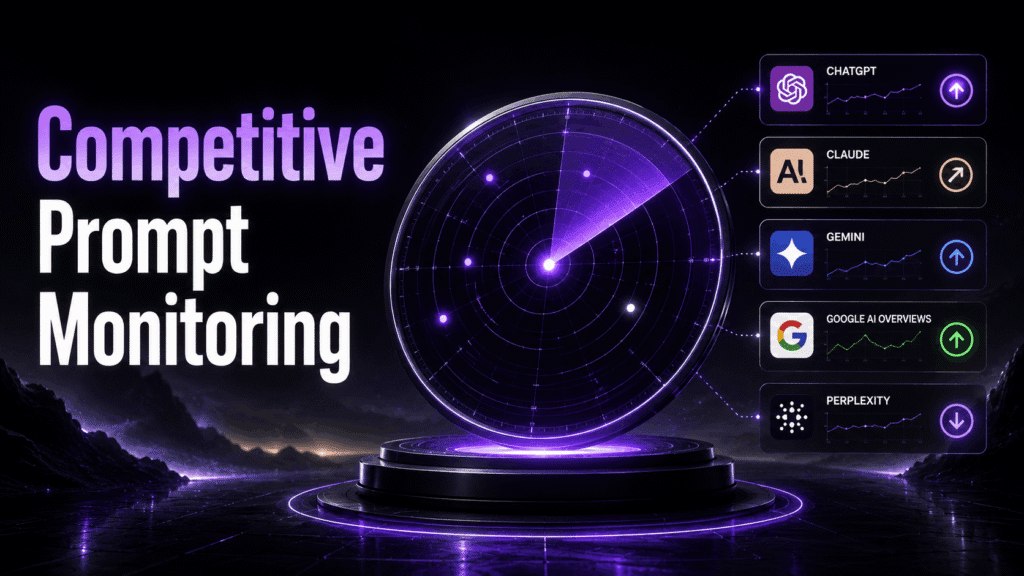
Competitive Prompt Monitoring
One of the biggest opportunities in AI Search Optimization is Competitive Prompt Monitoring.
Instead of checking only keyword rankings, monitor how AI assistants respond to the questions your customers actually ask.
Select approximately 100 important prompts related to your industry and test them across multiple AI platforms, including:
- ChatGPT
- Google AI Overviews
- Claude
- Gemini
- Perplexity
For every prompt, record:
| Prompt | Your Brand | Competitor A | Competitor B | No Brand Mention |
|---|---|---|---|---|
| Best AI SEO Agency | ✅ | ✅ | ❌ | ❌ |
| AI Search Visibility Metrics | ✅ | ❌ | ❌ | ❌ |
| AI Search Dashboard | ❌ | ✅ | ❌ | ❌ |
| Prompt Coverage | ✅ | ❌ | ❌ | ❌ |
| AI Citation Rate | ❌ | ✅ | ✅ | ❌ |
After reviewing your results, ask:
- How often does my brand appear?
- Which competitor appears most frequently?
- Which prompts have no clear authority?
- Which topics represent content opportunities?
This approach reveals gaps that traditional keyword tracking tools simply cannot identify.
Common Mistakes That Reduce Prompt Coverage
Many businesses unintentionally limit their AI visibility by following outdated SEO practices.
Avoid these common mistakes.
Only Targeting Keywords
Modern AI systems understand topics and intent, not just exact-match keywords.
Write for conversations rather than keyword repetition.
Ignoring Long-Tail Prompts
Some of the highest-converting AI searches are highly specific.
Cover niche questions that real customers ask instead of focusing only on broad terms.
Publishing Thin Content
Short articles rarely establish authority.
Create comprehensive resources that thoroughly answer a topic and anticipate follow-up questions.
Weak Internal Linking
Supporting articles should connect naturally to your pillar page and to one another.
Strong internal links reinforce topical authority and help AI understand your content relationships.
Ignoring Entity Optimization
Without consistent entity signals, AI systems may struggle to associate your brand with important topics.
Maintain consistent business information and implement structured data across your website.
Never Updating Content
AI Search evolves rapidly.
Articles that remain unchanged for years gradually lose relevance.
Regular updates help maintain authority and expand Prompt Coverage.
Tracking Google Rankings Only
Traditional rankings tell only part of the story.
Monitor your visibility inside AI-generated responses—not just search engine result pages.
Ignoring AI Assistants
Many businesses optimize exclusively for Google while overlooking platforms like ChatGPT, Claude, Gemini, and Perplexity.
As AI adoption grows, this approach leaves significant visibility opportunities untapped.
Real-World Example
Imagine your company publishes a comprehensive guide about AI Search Visibility.
A user asks ChatGPT:
“What is AI Search Visibility?”
Your article appears in the AI-generated response.
Prompt Covered ✅
Later, another user asks:
Your brand does not appear.
Prompt Not Covered ❌
Why?
Although both prompts relate to the same topic, the second question requires detailed information about measurement frameworks, KPIs, analytics, and reporting.
If your website doesn’t include dedicated supporting content covering these subtopics, AI assistants may recommend a competitor instead.
This gap indicates missing supporting content, not necessarily poor overall authority.
Creating dedicated resources on topics such as AI Search Visibility Metrics & KPIs, AI Citation Rate, Prompt Coverage, and AI Share of Voice expands your Prompt Coverage and increases the likelihood that your brand appears across a wider range of AI conversations.
Why Prompt Coverage Is a Competitive Advantage
While many marketers still focus exclusively on rankings and traffic, Prompt Coverage reflects how visible your brand is within the AI-powered conversations that increasingly influence purchasing decisions.
Businesses that build topical authority, answer real customer questions, monitor AI-generated responses, and continuously expand their content clusters will earn broader Prompt Coverage and stronger AI visibility over time.
Most websites discussing AI Search focus on AI Citation Rate or AI Share of Voice, but very few explain Prompt Coverage in depth. By publishing a comprehensive guide like this—supported by practical examples, prompt clustering strategies, competitive monitoring techniques, and strong internal links to your AI Search Visibility Metrics and KPIs pillar—Revolute X Digital can establish itself as one of the leading authorities on this emerging AI Search metric.
Frequently Asked Questions About Prompt Coverage
Prompt Coverage measures how many relevant AI prompts your brand appears in across AI-powered platforms like ChatGPT, Google AI Overviews, Claude, Gemini, and Perplexity. It helps evaluate your visibility beyond traditional keyword rankings.
Prompt Coverage shows how often your business appears in AI-generated responses. A higher Prompt Coverage means more opportunities for customers to discover your brand through conversational AI search experiences.
Keyword rankings measure your position for individual search terms, while Prompt Coverage measures how many different AI prompts your brand appears in. It focuses on conversational search rather than traditional rankings.
Prompt Coverage measures the number of prompts where your brand appears, whereas AI Share of Voice compares your visibility against competitors across those prompts. Both metrics work together to measure AI Search Visibility.
You can improve Prompt Coverage by creating topical clusters, publishing comprehensive pillar pages, answering real customer questions, optimizing for semantic search, strengthening entity signals, adding structured data, and updating your content regularly.
Prompt Clusters are groups of related conversational questions around the same topic. Optimizing content for multiple prompt variations increases the number of AI conversations where your brand can appear.
You should monitor ChatGPT, Google AI Overviews, Claude, Gemini, and Perplexity because each platform generates responses differently and may recommend different sources.
Yes. Prompt Coverage is one of the most important AI Search Visibility metrics because it measures how broadly your brand appears across AI-generated conversations.
Absolutely. Small businesses can compete by building topical authority, answering niche customer questions, publishing original content, and creating comprehensive content clusters that demonstrate expertise.
Review Prompt Coverage at least once a month. Regular monitoring helps identify new content opportunities, track competitor performance, and adapt to changing AI-generated search results.
Structured data does not directly increase Prompt Coverage, but it helps AI systems better understand your content, entities, and relationships, making it easier for AI platforms to reference your website.
AI assistants prefer authoritative sources that comprehensively cover a subject. Building a topical content cluster around a pillar page helps increase your Prompt Coverage across many related prompts.
Prompt Coverage measures how many prompts your brand appears in, while AI Citation Rate measures how often your content is cited as a source. Together, these metrics provide a clearer picture of your overall AI Search performance.
Businesses can manually test prompts across ChatGPT, Google AI Overviews, Claude, Gemini, and Perplexity or use AI visibility platforms that monitor brand mentions, prompt performance, and competitive visibility.
Prompt Coverage does not replace traditional SEO, but it has become an essential metric for businesses that want to increase visibility in AI-powered search. Combining strong SEO with AI Search Optimization provides the best long-term results.

Zack
Zack Robinson is a Digital Marketing Specialist at Revolute X Digital, specializing in SEO, Local SEO, Google Business Profile optimization, AI automation, and lead generation. He helps businesses improve their online visibility, attract qualified customers, and achieve sustainable growth through data-driven digital marketing strategies.