
For years, digital marketers have relied on tools like Google Analytics, Google Search Console, and third-party SEO platforms to measure website performance. These tools provide valuable insights into rankings, clicks, impressions, conversions, and user behavior.
However, the way people search for information is changing rapidly.
Instead of typing short keywords into a search engine, users are increasingly asking complete questions through AI-powered platforms such as Google AI Overviews, ChatGPT, Claude, Gemini, and Perplexity. These AI assistants don’t simply display a list of search results—they generate direct answers by analyzing and summarizing information from multiple trusted sources.
This shift introduces a new challenge for marketers and business owners.
A customer may discover your brand through an AI-generated recommendation without ever clicking on your website immediately. Traditional analytics platforms often fail to capture these interactions, making it difficult to understand how visible your brand actually is across AI-powered search experiences.
This is where AI Search Analytics becomes essential.
AI Search Analytics is the process of measuring, monitoring, and improving your brand’s visibility across AI search platforms. Rather than focusing only on rankings and traffic, it helps businesses answer questions like:
- How often does AI recommend my business?
- How to Measure AI Search Visibility?
- How many prompts does my content appear in?
- Which competitors are more visible in AI search?
- What AI Search KPIs should I track?
By answering these questions, businesses gain a clearer understanding of how they perform in the rapidly evolving AI Search ecosystem.
As AI-generated search continues to influence purchasing decisions, measuring AI visibility is becoming just as important as measuring traditional SEO performance.
Whether you’re a local business, SaaS company, enterprise brand, or digital marketing agency, AI Search Analytics provides the insights needed to optimize content, improve authority, and increase visibility across multiple AI platforms.
Recommended Reading: Before diving into AI Search Analytics, explore our complete AI Search Visibility Metrics & KPIs guide. It explains the core metrics—including AI Share of Voice, AI Citation Rate, Prompt Coverage, Entity Presence, Brand Mentions, Recommendation Rate, and AI Referral Traffic—that form the foundation of effective AI Search measurement.
What Is AI Search Analytics?
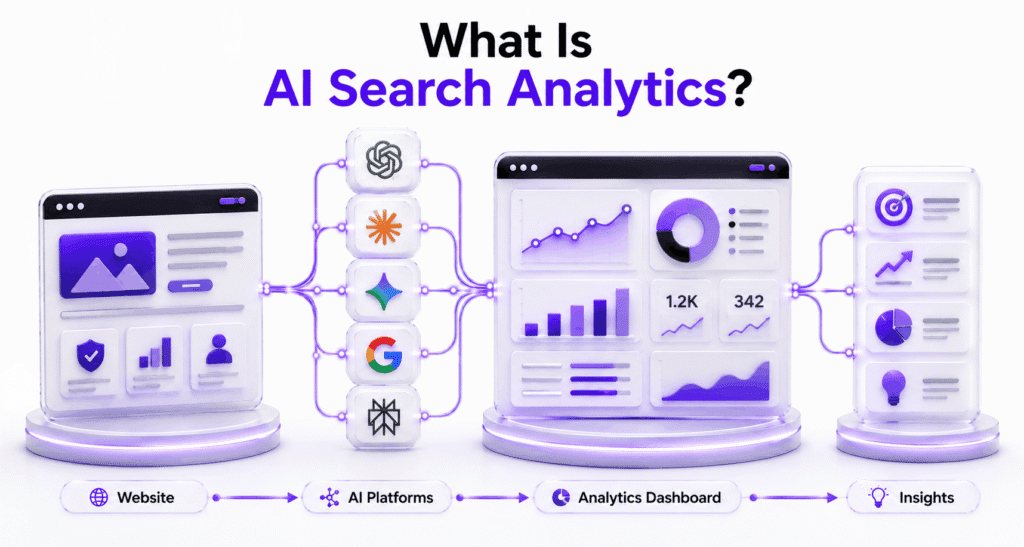
AI Search Analytics is the process of collecting, analyzing, and reporting data that measures how visible your brand is across AI-powered search platforms.
Unlike traditional web analytics, which primarily tracks website visits and user behavior, AI Search Analytics focuses on understanding how AI assistants discover, evaluate, recommend, and reference your content.
Rather than measuring only clicks and rankings, AI Search Analytics helps answer questions such as:
- Does ChatGPT recommend my business?
- How often does Google AI Overviews cite my content?
- Is my brand visible across important AI prompts?
- Which competitors receive more AI recommendations?
- Are my AI Search Optimization efforts improving over time?
These insights allow businesses to evaluate their performance beyond traditional search engines and adapt their strategies for the future of search.
As AI-powered search continues to evolve, businesses that actively monitor AI visibility will be better positioned to identify opportunities, improve authority, and remain competitive.
Why AI Search Analytics Matters
Traditional SEO reports focus heavily on rankings, impressions, clicks, and conversions.
While these metrics remain valuable, they no longer tell the complete story.
AI assistants influence customer decisions long before users visit a website. If your business appears consistently in AI-generated answers, your brand gains visibility even when traditional analytics tools don’t record a website visit.
This makes AI Search Analytics an essential part of modern digital marketing.
Measure Brand Visibility Beyond Rankings
Ranking on Google is important, but appearing in AI-generated recommendations is becoming equally valuable.
AI Search Analytics helps measure where your brand appears across conversational AI platforms instead of focusing only on search engine result pages.
Track AI Recommendations
AI assistants frequently recommend businesses, products, services, and resources.
Tracking these recommendations helps businesses understand:
- Which topics generate AI mentions
- Which platforms recommend their brand
- Which competitors appear more frequently
- Where visibility opportunities exist
Evaluate AI Search Performance
Successful AI Search Optimization requires continuous measurement.
AI Search Analytics allows businesses to monitor:
- AI Share of Voice
- AI Citation Rate
- Prompt Coverage
- Entity Presence
- Brand Mentions
- AI Referral Traffic
- Recommendation Rate
Together, these metrics provide a comprehensive picture of AI visibility.
Improve Content Strategy
Analytics should drive better decisions.
By understanding which topics generate AI recommendations and which prompts your brand misses, you can prioritize new content that expands topical authority and improves Prompt Coverage.
This data-driven approach ensures your content strategy aligns with real user behavior instead of relying solely on keyword research.
Monitor Competitor Performance
AI Search Analytics isn’t only about measuring your own visibility.
It also helps answer questions like:
- Which competitors dominate AI-generated answers?
- Which prompts consistently mention competing brands?
- Which content formats perform best?
- Where are the biggest content gaps?
These insights help identify opportunities to outperform competitors.
AI Search Analytics vs Traditional Web Analytics
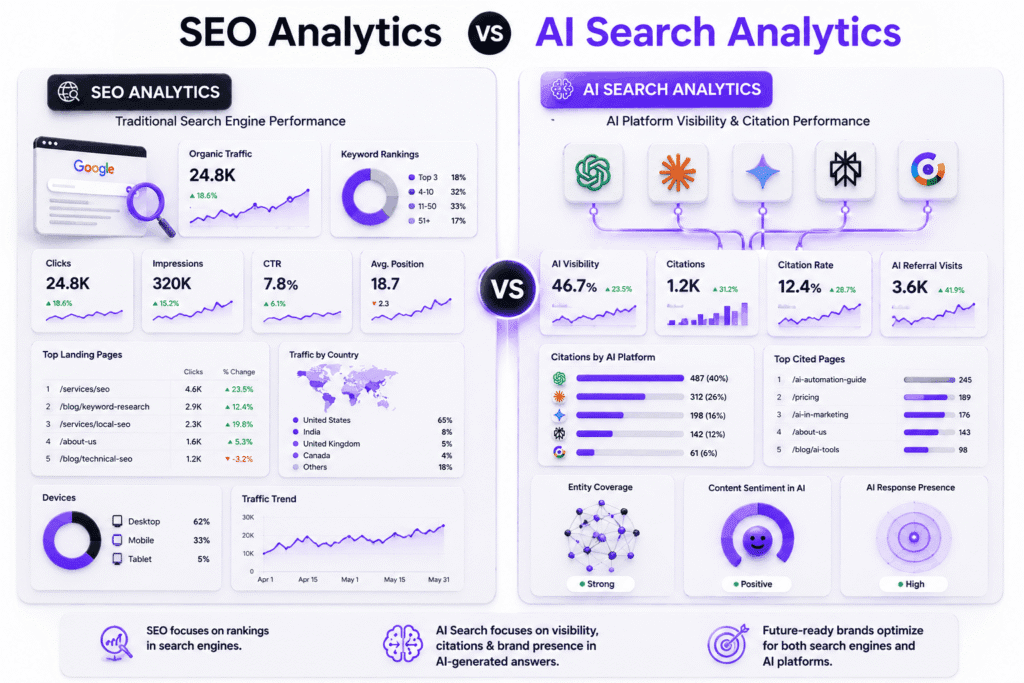
Although AI Search Analytics and traditional analytics complement each other, they measure different aspects of online visibility.
| Traditional Web Analytics | AI Search Analytics |
|---|---|
| Website Traffic | AI Visibility |
| Keyword Rankings | Prompt Coverage |
| Click-Through Rate | AI Recommendation Rate |
| Organic Sessions | AI Brand Mentions |
| Conversions | AI Referral Traffic |
| Bounce Rate | AI Citation Rate |
Traditional analytics explain what happens after users visit your website.
AI Search Analytics helps explain how users discover your brand before they ever click.
Both perspectives are necessary for a complete understanding of modern search performance.
AI Search Analytics Within the AI Search Visibility Metrics Framework
AI Search Analytics is not a single KPI.
Instead, it serves as the measurement and reporting layer for your broader AI Search Visibility Metrics & KPIs framework.
Think of the framework this way:
- AI Citation Rate measures how often AI platforms reference your content.
- Prompt Coverage measures how many relevant AI prompts your brand appears in.
- AI Share of Voice compares your AI visibility against competitors.
- Entity Presence evaluates how well AI systems recognize your brand.
- Brand Mentions track how often your business is referenced.
- AI Referral Traffic measures visits originating from AI-powered platforms.
- Recommendation Rate shows how frequently AI assistants recommend your business.
AI Search Analytics brings all of these metrics together into one reporting system, allowing you to monitor trends, identify opportunities, and make informed optimization decisions.
Rather than looking at isolated numbers, you gain a complete view of your AI Search performance across multiple platforms.
What Should You Measure in AI Search Analytics?
Measuring AI Search performance is very different from measuring traditional SEO.
For years, marketers tracked keyword rankings, organic traffic, click-through rates, and conversions. While these metrics remain valuable, they only explain part of the customer journey.
AI-powered search introduces a new visibility layer.
Platforms like ChatGPT, Google AI Overviews, Claude, Gemini, and Perplexity recommend brands, summarize content, answer questions, and cite trusted sources—often before users ever visit a website.
This means businesses need a new analytics framework designed specifically for AI Search.
Rather than asking:
“How many visitors did I receive?”
Modern marketers should also ask:
- How often does AI recommend my brand?
- How frequently is my content cited?
- Which prompts trigger my business?
- Which competitors appear more often?
- Which AI platforms generate the most visibility?
The answers come from tracking the right AI Search KPIs.
The Core AI Search Metrics Every Business Should Track
A complete AI Search Analytics dashboard should include several complementary metrics. Each KPI measures a different aspect of your brand’s visibility within AI-generated search experiences.
1. AI Share of Voice
AI Share of Voice (AI SOV) measures how frequently your brand appears in AI-generated responses compared to your competitors.
Instead of measuring rankings, AI Share of Voice answers questions like:
- Does ChatGPT recommend my business?
- How often does Gemini mention my brand?
- Am I appearing more often than my competitors?
For example, imagine testing 100 industry-related prompts.
Results might look like this:
- Your Brand → 42 appearances
- Competitor A → 31 appearances
- Competitor B → 18 appearances
- Other brands → 9 appearances
Your AI Share of Voice would be the highest among your competitors.
This metric helps businesses understand their competitive visibility across AI-powered search platforms.
Related Guide: Learn how to calculate and improve this metric in our complete AI Share of Voice Guide.
2. AI Citation Rate
Appearing in AI-generated answers is valuable.
Being cited as a trusted source is even more valuable.
AI Citation Rate measures how frequently AI platforms reference your content when generating responses.
Higher citation rates indicate stronger authority and greater trust.
For example:
A user asks:
“How do I improve AI Search Visibility?”
If ChatGPT references your article as one of its sources, that contributes to your AI Citation Rate.
Businesses with consistently high citation rates often become recognized as trusted industry resources.
Learn More: Read our complete guide on AI Citation Rate to understand how AI platforms choose which sources to reference.
3. Prompt Coverage
Prompt Coverage measures how many relevant AI prompts your business appears in.
Imagine your customers ask 100 different questions related to your industry.
If your brand appears in 65 of those prompts, your Prompt Coverage is significantly stronger than a competitor appearing in only 20.
This metric reveals the breadth of your AI visibility.
Rather than optimizing for one keyword, Prompt Coverage encourages businesses to optimize for hundreds of conversational searches.
Related Reading: Explore our detailed Prompt Coverage Explained guide to learn how prompt clusters influence AI Search performance.
4. Entity Presence
AI platforms understand brands as entities, not simply keywords.
Entity Presence measures how consistently AI systems recognize your business across multiple sources.
Strong entity signals include:
- Consistent business information
- Google Business Profile
- Industry directories
- Structured data
- Brand mentions
- Knowledge Graph associations
The stronger your entity recognition, the easier it becomes for AI systems to recommend your business confidently.
5. Brand Mentions
Brand Mentions track how often your company is mentioned across AI-generated responses.
Unlike citations, mentions may not always include a direct source reference.
However, frequent mentions indicate that AI systems recognize your brand as relevant within your industry.
Growing brand mentions usually strengthens overall AI Search visibility over time.
6. Recommendation Rate
One of the most valuable AI Search metrics is Recommendation Rate.
Instead of asking whether your business appears, Recommendation Rate measures:
How often does AI actively recommend my business?
For service-based companies, this metric can have a significant impact on lead generation because recommendations often influence purchasing decisions more than traditional search rankings.
7. AI Referral Traffic
Although AI Search doesn’t always generate clicks, some platforms direct users to websites.
AI Referral Traffic measures visits originating from:
- ChatGPT
- Google AI Overviews
- Perplexity
- Gemini
- Claude
- Other AI-powered platforms
Monitoring referral traffic helps businesses understand which AI platforms generate the most engaged visitors.
Building an AI Search Dashboard
Tracking individual KPIs is useful.
Bringing them together into a single dashboard provides a much clearer picture of your AI Search performance.
A well-designed AI Search dashboard should monitor:
- AI Share of Voice
- AI Citation Rate
- Prompt Coverage
- Entity Presence
- Brand Mentions
- Recommendation Rate
- AI Referral Traffic
- Monthly Visibility Trends
- Competitor Visibility
- AI Platform Performance
Instead of looking at isolated numbers, this dashboard reveals how your overall AI visibility changes over time.
For example:
| KPI | Current Month | Previous Month |
|---|---|---|
| AI Share of Voice | 34% | 27% |
| Prompt Coverage | 58% | 46% |
| Citation Rate | 31 | 24 |
| Brand Mentions | 68 | 49 |
| Recommendation Rate | 18% | 12% |
Tracking trends rather than isolated values helps businesses measure the effectiveness of their AI Search Optimization efforts.
AI Search Analytics vs Traditional SEO Analytics
Although both disciplines measure online performance, their objectives are different.
| Traditional SEO Analytics | AI Search Analytics |
|---|---|
| Keyword Rankings | Prompt Coverage |
| Organic Traffic | AI Visibility |
| Click-Through Rate | Recommendation Rate |
| Backlinks | AI Citation Rate |
| Sessions | AI Referral Traffic |
| Search Impressions | Brand Mentions |
| Domain Authority | Entity Presence |
Traditional SEO explains how users discover your website through search engines.
AI Search Analytics explains how AI systems discover, understand, recommend, and reference your brand.
The future of digital marketing requires both.
Businesses that combine traditional SEO reporting with AI Search Analytics gain a far more complete understanding of their online visibility.
Best AI Search Analytics Tools, Reporting Process & Future Trends
AI Search Analytics isn’t just about collecting numbers—it’s about transforming data into actionable insights that help your brand become more visible across AI-powered search platforms.
As AI assistants continue to influence how people discover businesses, marketers need reliable systems to measure visibility, identify opportunities, and continuously improve their AI Search performance.
This section explores the best AI Search Analytics tools, how to build an effective reporting process, common reporting mistakes, and what the future of AI Search Analytics looks like.
Best AI Search Analytics Tools
Unlike traditional SEO, no single platform currently measures every aspect of AI Search performance. Instead, businesses should combine multiple tools to build a comprehensive AI Search Analytics framework.
Google Analytics 4 (GA4)
Google Analytics 4 remains an essential tool for measuring website performance.
Although it doesn’t directly track AI recommendations, it can help monitor:
- AI referral traffic
- User engagement
- Conversions
- Landing pages
- Session quality
- Customer journeys
When AI-powered platforms send visitors to your website, GA4 helps measure what those users do after they arrive.
Google Search Console
Google Search Console provides valuable insights into your website’s search performance.
Use it to monitor:
- Search impressions
- Organic clicks
- Query performance
- Indexing
- Core Web Vitals
- Technical SEO issues
Although Search Console doesn’t specifically report AI visibility, it remains an important part of your overall analytics strategy.
AI Platform Testing
One of the most effective AI Search Analytics techniques is manual testing.
Regularly test important prompts across:
- ChatGPT
- Google AI Overviews
- Claude
- Gemini
- Perplexity
Record:
- Whether your brand appears
- Which competitors appear
- Which sources are cited
- Which prompts produce recommendations
Manual testing provides insights that many analytics platforms still cannot capture automatically.
AI Visibility Platforms
Several specialized tools now focus specifically on AI Search performance.
Examples include:
- Semrush AI Toolkit
- Profound
- Peec AI
- Otterly.AI
These platforms help businesses monitor:
- Brand mentions
- AI citations
- Prompt Coverage
- AI Share of Voice
- Competitive visibility
- AI-generated recommendations
As AI Search evolves, these tools are becoming valuable additions to modern SEO workflows.
Custom AI Search Dashboards
Many organizations combine multiple data sources into a single reporting dashboard.
Popular reporting platforms include:
- Looker Studio
- Microsoft Power BI
- Tableau
- Google Sheets
- Notion
Combining AI metrics into one dashboard makes it easier to monitor long-term trends and communicate results with stakeholders.
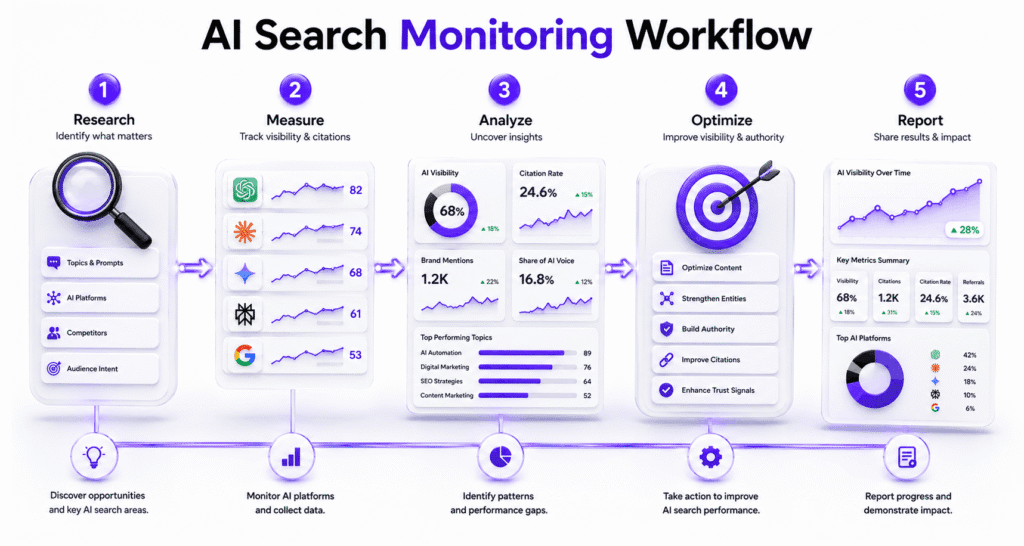
How to Build an AI Search Reporting Process
Collecting data without a process often leads to inconsistent reporting.
Successful businesses follow a structured workflow that allows them to monitor AI Search performance over time.
A practical monthly reporting process might look like this:
Step 1: Select Your Core Prompts
Choose approximately 100 important prompts related to your products, services, and industry.
Include different search intents:
- Informational
- Commercial
- Comparison
- Transactional
- Local
- Educational
This creates a representative sample of your AI Search landscape.
Step 2: Track Visibility Across AI Platforms
Test every prompt across:
- ChatGPT
- Google AI Overviews
- Claude
- Gemini
- Perplexity
Record:
- Brand appears
- Competitor appears
- No recommendation
- AI citations
- Source references
This provides a baseline for measuring Prompt Coverage and AI Share of Voice.
Step 3: Measure KPI Trends
Review your core AI Search KPIs, including:
- AI Share of Voice
- AI Citation Rate
- Prompt Coverage
- Brand Mentions
- Entity Presence
- Recommendation Rate
- AI Referral Traffic
Compare monthly results to identify growth or decline.
Step 4: Compare Competitors
Your analytics shouldn’t focus only on your own brand.
Review:
- Which competitors dominate AI recommendations
- Which prompts they own
- Which topics they cover better
- Which content formats perform well
Competitive analysis often reveals the fastest opportunities for improvement.
Step 5: Optimize Content
Use your findings to improve existing content.
Examples include:
- Expanding pillar pages
- Creating new supporting articles
- Adding FAQs
- Improving internal linking
- Strengthening entity signals
- Updating structured data
Analytics should guide content strategy—not simply report performance.
Step 6: Repeat Every Month
AI-generated search results evolve continuously.
Monthly reporting helps businesses identify changes before they impact visibility.
Consistent monitoring also makes it easier to measure the effectiveness of AI Search Optimization efforts.
Common AI Search Analytics Mistakes
Many organizations continue using reporting systems designed for traditional SEO.
This often creates blind spots in AI Search performance.
Avoid these common mistakes.
Tracking Google Rankings Only
Ranking reports no longer provide the complete picture.
Your business might rank highly in Google while remaining invisible across AI-powered search platforms.
Ignoring AI Assistants
Many companies never test ChatGPT, Claude, Gemini, or Perplexity.
This leaves significant visibility opportunities undiscovered.
Measuring Traffic Instead of Visibility
Not every AI interaction generates a website visit.
Measure how often your brand appears—not just how many visitors arrive.
Failing to Benchmark Competitors
Without competitor tracking, it’s impossible to know whether your AI visibility is improving relative to your market.
Always compare your performance with competing brands.
No Reporting Dashboard
Scattered spreadsheets make trend analysis difficult.
Centralize your AI Search KPIs in one reporting dashboard.
Focusing on Vanity Metrics
Traffic alone doesn’t measure AI success.
Instead, prioritize meaningful KPIs like:
- AI Citation Rate
- Prompt Coverage
- Recommendation Rate
- AI Share of Voice
- Entity Presence
These metrics provide a more accurate picture of AI Search performance.
Real-World Example
Imagine a digital marketing agency begins measuring AI Search Analytics.
Month 1
The team tracks 100 industry-related prompts across ChatGPT, Google AI Overviews, Claude, Gemini, and Perplexity.
Results:
- Brand appears in 18 prompts
- AI Citation Rate: 12
- AI Share of Voice: 14%
- Prompt Coverage: 18%
The analytics reveal several gaps.
Many AI assistants recommend competitors for topics such as:
- AI Search Visibility Metrics
- AI Search Dashboards
- AI Reporting
- Prompt Coverage
Optimization Phase
The agency responds by:
- Publishing comprehensive supporting articles
- Expanding its pillar content
- Improving internal linking
- Strengthening entity signals
- Adding FAQ Schema
- Updating older content
Month 2
The same 100 prompts are tested again.
Results:
- Brand appears in 43 prompts
- AI Citation Rate increases significantly
- AI Share of Voice nearly doubles
- Prompt Coverage grows from 18% to 43%
This demonstrates how AI Search Analytics helps businesses measure the real impact of their optimization efforts—not just traditional rankings.
The Future of AI Search Analytics
AI Search Analytics is evolving rapidly.
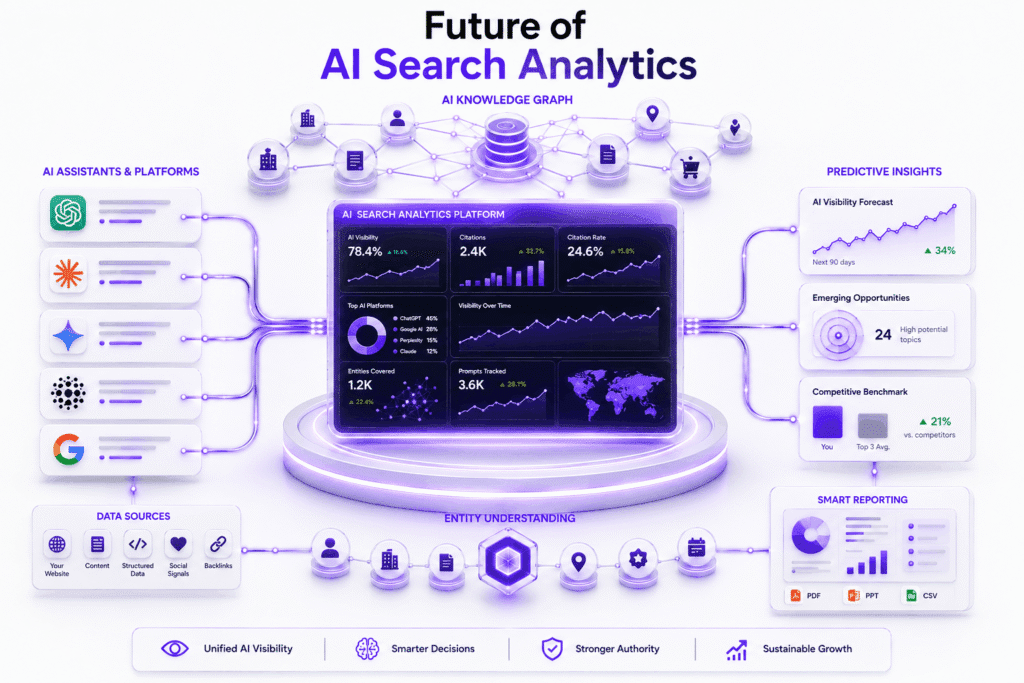
Over the next few years, businesses can expect more advanced measurement capabilities, including:
- Real-time AI visibility dashboards
- Predictive AI Search performance
- Automated prompt monitoring
- AI recommendation tracking
- Knowledge Graph monitoring
- Entity relationship analytics
- AI-generated competitive intelligence
- Cross-platform AI visibility reporting
Organizations that begin building AI Search Analytics systems today will be better prepared as AI-powered search becomes an increasingly important channel for customer discovery.
Conclusion
AI Search Analytics is quickly becoming an essential component of modern digital marketing. While traditional SEO metrics such as rankings, traffic, and conversions remain important, they no longer capture the full picture of how customers discover brands in AI-powered search.
By tracking AI-specific KPIs, building comprehensive reporting dashboards, monitoring competitors, and regularly analyzing AI-generated responses, businesses can make informed decisions that improve visibility across ChatGPT, Google AI Overviews, Claude, Gemini, Perplexity, and future AI platforms.
Frequently Asked Questions About AI Search Analytics
1. What is AI Search Analytics?
AI Search Analytics is the process of measuring how your brand appears across AI-powered search platforms like ChatGPT, Google AI Overviews, Claude, Gemini, and Perplexity. It tracks metrics such as AI citations, Prompt Coverage, AI Share of Voice, brand mentions, and recommendations to help businesses understand their AI Search performance.
2. How is AI Search Analytics different from Google Analytics?
Google Analytics measures website traffic, user behavior, and conversions after visitors arrive on your website. AI Search Analytics measures your brand’s visibility before users visit your site by tracking AI recommendations, citations, Prompt Coverage, and AI-generated mentions.
3. Which AI platforms should I monitor?
You should monitor the major AI-powered search platforms, including:
- ChatGPT
- Google AI Overviews
- Claude
- Gemini
- Perplexity
Monitoring multiple platforms provides a more complete view of your AI Search Visibility.
4. How often should I measure AI Search Visibility?
Most businesses should review AI Search Visibility at least once per month. Monthly reporting helps identify changes in Prompt Coverage, AI citations, competitor visibility, and recommendation trends while keeping your optimization strategy up to date.
5. What KPIs should be included in an AI Search Analytics dashboard?
A complete AI Search dashboard should include:
- AI Share of Voice
- AI Citation Rate
- Prompt Coverage
- Brand Mentions
- Entity Presence
- Recommendation Rate
- AI Referral Traffic
- AI Conversion Rate
- Competitor Visibility
- Monthly Visibility Trends
Together, these metrics provide a comprehensive view of your AI Search performance.
6. Can AI Search Analytics improve traditional SEO?
Yes. AI Search Analytics helps identify content gaps, improve topical authority, strengthen entity recognition, and optimize user-focused content. These improvements often benefit both AI Search Visibility and traditional organic search rankings.
7. What is AI referral traffic?
AI referral traffic refers to website visitors who arrive from AI-powered platforms such as ChatGPT, Google AI Overviews, Gemini, Claude, or Perplexity. Tracking this traffic helps measure how AI-generated recommendations contribute to website visits and conversions.
8. What is AI visibility reporting?
AI visibility reporting is the process of monitoring how often your brand appears, is cited, or is recommended across AI-generated responses. It combines AI Search KPIs into reports that help businesses evaluate performance and identify opportunities for improvement.
9. Which tools can track AI Search Analytics?
Businesses can combine several tools, including:
- Google Analytics 4
- Google Search Console
- Semrush AI Toolkit
- Peec AI
- Profound
- Otterly.AI
- Looker Studio
- Microsoft Power BI
Manual prompt testing across AI platforms is also an effective way to monitor AI Search Visibility.
10. How do I build an AI Search Analytics dashboard?
Start by defining the AI Search KPIs you want to measure, collect data from analytics tools and AI platforms, organize the information into a centralized dashboard, and review performance monthly. Your dashboard should track visibility, citations, Prompt Coverage, recommendations, competitor performance, and AI referral traffic.
11. Why is competitor tracking important in AI Search Analytics?
Competitor tracking helps you understand which brands dominate AI-generated responses, identify gaps in your content strategy, discover new optimization opportunities, and measure your AI Share of Voice against competing businesses.
12. What is the difference between AI Search Analytics and AI Search Visibility?
AI Search Visibility describes how often your brand appears across AI-powered search platforms. AI Search Analytics is the process of measuring, reporting, and analyzing that visibility using dashboards, KPIs, and performance data.
13. Can small businesses benefit from AI Search Analytics?
Absolutely. AI Search Analytics enables small businesses to measure AI visibility, discover new growth opportunities, improve content strategies, compete with larger brands, and increase their presence across AI-powered search platforms.
14. What are the biggest mistakes businesses make when measuring AI Search Analytics?
Some of the most common mistakes include:
- Tracking only Google rankings
- Ignoring AI-powered search platforms
- Measuring traffic without monitoring AI visibility
- Failing to benchmark competitors
- Publishing thin or outdated content
- Neglecting Prompt Coverage
- Not tracking AI citations or recommendations
- Skipping monthly performance reviews
15. Why is AI Search Analytics important for the future of digital marketing?
As AI-powered search continues to grow, businesses need more than traditional SEO reports to measure online success. AI Search Analytics provides insights into citations, recommendations, Prompt Coverage, and brand visibility, helping organizations adapt to the future of search and make data-driven marketing decisions.

Zack
Zack Robinson is a Digital Marketing Specialist at Revolute X Digital, specializing in SEO, Local SEO, Google Business Profile optimization, AI automation, and lead generation. He helps businesses improve their online visibility, attract qualified customers, and achieve sustainable growth through data-driven digital marketing strategies.