

Search engines have evolved dramatically over the past decade.
There was a time when SEO revolved around one primary goal—ranking keywords. Businesses optimized webpages by repeating target phrases, building backlinks, and improving technical SEO in hopes of appearing at the top of Google’s search results.
While keywords still play an important role, modern search engines and AI-powered platforms have become significantly more intelligent.
Today, Google, ChatGPT, Google AI Overviews, Claude, Gemini, Perplexity, and other AI systems don’t simply understand webpages—they understand entities.
An entity is a uniquely identifiable thing, such as a person, business, organization, product, service, location, or event. Rather than relying solely on keywords, AI systems connect these entities through massive knowledge graphs that describe how they relate to one another.
For example, when AI recognizes Revolute X Digital, it doesn’t only see a website.
It can also understand relationships such as:
- The company provides AI Search Optimization services.
- The company publishes SEO resources.
- The company specializes in Local SEO and AI Search.
- The business operates within the digital marketing industry.
- The website contains authoritative content about AI Search Visibility.
These relationships help AI systems determine whether your business is qualified to answer specific user questions.
This represents one of the biggest shifts in modern SEO.
Instead of asking:
“Which keyword should I rank for?”
Businesses should also ask:
“Does AI clearly understand who we are, what we do, and why we should be recommended?”
If AI cannot confidently identify your brand as a trusted entity, it becomes much more difficult for platforms like ChatGPT, Google AI Overviews, Claude, Gemini, and Perplexity to recommend your business—even if your content ranks well in traditional search results.
This is exactly why AI Entity SEO has become one of the most important foundations of AI Search Optimization.
Strong entity signals help AI systems connect your website, services, authors, social profiles, business listings, reviews, structured data, and brand mentions into a single, trusted digital identity.
The stronger your entity, the easier it becomes for AI platforms to:
- Understand your expertise
- Trust your content
- Recommend your business
- Connect your services with relevant searches
- Increase your visibility across AI-powered search platforms
As AI Search continues to evolve, businesses that invest in Entity SEO will be better positioned to build authority, improve AI recommendations, and strengthen their long-term online presence.
What Is AI Entity SEO?
AI Entity SEO is the process of optimizing your digital presence so AI-powered search engines clearly understand your business, brand, products, services, authors, and other important entities.
Unlike traditional SEO, which primarily focuses on keywords, Entity SEO focuses on building relationships between entities and helping search engines understand the context behind your content.
Rather than simply identifying words on a page, AI systems attempt to answer questions such as:
- Who owns this website?
- What services does this company provide?
- Which industry does this business belong to?
- Which topics does this brand specialize in?
- Is this business trustworthy?
- Is this entity connected to other authoritative entities?
The clearer these relationships become, the more confidently AI systems can recommend your business.
What Is an Entity?
An entity is any uniquely identifiable person, organization, place, product, service, event, or concept.
Examples include:
- A business
- A person
- A city
- A software product
- A brand
- A healthcare provider
- A restaurant
- A digital marketing agency
Unlike keywords, entities have meaning.
For example, “Apple” can refer to a fruit or a technology company.
AI uses contextual relationships to determine which entity a user intends.
This ability allows AI assistants to generate more accurate answers and recommendations.
What Is a Knowledge Graph?
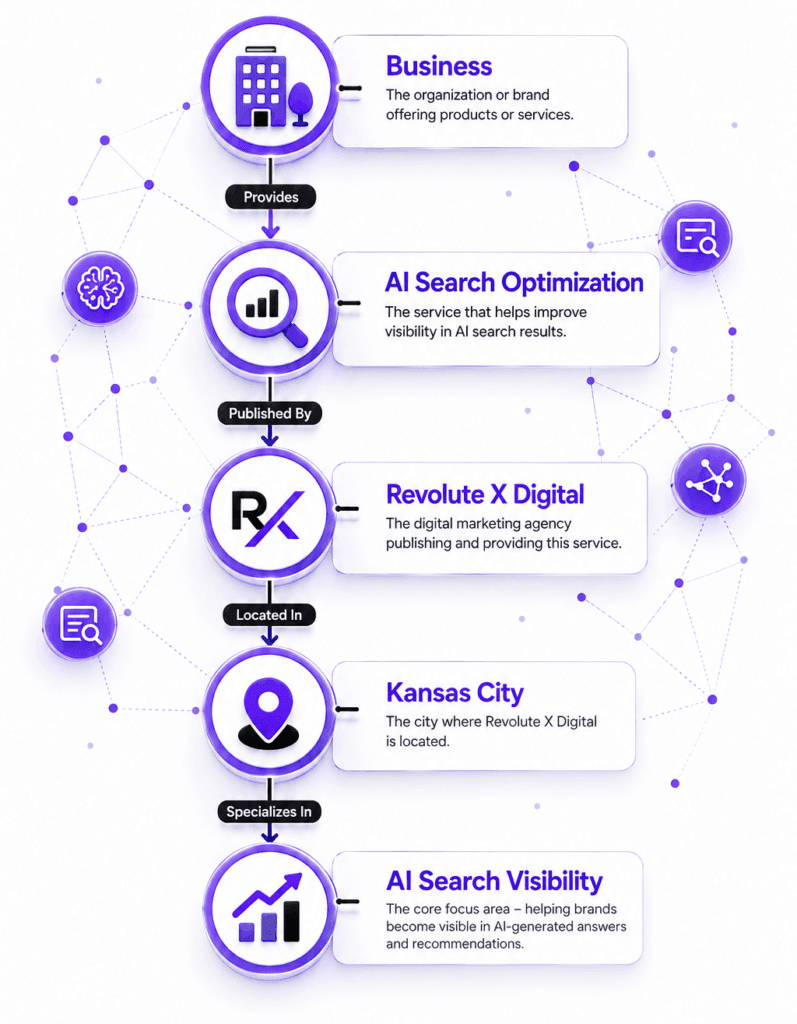
A Knowledge Graph is a structured database that connects entities and their relationships.
Instead of storing isolated pieces of information, a Knowledge Graph maps how entities interact with one another.
This interconnected structure helps AI understand context instead of relying on exact keyword matches.
Knowledge Graphs power many AI-generated search experiences by helping AI assistants identify trusted sources and relevant relationships.
What Is Entity Recognition?
Entity Recognition is the process AI systems use to identify and classify entities within content.
When AI reads a webpage, it attempts to determine:
- Who is being discussed?
- Which organization is mentioned?
- Which products are referenced?
- Which services are offered?
- Which locations are involved?
The more consistent your entity information is across the web, the easier it becomes for AI systems to recognize your business.
Strong entity recognition improves both AI Search Visibility and brand authority.
What Is Semantic Search?
Semantic Search focuses on understanding the meaning behind a user’s query rather than matching exact keywords.
For example, someone might search:
- Best AI SEO Agency
- AI Search Optimization Company
- Generative Engine Optimization Expert
- AI Visibility Consultant
Although each query uses different words, AI understands they share a similar intent.
Entity SEO strengthens this process by helping AI connect your business with related topics, services, industries, and customer needs.
Rather than optimizing for isolated keywords, businesses build semantic relationships that improve visibility across many conversational searches.
Why AI Entity SEO Matters
As AI-powered search becomes more sophisticated, Entity SEO is becoming one of the strongest indicators of digital authority.
Modern AI assistants don’t simply recommend websites—they recommend entities they understand and trust.
Builds AI Trust
Strong entities help AI platforms confidently recognize your business as a reliable source of information.
Trust is essential for AI-generated recommendations.
Improves AI Recommendations
Businesses with clear entity relationships are more likely to appear when users ask AI assistants for recommendations related to their expertise.
Strengthens Knowledge Graph Connections
Consistent entity information across your website, business profiles, structured data, and digital mentions helps AI connect your brand to larger knowledge graphs.
Enhances Entity Recognition
Clear entity signals reduce ambiguity and improve AI’s understanding of your business, services, products, and industry.
Increases Brand Authority
Entity SEO goes beyond rankings.
It establishes your business as a recognized authority that AI systems can confidently recommend across multiple search experiences.
AI Entity SEO Within the AI Search Visibility Metrics & KPIs Framework
AI Entity SEO is not an isolated optimization strategy.
It directly supports one of the most important metrics within the AI Search Visibility Metrics & KPIs framework:
Entity Presence.
Entity Presence measures how consistently AI platforms recognize, understand, and associate your brand across websites, structured data, business profiles, directories, social platforms, and AI-generated search results.
Strong Entity Presence positively influences other AI Search metrics, including:
- AI Share of Voice
- AI Citation Rate
- Prompt Coverage
- Brand Mentions
- Recommendation Rate
- AI Referral Traffic
Together, these KPIs provide a complete picture of your AI Search performance.
How AI Understands Entities and Why They Matter for AI Search
In traditional SEO, search engines primarily matched keywords to webpages.
Modern AI-powered search works differently.
Platforms like Google AI Overviews, ChatGPT, Claude, Gemini, and Perplexity attempt to understand the relationships between entities rather than simply matching words on a page.
Instead of asking:
“Does this page contain the keyword?”
AI asks questions such as:
- Who owns this website?
- What services does this business provide?
- Which industry does it belong to?
- Is this brand trustworthy?
- How is this business connected to other recognized entities?
The stronger these relationships become, the more confident AI systems are in recommending your business.
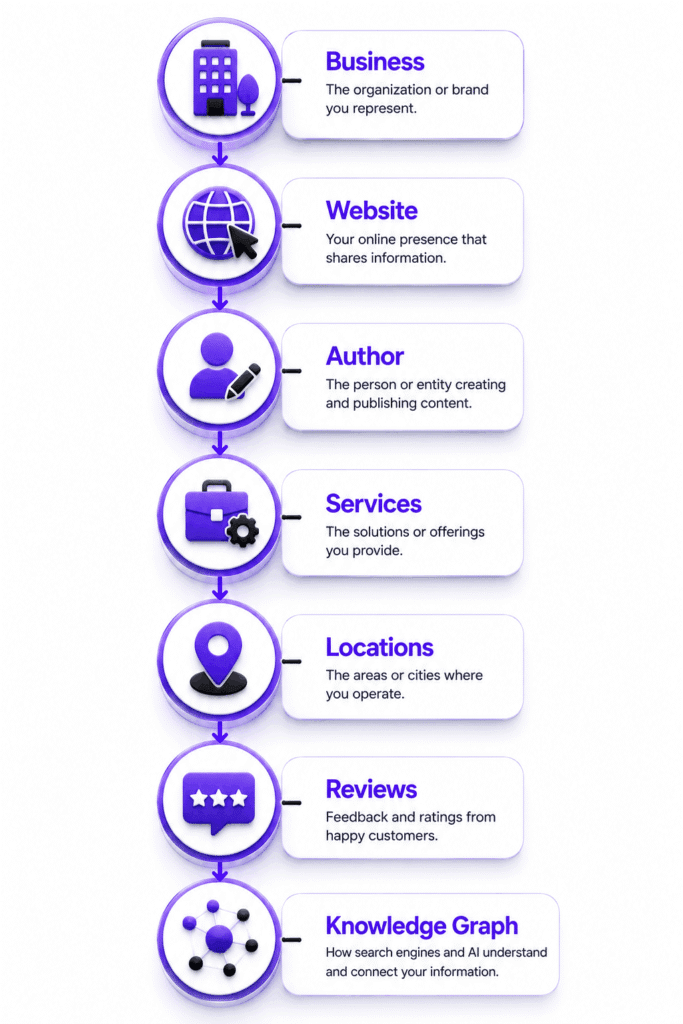
How AI Understands Entities
Think of AI as building a digital identity for every business.
Instead of viewing your website as a collection of pages, AI connects multiple sources of information to create one complete entity.
The process looks like this:
Business
        ↓
Website
        ↓
Author
        ↓
Services
        ↓
Locations
        ↓
Reviews
        ↓
Knowledge Graph
Each layer provides another piece of evidence about your business.
Business
Everything starts with your organization.
AI wants to understand:
- Company name
- Industry
- Services
- Products
- Brand identity
- Business purpose
A clearly defined business entity becomes the foundation for all other relationships.
Website
Your website acts as the primary source of information.
AI analyzes:
- Content
- Navigation
- Internal linking
- Service pages
- Blog articles
- Structured data
- Contact information
A well-organized website helps AI understand what your business actually specializes in.
Author
Author profiles have become increasingly important.
AI evaluates:
- Author expertise
- Credentials
- Experience
- Published articles
- Topic consistency
Consistent authorship strengthens EEAT and improves trust.
Services
AI connects businesses to their services.
For example:
These relationships help AI determine when your business is relevant for specific searches.
Locations
Location information helps AI understand geographic relevance.
Examples include:
- Google Business Profile
- Address
- Service areas
- City pages
- Local citations
Strong location signals improve local AI recommendations.
Reviews
Reviews reinforce trust.
AI evaluates:
- Review consistency
- Overall sentiment
- Review platforms
- Business reputation
Positive reviews strengthen entity credibility.
Knowledge Graph
Finally, all these signals contribute to a broader Knowledge Graph.
Instead of viewing isolated webpages, AI understands an interconnected entity with relationships to services, industries, locations, authors, and customers.
The stronger these relationships become, the easier it is for AI systems to recommend your business.
Types of Entities
Modern AI systems recognize many different entity types.
Understanding these entities helps businesses create stronger optimization strategies.
People
People include:
- Authors
- Founders
- CEOs
- Industry experts
- Team members
Connecting expert authors to your content strengthens credibility.
Organizations
Organizations include:
- Companies
- Government agencies
- Universities
- Nonprofits
- Associations
AI uses organizational entities to understand authority.
Businesses
Businesses represent commercial organizations.
Examples include:
- Digital marketing agencies
- Law firms
- Restaurants
- SaaS companies
- Healthcare providers
Business entities are central to local and AI Search.
Products
Products include:
- Software
- Physical products
- Digital downloads
- Applications
- Platforms
Product entities help AI answer product-specific questions.
Services
Services describe what a business provides.
Examples include:
- AI Search Optimization
- Local SEO
- PPC Management
- Website Design
- Content Marketing
Clear service entities improve recommendation accuracy.
Locations
Locations include:
- Cities
- States
- Countries
- Service areas
- Office locations
Strong location entities improve geographic relevance.
Events
Events include:
- Conferences
- Webinars
- Workshops
- Product launches
- Industry events
Events help AI connect brands with industry activities.
Brands
Brands are unique commercial identities.
Examples:
- Revolute X Digital
- Microsoft
- Adobe
AI recognizes brands as entities with relationships to products, services, and industries.
How Entity Recognition Works
Entity Recognition is the process AI uses to connect information from multiple sources.
Rather than relying on one webpage, AI validates your business across the web.
A simplified workflow looks like this:
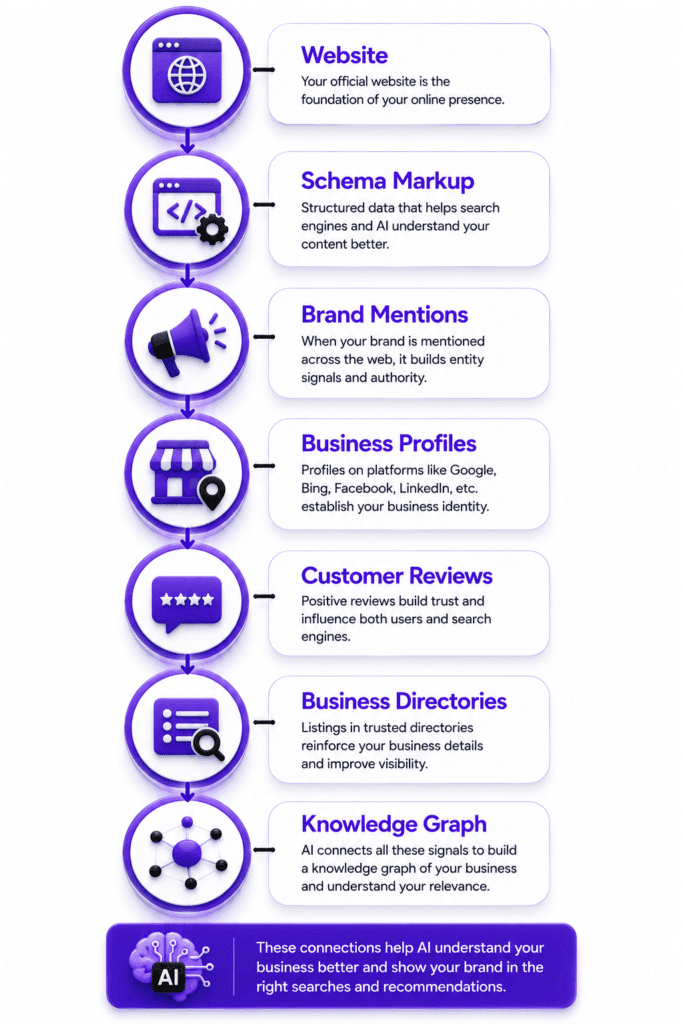
Each connection increases confidence.
For example:
Your website states you provide AI Search Optimization.
↓
Organization Schema confirms your company information.
↓
Google Business Profile lists the same business name.
↓
LinkedIn describes the same services.
↓
Industry directories repeat the same information.
↓
Customer reviews mention AI Search services.
↓
AI now confidently understands your business entity.
This consistency strengthens your overall AI visibility.
Understanding Semantic Relationships
Entity SEO isn’t only about identifying businesses.
It’s also about understanding how those entities relate to broader topics.
A simplified semantic relationship looks like this:
Business
      ↓
Primary Topic
      ↓
Subtopics
      ↓
Services
      ↓
Audience
      ↓
Search Intent
For example:
Revolute X Digital
↓
↓
Entity SEO
↓
Consulting
Technical SEO
↓
Business Owners
Marketing Teams
SEO Professionals
↓
Learn
Compare
Buy
Hire
Modern AI understands these relationships rather than treating each keyword independently.
This allows businesses to appear across a wider variety of conversational searches.
Keywords vs. Entities
One of the biggest differences between traditional SEO and AI Search is the shift from keywords to entities.
| Traditional Keyword SEO | AI Entity SEO |
|---|---|
| Focuses on keywords | Focuses on entities and relationships |
| Matches exact phrases | Understands context and meaning |
| Individual webpages | Connected knowledge graphs |
| Ranking specific keywords | Building topic authority |
| Search intent by keyword | Search intent through semantic understanding |
| Backlinks are primary signals | Entity relationships and trust signals are equally important |
| Optimizes isolated pages | Builds interconnected content ecosystems |
| Primarily search engine focused | Designed for both search engines and AI assistants |
Keywords are still valuable, but entities provide the context that allows AI systems to understand who you are, what you offer, and why your business should be recommended.
Related Reading: Entity Presence is one of the core metrics within our AI Search Visibility Metrics & KPIs framework. Combined with AI Citation Rate, Prompt Coverage, AI Share of Voice, and AI Search Analytics, it helps measure how effectively AI platforms understand and recommend your brand.
How to Build Strong Entity SEO for AI Search
Entity SEO isn’t about adding one piece of Schema Markup or claiming your Google Business Profile. It’s about creating a consistent digital identity that AI systems can understand, verify, and trust.
Think of Entity SEO as building a complete profile of your business across the internet. Every website, social profile, citation, review, author page, and piece of structured data becomes another signal that helps AI assistants confidently recognize your brand.
The stronger these signals become, the more likely AI-powered platforms are to recommend your business.
How to Build Strong Entity SEO
1. Implement Organization Schema
Organization Schema tells search engines exactly who your business is.
It should include:
- Business name
- Logo
- Website
- Contact information
- Social profiles
- SameAs links
- Founding date (if applicable)
This structured data helps connect your website to your brand entity and reduces ambiguity.
2. Add Person Schema
If your website publishes educational content, author credibility matters.
Every author should have:
- Full name
- Professional title
- Biography
- Experience
- Social profiles
- Company association
Modern AI systems evaluate authors as entities, not just businesses.
Strong author entities improve EEAT while increasing trust.
3. Use Service Schema
Every major service should include structured data describing:
- Service name
- Description
- Service area
- Provider
- Category
For example:
AI Search Optimization
↓
Provided By
↓
Revolute X Digital
This relationship helps AI understand exactly what your company offers.
4. Publish FAQ Schema
FAQs naturally answer conversational questions.
Because AI assistants frequently answer similar prompts, FAQ Schema helps reinforce semantic relationships while improving content understanding.
Every major service page should include helpful FAQs written for real customers.
5. Use Article Schema
Every blog post should include Article or BlogPosting Schema.
This helps AI understand:
- Author
- Publisher
- Publication date
- Topic
- Images
- Headline
Combined with Organization and Person Schema, Article Schema strengthens the relationship between your content and your business entity.
6. Maintain Brand Consistency
One of the strongest Entity SEO signals is consistency.
Your business name, logo, phone number, website, and branding should remain consistent across every online platform.
Inconsistent branding creates confusion.
Consistent branding builds confidence.
7. Optimize Your Google Business Profile
Google Business Profile remains one of the strongest entity signals available.
A complete profile should include:
- Accurate business information
- Categories
- Services
- Photos
- Reviews
- Business description
- Service areas
- Website
Your Google Business Profile reinforces the connection between your website, business, and local entity.
8. Build Trusted External Profiles
Authoritative profiles help AI verify your business.
Important examples include:
- Crunchbase (where appropriate)
- Industry associations
- Professional organizations
- Local business directories
These trusted sources strengthen your entity relationships.
9. Build High-Quality Business Citations
Business directories continue to play an important role.
Focus on:
- Consistent NAP
- Accurate website URL
- Correct categories
- Updated descriptions
Quality matters far more than quantity.
10. Strengthen Your Social Profiles
AI increasingly connects brands across multiple platforms.
Maintain active, consistent profiles on relevant social networks using the same:
- Business name
- Logo
- Website
- Description
These profiles reinforce your digital identity.
11. Create Detailed Author Pages
Author pages demonstrate expertise.
Include:
- Biography
- Credentials
- Areas of expertise
- Published articles
- Social links
- Company information
This strengthens both author entities and overall EEAT.
12. Build Strong Internal Linking
Entity relationships exist inside your own website.
For example:
AI Search Visibility Metrics & KPIs
↓
AI Citation Rate
↓
Prompt Coverage
↓
AI Search Analytics
↓
AI Entity SEO
↓
AI Share of Voice
Strong internal linking helps AI understand topic relationships and strengthens your content ecosystem.
13. Create Topic Clusters
Instead of publishing isolated articles, organize your content into connected topical clusters.
Example:
AI Search Visibility
↓
Metrics
↓
Analytics
↓
Prompt Coverage
↓
Citation Rate
↓
Entity SEO
↓
Knowledge Graph
↓
Brand Authority
AI recognizes these relationships and develops greater confidence in your expertise.
14. Earn Brand Mentions
AI doesn’t rely only on links.
Mentions across trusted websites help validate your entity.
Examples include:
- Guest articles
- Industry interviews
- Podcasts
- News features
- Research reports
- Community discussions
Consistent brand mentions strengthen authority.
15. Invest in Digital PR
Digital PR is becoming increasingly valuable for Entity SEO.
Coverage from authoritative publications strengthens:
- Trust
- Entity recognition
- Brand authority
- Knowledge Graph relationships
High-quality mentions often have a greater long-term impact than acquiring low-quality backlinks.
16. Build Knowledge Panel Eligibility
Although not every business qualifies for a Google Knowledge Panel, building a strong entity increases your chances over time.
Knowledge Panels are influenced by:
- Structured data
- Trusted citations
- Brand consistency
- High-authority mentions
- Strong entity relationships
The stronger your digital footprint, the easier it becomes for search engines to recognize your business as a distinct entity.
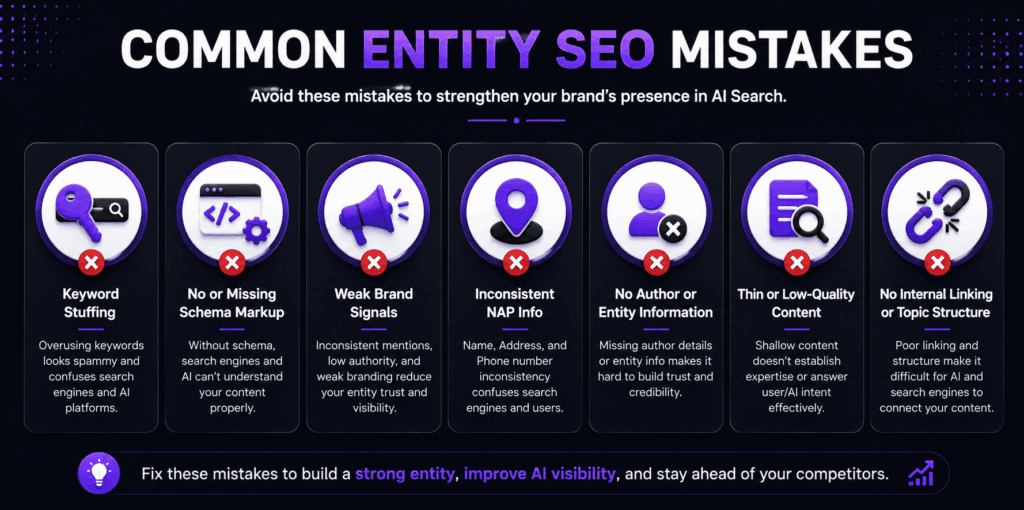
Common Entity SEO Mistakes
Many businesses unknowingly weaken their entity signals.
Avoid these common mistakes.
Keyword Stuffing
Modern AI understands context.
Repeating keywords excessively makes content less useful and does not strengthen your entity.
Missing Schema Markup
Without structured data, AI receives fewer signals about your business.
Schema helps connect your website to your entity.
Weak Branding
Using different logos, company names, or descriptions across platforms creates confusion.
Maintain a consistent identity everywhere.
Inconsistent NAP Information
Different business names, addresses, or phone numbers reduce trust.
Keep your NAP identical across every platform.
No Author Information
Anonymous content is harder to trust.
Clear author profiles strengthen expertise and authority.
Weak Entity Relationships
Publishing isolated pages without connecting related topics limits AI’s understanding of your expertise.
Build topical clusters with strategic internal linking.
Thin Content
Short, generic articles rarely establish authority.
Create comprehensive, experience-driven resources that fully answer user questions.
Duplicate Business Profiles
Multiple inconsistent listings can fragment your entity and confuse search engines.
Audit your online profiles regularly and remove duplicate or outdated listings.
Real-World Example
Imagine two digital marketing agencies competing for AI visibility.
Business A
- Website only
- Basic homepage
- No Schema
- Few blog posts
- No author pages
- Limited reviews
- Minimal online presence
↓
Weak Entity
AI has very little evidence to understand or trust this business.
Business B
- Professional website
- Google Business Profile
- Organization Schema
- Person Schema
- Service Schema
- Comprehensive blog
- Expert author profiles
- Strong internal linking
- Positive customer reviews
- Active LinkedIn profile
- Business directory citations
- Industry mentions
- Digital PR coverage
↓
Strong Entity
↓
AI confidently understands:
- Who the business is
- What services it provides
- Where it operates
- Which topics it specializes in
- Why it is trustworthy
The Future of Entity SEO
Entity SEO will become even more important as AI-powered search evolves.
Several emerging trends are already shaping the future.
AI Agents
Autonomous AI agents will increasingly rely on verified entities when researching businesses and making recommendations.
Knowledge Graph Expansion
Knowledge Graphs will continue growing as AI systems connect more entities, relationships, and contextual information.
Entity-First Search
Future search experiences will prioritize understanding entities before matching keywords.
Businesses with strong entity signals will have a competitive advantage.
Personal AI Assistants
Personal AI assistants will recommend brands based on trust, authority, and entity relationships rather than simple keyword relevance.
AI Recommendations
As recommendation engines become more sophisticated, recognized entities will appear more frequently across AI-generated answers.
Brand Authority
Strong entity recognition will become one of the most valuable digital assets a business can build.
Brands that consistently demonstrate expertise, trustworthiness, and topical authority will be better positioned for long-term success.
Conclusion
AI Entity SEO is rapidly becoming one of the most important foundations of modern AI Search Optimization. While traditional SEO focuses on keywords and rankings, Entity SEO helps AI systems understand who your business is, what you offer, and why your brand deserves to be trusted.
By implementing structured data, maintaining consistent branding, optimizing your Google Business Profile, creating expert author pages, building topical content clusters, strengthening internal linking, and earning authoritative brand mentions, you create a strong digital entity that AI assistants can confidently recognize and recommend.
As AI-powered search continues to evolve, businesses that invest in Entity SEO today will build stronger Knowledge Graph connections, increase AI visibility, improve recommendation rates, and establish lasting authority across platforms like ChatGPT, Google AI Overviews, Claude, Gemini, and Perplexity.
The future of search is becoming entity-first, and the brands that build the strongest entities will have the greatest opportunity to lead in AI Search.
Frequently Asked Questions About AI Entity SEO
1. What is AI Entity SEO?
AI Entity SEO is the process of optimizing your business, website, authors, products, and services so AI-powered search engines clearly understand who you are and what you offer. Instead of relying only on keywords, AI Entity SEO builds strong entity relationships that help platforms like Google AI Overviews, ChatGPT, and Gemini confidently recommend your brand.
2. What is an entity in SEO?
An entity in SEO is a uniquely identifiable person, business, organization, product, service, location, or concept that search engines can recognize and understand independently of keywords. Entities help AI interpret meaning, context, and relationships between different pieces of information.
3. What are entities, and why do they matter for SEO?
Entities matter because modern search engines use them to understand topics rather than simply matching keywords. Strong entity signals help search engines and AI assistants determine your expertise, improve content relevance, strengthen topical authority, and increase the likelihood of your business appearing in AI-generated recommendations.
4. How does Google identify entities?
Google identifies entities by analyzing multiple signals, including structured data (Schema Markup), website content, Google Business Profile information, business directories, social profiles, backlinks, author pages, reviews, and mentions across trusted websites. These signals are connected through Google’s Knowledge Graph to better understand your business.
5. What is a Knowledge Graph?
A Knowledge Graph is a database that connects entities and their relationships. Instead of viewing webpages individually, search engines organize information about businesses, people, products, services, and locations into a connected network that helps AI generate more accurate and relevant search results.
6. Does Schema Markup improve AI Entity SEO?
Yes. Schema Markup helps search engines understand important information about your business, services, authors, FAQs, and articles. While Schema alone won’t improve rankings, it strengthens entity recognition and makes it easier for AI systems to understand your website.
7. Is AI Entity SEO different from traditional SEO?
Yes. Traditional SEO focuses primarily on keywords, backlinks, and rankings. AI Entity SEO focuses on building a recognizable and trustworthy digital identity by connecting your business, content, authors, services, and online profiles into a strong entity that AI systems can understand and recommend.
8. How do AI assistants understand businesses?
AI assistants understand businesses by analyzing multiple sources of information, including website content, structured data, Google Business Profiles, reviews, social media, business directories, author profiles, and external mentions. The more consistent these signals are, the more confidently AI can recognize your business as a trusted entity.
9. What are entity relationships?
Entity relationships describe how different entities are connected. For example, a business is connected to its services, authors, locations, customers, reviews, and industry. These relationships help AI understand context and determine when your business is relevant to a user’s search.
10. Can AI Entity SEO improve AI Search Visibility?
Absolutely. Strong Entity SEO improves AI Search Visibility by helping platforms like ChatGPT, Google AI Overviews, Claude, Gemini, and Perplexity recognize your expertise and recommend your business in relevant AI-generated responses. It also supports metrics such as AI Citation Rate, Prompt Coverage, and AI Share of Voice.
11. What is brand entity optimization?
Brand entity optimization is the process of making your brand consistently recognizable across your website and the web. This includes using consistent business information, implementing structured data, maintaining active business profiles, earning trusted mentions, and publishing authoritative content that reinforces your brand identity.
12. How do I build a strong entity for AI Search?
Build a strong entity by creating high-quality topical content, implementing Organization and Person Schema, maintaining consistent branding, optimizing your Google Business Profile, earning customer reviews, publishing expert author pages, building topic clusters, and obtaining mentions from trusted industry websites.
13. Does Google Business Profile help AI Entity SEO?
Yes. Google Business Profile is one of the strongest entity signals available for local businesses. A fully optimized profile with accurate business information, services, categories, reviews, photos, and regular updates helps Google and AI systems verify your business and improve local AI recommendations.
14. What is Entity Authority?
Entity Authority refers to the level of trust and expertise AI systems associate with your business or brand. It is built through consistent entity signals, authoritative content, structured data, brand mentions, quality backlinks, expert authors, reviews, and topical authority across your niche.
15. Why are brand mentions important for Entity SEO?
Brand mentions help validate your business across the web. When reputable websites, publications, directories, podcasts, or industry resources mention your brand, AI systems gain additional confidence that your business is legitimate and authoritative, strengthening your overall entity.
16. How does AI Entity SEO affect AI Search?
AI Entity SEO directly influences how AI-powered search engines understand and recommend your business. Strong entity signals improve recognition, trust, topical authority, and Knowledge Graph relationships, making your brand more likely to appear in AI-generated answers, citations, and recommendations across modern AI search platforms.

Zack
Zack Robinson is a Digital Marketing Specialist at Revolute X Digital, specializing in SEO, Local SEO, Google Business Profile optimization, AI automation, and lead generation. He helps businesses improve their online visibility, attract qualified customers, and achieve sustainable growth through data-driven digital marketing strategies.