
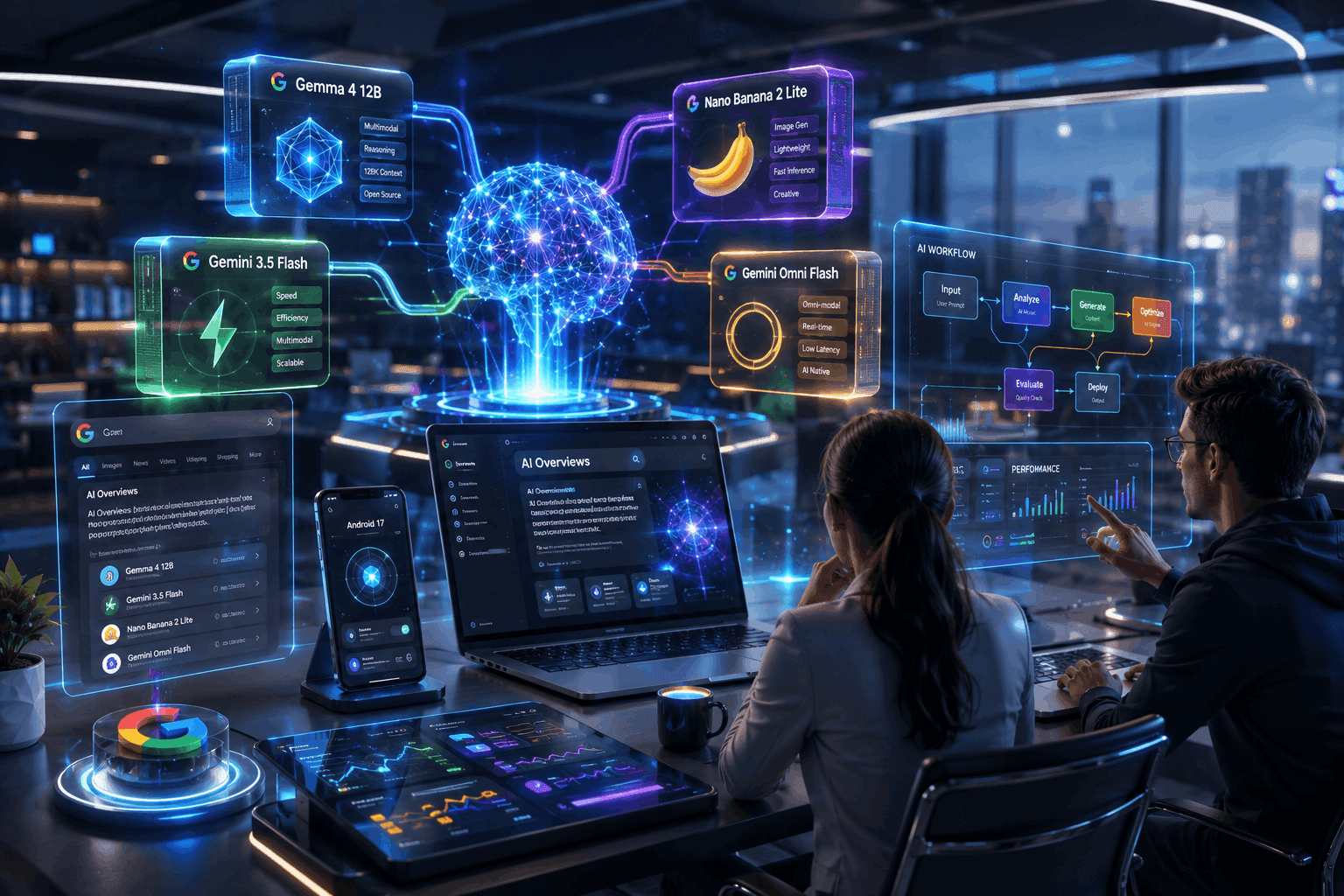
Google Latest AI Updates: What They Mean for Businesses, Developers, and the Future of Search
Artificial intelligence is no longer just a feature—it’s becoming the foundation of how people work, search, communicate, and build software.
Google’s latest AI announcements demonstrate a clear shift toward creating a connected ecosystem where AI works seamlessly across devices, applications, and workflows. Rather than requiring users to switch between multiple tools, Google is embedding AI directly into everyday experiences.
From powerful local AI models running on consumer laptops to intelligent software agents capable of performing complex tasks, these innovations signal the next stage of AI adoption for businesses and developers alike.
Here’s a closer look at Google’s newest AI technologies and what they mean for the future.
AI Is Becoming Your Everyday Digital Assistant
Google’s latest vision focuses on making AI feel less like a chatbot and more like an intelligent assistant that works quietly in the background.
Instead of asking AI to complete isolated tasks, users will increasingly rely on AI to:
- Organize schedules
- Automate repetitive work
- Analyze information
- Create content
- Manage workflows
- Assist with software development
- Support decision-making
Whether you’re running a small business, studying for exams, or managing enterprise operations, Google’s goal is to reduce complexity so you can focus on meaningful work.
Gemma 4 12B Brings Powerful AI to Local Devices
One of the most exciting announcements is Gemma 4 12B, Google’s newest open AI model.
Unlike many AI systems that depend entirely on cloud computing, Gemma 4 12B is designed to run locally on laptops with as little as 16GB of memory.
This offers several important advantages.
Improved Privacy
Since the model runs directly on your computer, sensitive business information can remain on your device instead of being processed in the cloud.
This is especially valuable for organizations working with confidential client data or regulated industries.
Faster Performance
Local processing reduces network delays, making AI interactions faster and more responsive.
Multimodal Intelligence
Gemma 4 12B combines several capabilities into a single model, including:
- Vision understanding
- Native voice processing
- Advanced reasoning
- Intelligent agents
This unified architecture allows developers to create more capable AI applications without relying on multiple separate systems.
Gemini 3.5 Flash Introduces Computer Use
Google has expanded Gemini 3.5 Flash with a powerful new capability known as computer use.
Instead of simply answering questions, AI can now interact with desktop applications, browsers, and mobile interfaces to complete tasks.
Examples include:
- Filling out forms
- Navigating websites
- Testing software
- Managing repetitive workflows
- Assisting customer support teams
- Performing research
- Automating administrative tasks
This moves AI closer to functioning as a true digital employee rather than just an intelligent assistant.
Better Automation for Businesses
Business automation has traditionally required expensive software integrations and custom development.
AI-powered computer use changes that.
Instead of building complex automation workflows manually, businesses can develop intelligent agents capable of:
- Reading documents
- Understanding business processes
- Completing repetitive actions
- Monitoring software
- Supporting internal operations
For small businesses with limited resources, this opens the door to automation that was previously available only to large enterprises.
Nano Banana 2 Lite Makes AI Image Generation Faster
Google also introduced Nano Banana 2 Lite, its fastest and most cost-efficient Gemini image model to date.
Developers can now generate, edit, and refine AI-generated images more quickly while reducing operational costs.
Potential business applications include:
- Social media graphics
- Product mockups
- Marketing visuals
- Advertising creatives
- Website illustrations
- Brand concepts
Lower costs make AI-powered design accessible to businesses of every size.
Gemini Omni Flash Expands Multimodal AI
Another significant announcement is the public preview of Gemini Omni Flash APIs.
Unlike traditional AI models that focus primarily on text, Gemini Omni Flash is natively multimodal.
Developers can build applications that understand and generate:
- Text
- Images
- Audio
- Video
This creates exciting opportunities for:
- Interactive learning platforms
- AI-powered video creation
- Customer support applications
- Content generation tools
- Marketing automation
- Enterprise knowledge systems
As multimodal AI continues evolving, businesses will be able to deliver richer customer experiences using a single integrated platform.
What These Updates Mean for Digital Marketing
Although many of these announcements target developers, marketers should pay close attention.
AI-powered search is becoming increasingly capable of understanding business entities, customer intent, and content quality.
Businesses that invest in:
- Helpful content
- Strong topical authority
- Accurate business information
- Technical SEO
- Structured data
- High-quality user experiences
will be better positioned as AI continues reshaping search results.
The days of relying solely on keyword optimization are fading. Modern SEO increasingly rewards businesses that demonstrate expertise, trustworthiness, and genuine value.
Preparing Your Business for Google’s AI Future
Businesses don’t need to adopt every new AI technology immediately.
Instead, focus on building a strong digital foundation.
Prioritize:
- A fast, secure website
- Helpful, original content
- A complete Google Business Profile
- Strong customer reviews
- Consistent branding
- AI-friendly website architecture
- Structured data implementation
These fundamentals will remain valuable regardless of how AI continues to evolve.
Final Thoughts
Google’s latest AI announcements highlight a future where artificial intelligence is deeply integrated into everyday work rather than existing as a separate tool.
From locally running AI models like Gemma 4 12B to intelligent computer-use agents and multimodal APIs, Google is giving businesses and developers new ways to automate work, improve productivity, and build smarter digital experiences.
For business owners, the takeaway is clear: preparing for AI isn’t just about adopting new tools—it’s about creating trustworthy digital assets that AI systems can understand, recommend, and build upon.
At Revolute X Digital, we help businesses stay ahead of emerging technologies by combining Local SEO, AI search optimization, technical SEO, and content strategies designed for the next generation of search. As Google’s AI ecosystem continues to evolve, businesses that adapt early will be best positioned for long-term success.

Jason
We are an Affordable Digital Marketing Agency in Shawnee with budget-friendly solutions to amplify your brand. Elevate your business without compromising quality or cost.