
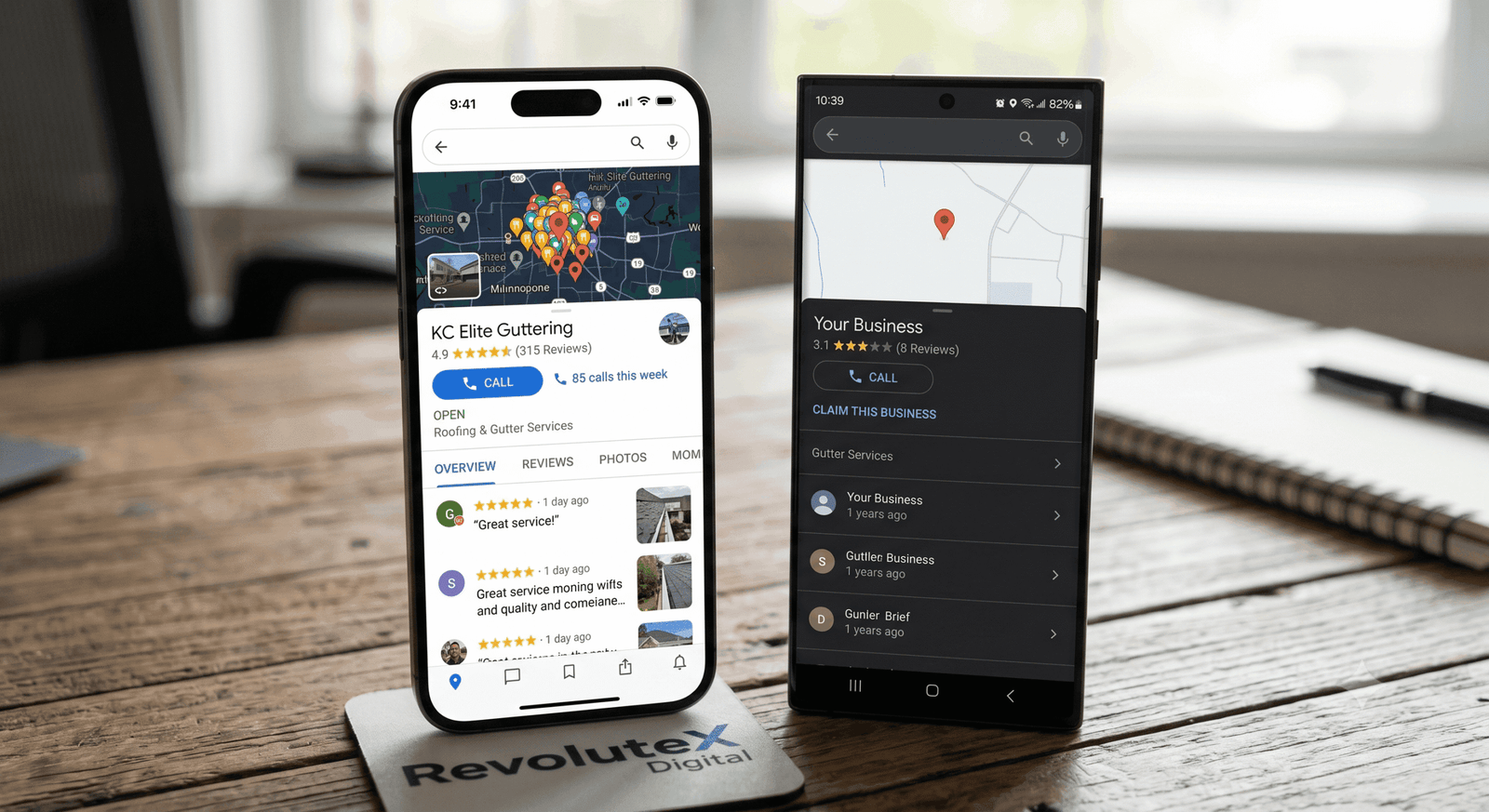
You know the feeling. You Google your own service — “plumber near me,” “digital marketing agency Kansas City,” “electrician Shawnee KS” — and there they are. Your competitor. Phone number front and center. Reviews stacking up. Calls rolling in. And you’re nowhere to be found.
This isn’t bad luck. It’s a fixable gap. And in this post, we’re going to do a real audit — the exact same process we run for clients at RevoluteX Digital — to pinpoint exactly why your competitor is winning Google’s phone calls and what you can do about it today.
The good news: most businesses losing in local search are losing for the same 7 reasons. None of them require a massive budget to fix. They require attention, consistency, and knowing what to look for.
Let’s get into it.
First: Understand How Google Decides Who Gets the Calls
Before you can fix the problem, you need to understand the game. Google’s local search algorithm — the one that decides who appears in the Map Pack (those top 3 results with the phone number, address, and reviews) — runs on three core pillars:
| Pillar | What It Means | What Google Checks |
|---|---|---|
| Relevance | Does your business match what the searcher wants? | Business category, keywords in profile, services listed, website content |
| Distance | How close are you to the searcher? | Physical address, service area settings, proximity to search location |
| Prominence | How well-known and trusted is your business? | Reviews, backlinks, citations, website authority, engagement signals |
Your competitor isn’t cheating. They’ve simply scored higher across these three pillars — often without even realizing exactly what they did right. Your job is to close those gaps methodically. Here’s how to find them.
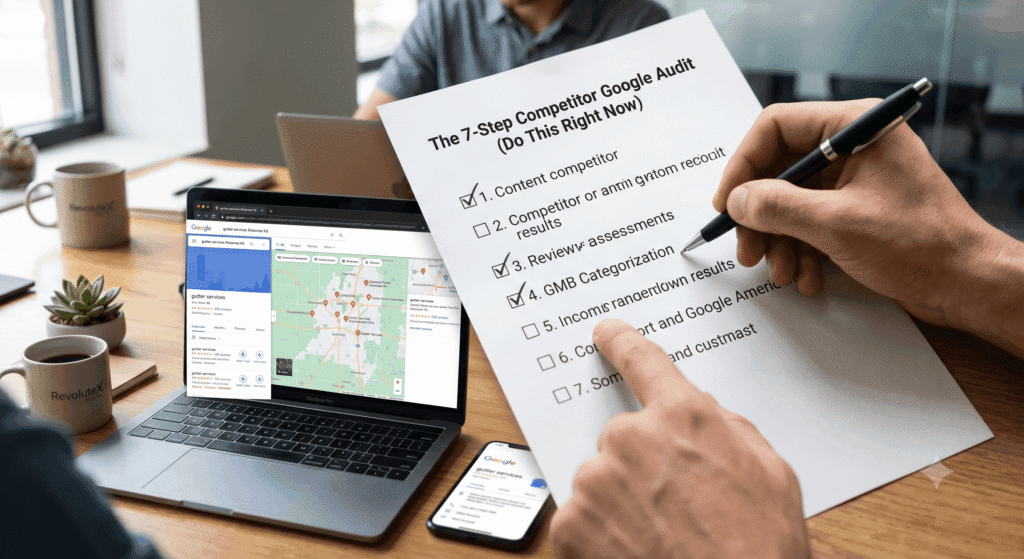
The 7-Step Competitor Google Audit (Do This Right Now)
Open Google in a new tab. Search for your main service + your city. Look at who’s in the top 3 map results. Now run through each of these steps comparing their profile to yours.
Google Business Profile: Are They More Complete Than You?
Click on your competitor’s Google Business Profile. Then open yours. Compare them side by side across every field:
- Business name — do they have a relevant keyword naturally in theirs?
- Primary category — is theirs more specific than yours?
- Secondary categories — how many do they have listed?
- Services — have they filled out every individual service with descriptions?
- Business description — is it keyword-rich and over 250 words?
- Photos — how many photos do they have? How recent?
- Posts — are they posting weekly updates, offers, or events?
- Q&A section — have they seeded their own questions and answers?
- Attributes — have they selected every applicable attribute (veteran-owned, women-led, LGBTQ+ friendly, etc.)?
Fix: Profile completeness is a direct ranking signal. Google has confirmed that incomplete profiles consistently underperform in local pack results. Fill every single field. Add 20+ photos (interior, exterior, team, work examples). Post at minimum once per week. Seed 5–10 Q&A entries yourself — they appear publicly and influence both ranking and click-through rate.
Business Category: Are They Telling Google Exactly What They Do?
Your primary business category is one of the single most powerful local ranking signals that exists. It functions as a filter — Google uses it to decide whether your business is even relevant for a given search.
⚠️ Real example: A personal injury attorney listing their primary category as “Lawyer” instead of “Personal Injury Attorney” is essentially invisible for high-intent searches — even with hundreds of reviews.
Check what primary category your top 3 competitors are using. If all three are using a more specific category than you, that single fix can move you multiple positions in the map pack.
Fix: Go to your Google Business Profile → Edit profile → Business category. Switch your primary category to the most specific, high-intent option available. Add 3–5 secondary categories that cover your other services. Audit competitors’ categories every quarter — the available options in Google’s category library are updated regularly.
Reviews: Are They Beating You on Volume, Recency, and Content?
Reviews are the highest-weighted prominence signal in Google’s local algorithm in 2026 — and they now do double duty: they influence your ranking AND they feed Google’s AI summaries of your business.
📊 Key benchmark: A rating below 4.0 actively suppresses your local visibility. Between 4.0–4.4 is competitive. Above 4.5 is a ranking advantage. And recency matters enormously — 5 reviews from last month outweigh 80 reviews where the most recent was 9 months ago.
For your competitor audit, check:
- Total review count — how far ahead are they?
- Most recent review date — are they getting reviews consistently?
- Average star rating — what’s the gap?
- Review content — do their reviews mention specific services, locations, and outcomes? (Google reads and extracts themes from review text.)
- Response rate — are they responding to every review, including negative ones?
Fix: Build a review velocity system — not a review blast. Ask every single customer immediately after a completed job via SMS or email with a direct Google review link. Aim for 3–5 new reviews per month minimum. Respond to every review within 48 hours (this signals engagement to Google). Ask customers to mention the specific service and city in their review — “They did an amazing electrical panel upgrade in Shawnee, KS” is far more valuable than “Great service!”
Step 4 of 7
NAP Consistency: Is Your Name, Address & Phone Identical Everywhere?
NAP stands for Name, Address, Phone — and consistency across every online mention of your business is a foundational trust signal for Google. Even minor variations create confusion in Google’s data systems and suppress your local ranking.
Common problems we find in audits:
- “St.” on Google vs. “Street” on Yelp
- Old phone number still listed on a directory from 2019
- Business name abbreviated differently across platforms
- Two different addresses (old location + new location) both still live
- Suite number missing from some listings
Fix: Create a “Master NAP” document with the exact, definitive version of your business name, address, and phone. Then audit every citation — Google Business Profile, Yelp, BBB, Apple Maps, Bing Places, your own website footer, industry directories — and update every mismatch. Use BrightLocal or Whitespark to surface listings you don’t even know exist. Never delete old listings — update them, as deletion can create duplicate confusion.
Website: Does Your Site Speak “Local” to Google?
Your Google Business Profile and your website are connected signals. A strong GBP with a weak website — or a website that never mentions your city, neighborhood, or service area — limits how far your local rankings can climb.
Check your competitor’s website for these local SEO signals that your site may be missing:
- City + service keyword in the homepage title tag (e.g., “Plumber in Kansas City, KS | Smith Plumbing”)
- Embedded Google Map on the contact page
- Dedicated service area pages for each city they serve
- Local schema markup (LocalBusiness JSON-LD) in the website code
- Phone number in click-to-call format in the header
- Location-specific testimonials or case studies on service pages
- Blog posts targeting local keywords (“best electrician tips for Shawnee homeowners”)
Fix: Update your homepage title tag to include your primary service + city. Add LocalBusiness schema to every page (Rank Math can generate this automatically). Build a dedicated page for each city you serve — not a copy-paste page, but a unique page that answers what a local customer in that city would actually want to know. Our Local SEO service handles this entire layer for you.
Backlinks: Is Google Seeing Your Competitor as More Authoritative?
Backlinks — other websites linking to yours — are a core component of Google’s prominence signal. A competitor with more quality backlinks from local and industry-relevant sources appears more authoritative in Google’s eyes, which directly lifts their local ranking.
You don’t need thousands of backlinks. In local SEO, a handful of high-quality, locally relevant links can make a significant difference. Check what your competitor has that you might be missing:
- Local Chamber of Commerce membership listing (with a link)
- Local newspaper or news site features
- Industry association directories
- Sponsor links from local events, charities, or schools
- Partner or vendor cross-links
- Guest posts on local or industry blogs
Fix: Use the free version of Ahrefs or Ubersuggest to check your competitor’s backlink profile. Find links they have that you don’t — then go get them. Start with your local Chamber, BBB, and any relevant industry associations. Sponsor one local event. Reach out to one complementary (non-competing) local business about a mutual link. Five quality local backlinks in 90 days can meaningfully shift your ranking.
AI Visibility: Is Your Competitor Showing Up in ChatGPT and Google AI Summaries?
This is the 2026 layer most businesses have not yet audited. Google’s “Ask Maps about this place” AI feature, ChatGPT Search, and Google Gemini are now surfacing local business recommendations — and they pull from review content, website authority, and structured data, not just raw rankings.
📊 Google’s “Ask Maps” AI feature now pulls directly from your GBP profile data. Missing details — services, descriptions, photos, attributes — limit how you appear in these AI-driven results.
Try this right now: Open ChatGPT or Google’s AI Overview and ask: “What’s the best [your service] in [your city]?” See if your competitor appears. See if you appear. If they’re there and you’re not, you have an AI visibility gap that goes beyond traditional SEO.
Fix: Get your business mentioned in trusted online sources — local news sites, industry publications, review platforms like Trustpilot and Clutch. Make sure your GBP description, services, and website content clearly and consistently communicate what you do, where you do it, and who you’ve helped. Structured data (schema markup) is critical for AI systems to correctly interpret and cite your business. This is exactly what our Website SEO service is built to deliver.
Your Audit Scorecard: What to Fix First
After running through all 7 steps, you likely found multiple gaps. Here’s how to prioritize based on the fastest path to more calls:
| Fix | Time to Implement | Expected Impact | Priority |
|---|---|---|---|
| Correct your primary GBP category | 5 minutes | High — immediate relevance lift | 🔴 Do today |
| Complete every GBP field | 1–2 hours | High — profile completeness is a ranking factor | 🔴 Do this week |
| Fix NAP inconsistencies | 2–4 hours | Medium-High — builds trust signals over 2–4 weeks | 🟠 Do this week |
| Launch a review velocity system | 30 minutes to set up | High — compounding over 60–90 days | 🔴 Start today |
| Add LocalBusiness schema to website | 30 minutes with Rank Math | Medium — AI visibility and structured data | 🟠 This week |
| Build service area pages | 1 week | High — long-term organic and local ranking | 🟡 This month |
| Acquire 3–5 local backlinks | 2–4 weeks | Medium — authority signals build over 60+ days | 🟡 This month |
A good rule of thumb: fix the quick wins first (category, profile completeness, NAP) to stop the bleeding, then invest in the compounding wins (reviews, backlinks, content) that protect your position long-term.
Real Talk: Why Most Business Owners Never Fix This
Every business owner who finds these gaps has the same reaction: “That’s it? Why didn’t anyone tell me this sooner?”
The honest answer is that local SEO requires consistent attention across a dozen different systems simultaneously — your Google Business Profile, your website, third-party directories, review platforms, and now AI search tools. Each one requires regular maintenance. Each one has its own quirks. And when any one falls behind, it drags your overall visibility down.
Most business owners are running their actual business — they don’t have 4 hours a week to audit their Google presence. That’s exactly why working with a full-service digital marketing team pays for itself: your competitor is getting calls because someone is actively managing their visibility. That someone could be working for you.
The 30-Day Quick-Win Checklist
If you want to start today without hiring anyone, here’s your 30-day action plan:
- Day 1 — Verify and correct your GBP primary category
- Day 1 — Fill every incomplete field in your Google Business Profile
- Day 2 — Create your Master NAP document and audit the top 10 directories
- Day 3 — Add 10 new photos to your GBP (team, work, location, before/after)
- Day 4 — Set up a review request SMS or email that goes to every new customer
- Day 5 — Seed 5 Q&A entries on your GBP answering common customer questions
- Week 2 — Update your homepage title tag to include city + service keyword
- Week 2 — Add LocalBusiness JSON-LD schema via Rank Math
- Week 3 — Reach out to your local Chamber of Commerce for a listing link
- Week 4 — Publish one blog post targeting a local service keyword
- Week 4 — Respond to every existing review you haven’t responded to yet
- Ongoing — Post a GBP update every 7 days (offer, tip, photo, or update)
Do all of this and you will see movement in your Google Maps ranking within 30–60 days. Not overnight — but noticeably, measurably faster than your competitor can respond.
Frequently Asked Questions
Q: Why is my competitor ranking higher on Google Maps even though I have more reviews?Reviews are just one of many factors. Your competitor may be winning on relevance (better GBP category or keyword optimization), prominence (stronger backlink profile or more complete profile), or proximity (they may physically be closer to the searcher’s location). Run through all 7 audit steps — reviews alone rarely tell the whole story.
Q: How long does it take to outrank a competitor in Google local search?
Quick fixes like correcting your GBP category, filling out your profile, and fixing NAP inconsistencies can show results in 2–4 weeks. Review velocity improvements typically show ranking movement in 60–90 days. Website content and backlink-building efforts compound over 3–6 months. The businesses that win long-term start all of these simultaneously rather than waiting for one to work before starting the next.
Q: Can I do this audit myself or do I need an agency?
You can absolutely run this audit yourself — this article gives you the full framework. The challenge is consistent execution over time. Many business owners complete the initial fixes but fall behind on ongoing maintenance (review responses, weekly GBP posts, content publishing, citation management). An agency handles the consistent execution so you can focus on running your business.
Q: Does my website affect my Google Maps ranking?
Yes, significantly. Your website is a prominence signal — Google cross-references your GBP with your website to validate your business information, assess your authority, and confirm that your service area claims are accurate. A website without local schema markup, city-specific content, or proper keyword optimization limits how high your Maps listing can rank.
Q: My business doesn’t have a physical address — can I still rank in Google Maps?
Yes. Service-area businesses (contractors, agencies, mobile services) can rank in Google Maps by setting a service area in their GBP instead of displaying a physical address. The key is making sure your service area settings accurately reflect where you work, and that your website content reinforces those service areas with city-specific landing pages.
Stop Watching Your Competitor Win — Start Outranking Them
Every call your competitor gets from Google is a call that could have gone to you. The gap between you and them isn’t talent, isn’t budget, and isn’t luck. It’s a series of specific, fixable issues — most of which you can start addressing today.
At RevoluteX Digital, we run this exact audit for every new client — then we build a 90-day plan to close every gap we find. We’ve done it for contractors, service businesses, agencies, and local retailers across Kansas City, Long Island, Miami, and beyond.
Want Us to Run This Audit on Your Business — Free?
We’ll analyze your Google Business Profile, compare it against your top 3 local competitors, and show you exactly where your calls are going — and how to get them back.
👉 Get Your Free Local SEO Competitor Audit
Our Local SEO service and Google Marketing services are built specifically for businesses that are tired of losing to a competitor who isn’t better than them — just better at being found.
You built a great business. Let’s make sure Google knows it.

Jason
We are an Affordable Digital Marketing Agency in Shawnee with budget-friendly solutions to amplify your brand. Elevate your business without compromising quality or cost.