
Search is no longer limited to a list of blue links.
People increasingly ask complete questions through AI-powered search experiences and expect direct, useful answers. Google AI Overviews, ChatGPT, Gemini, Claude, and Perplexity can summarize information, compare businesses, recommend products, and surface sources without requiring users to visit multiple websites first.
That creates a new challenge for businesses:
How do you make your website visible when the search experience itself is powered by AI?
The answer isn’t a single optimization technique.
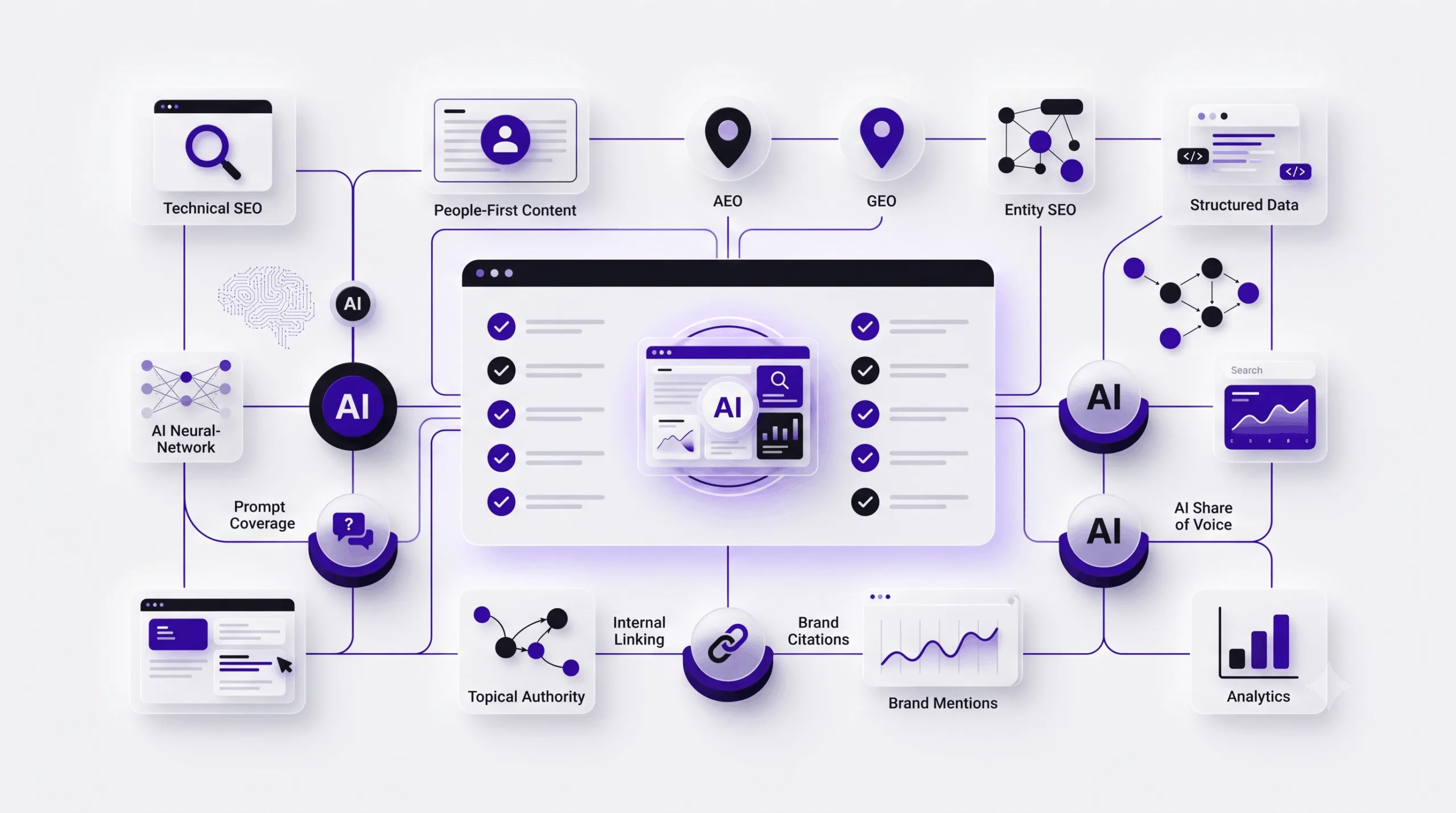
AI Search Optimization combines the strongest principles of traditional SEO with Answer Engine Optimization (AEO), Generative Engine Optimization (GEO), entity optimization, structured data, content quality, technical accessibility, and ongoing AI visibility measurement.
This makes a checklist particularly useful.
Instead of treating AI Search Optimization as an abstract concept, you can use a practical framework to audit your website, identify gaps, prioritize improvements, and measure whether your visibility is growing.
This guide provides a comprehensive AI Search Optimization Checklist covering the areas that matter most:
- Traditional SEO foundations
- Helpful, people-first content
- AEO and direct-answer optimization
- GEO and generative search visibility
- Entity SEO
- Structured data
- Internal linking
- Topical authority
- Brand authority
- AI citations
- Prompt Coverage
- AI Share of Voice
- Technical accessibility
- Measurement and reporting
The goal isn’t to “game” AI systems.
The goal is to make your website easy to crawl, understand, trust, cite, and recommend while providing genuinely useful information to people.

What Is AI Search Optimization?
AI Search Optimization is the process of improving a website’s content, technical accessibility, entity signals, authority, and structure so that search engines and AI-powered systems can better understand and potentially surface the website in relevant answers.
Traditional SEO primarily focuses on organic search visibility.
AEO focuses on providing direct answers to questions.
GEO focuses on improving the likelihood that content is represented or referenced in generative AI experiences.
AI Search Optimization brings these disciplines together.
The central principle is simple:
Create genuinely useful content, make your website technically accessible, establish clear entities and relationships, and provide enough evidence for search and AI systems to understand your expertise.
There is no guaranteed formula for appearing in AI-generated answers. AI systems can change their retrieval, ranking, and generation processes, and different platforms may produce different results.
That’s why an effective strategy should focus on strong fundamentals rather than shortcuts.
AI Search Optimization vs SEO, AEO, and GEO
These concepts overlap, but they are not identical.
| Approach | Primary Focus | Main Goal |
|---|---|---|
| SEO | Search engines and webpages | Organic visibility |
| AEO | Questions and direct answers | Answer visibility |
| GEO | Generative search experiences | AI-generated visibility |
| AI Search Optimization | SEO + AEO + GEO + entities + authority | Broader AI Search visibility |
Think of traditional SEO as the foundation.
AEO improves how clearly your content answers questions.
GEO focuses on generative search environments.
AI Search Optimization brings the pieces together into a broader visibility strategy.
The Complete AI Search Optimization Checklist
1. Technical SEO Checklist
Before optimizing for AI Search, make sure search engines can actually access and understand your website.
☐ Make important pages crawlable
Check that your important content isn’t accidentally blocked by:
robots.txtnoindex- Incorrect canonical tags
- Authentication requirements
- Broken internal links
If search systems cannot access a page, optimization becomes irrelevant.
☐ Use HTTPS
Your website should use a secure HTTPS connection across all important pages.
☐ Optimize Core Web Vitals
Monitor:
- Largest Contentful Paint
- Interaction to Next Paint
- Cumulative Layout Shift
Performance contributes to a better overall user experience and supports strong technical SEO.
☐ Create an XML Sitemap
Maintain an accurate XML sitemap containing your canonical, indexable URLs.
☐ Fix broken links
Regularly identify:
- 404 pages
- Broken internal links
- Incorrect redirects
- Redirect chains
☐ Use canonical URLs correctly
Make sure search engines can identify the preferred version of duplicate or similar pages.
☐ Ensure mobile usability
Your content should be easy to use and read on mobile devices.
2. Content and AEO Checklist
AI systems need content that clearly answers questions.
☐ Answer the primary question quickly
Don’t hide the answer beneath several paragraphs of introduction.
Start important sections with a concise, accurate explanation and then provide supporting detail.
☐ Use descriptive headings
Organize content using meaningful:
- H1
- H2
- H3
headings.
Headings should tell readers and search systems what each section covers.
☐ Answer related questions
Don’t stop at the primary question.
Cover relevant follow-up questions, definitions, comparisons, examples, and practical applications.
☐ Use concise definitions
When introducing an important concept, provide a clear definition before expanding on it.
☐ Include FAQs where useful
Create FAQs based on genuine user questions rather than adding repetitive questions simply to increase keyword coverage.
☐ Demonstrate first-hand experience
Where appropriate, include:
- Original examples
- Case studies
- Screenshots
- Data
- Methodologies
- Expert commentary
- Lessons learned
Experience makes content more useful and differentiated.
☐ Keep information accurate
Review important claims, statistics, dates, and examples.
Don’t publish unsupported claims simply because they sound authoritative.
3. GEO and AI Visibility Checklist
Generative search requires you to think beyond traditional rankings.
☐ Build topical depth
Create comprehensive resources around important subjects instead of publishing disconnected articles.
☐ Create pillar content
Build authoritative cornerstone pages that provide broad coverage of an important topic.
☐ Publish supporting content
Create specialized articles addressing subtopics and related questions.
☐ Cover conversational prompts
Think beyond keywords.
Ask:
What would my customer actually ask an AI assistant?
Create content that answers those questions naturally.
☐ Monitor AI citations
Track whether AI systems reference your website as a source.
☐ Track brand mentions
Monitor whether your business appears in AI-generated answers even when a direct citation isn’t provided.
☐ Track Prompt Coverage
Build a representative set of important prompts and monitor how frequently your brand appears.
☐ Track AI Share of Voice
Compare your visibility with competing brands across relevant prompts.
4. Entity SEO Checklist
AI systems need to understand who you are.
☐ Define your primary business entity
Make your organization name, description, website, and business information consistent.
☐ Implement Organization Schema
Use appropriate structured data to describe your organization.
☐ Connect your official profiles
Where appropriate, connect authoritative profiles using consistent information and relevant sameAs properties.
☐ Create expert author profiles
Identify the people responsible for important content.
☐ Strengthen service entities
Clearly describe your services and connect them to the organization providing them.
☐ Maintain consistent business information
Keep important business details consistent across trusted sources.
☐ Build legitimate brand mentions
Earn recognition through genuinely useful contributions, publications, partnerships, research, interviews, and industry coverage.
Don’t manufacture mentions or create low-quality profiles simply to manipulate entity signals.
5. Structured Data Checklist
Structured data helps search engines understand the meaning and relationships represented on your pages.
Use relevant Schema.org types where they accurately describe the content.
Potential examples include:
OrganizationWebSiteWebPageArticleBlogPostingPersonServiceProductBreadcrumbListFAQPage
☐ Match schema to visible content
Don’t add structured data for information that isn’t actually represented on the page.
☐ Keep schema accurate
Update structured data when the underlying information changes.
☐ Validate implementation
Check your structured data for syntax and eligibility issues using appropriate testing tools.
Schema is not a shortcut to AI visibility. Its primary purpose is to help search systems understand content and entities more accurately.
6. Internal Linking and Topical Authority Checklist
Your website should communicate relationships between related topics.
☐ Create content clusters
Organize content around major topics.
☐ Link supporting pages to pillar pages
For example:
AI Search Visibility Metrics & KPIs
↓
↓
↓
↓
↓
☐ Use descriptive anchor text
Make links understandable in context.
☐ Link related articles naturally
Don’t force links where they don’t help readers.
☐ Audit orphan pages
Important content should be discoverable through your site’s internal linking structure.
7. AI Search Measurement Checklist
Optimization without measurement becomes guesswork.
Track:
☐ AI Citation Rate
How frequently your content is cited.
☐ Prompt Coverage
How many relevant prompts include your brand.
☐ AI Share of Voice
How your visibility compares with competitors.
☐ Entity Presence
How consistently AI systems recognize your business.
☐ Brand Mentions
How frequently your brand appears in AI responses.
☐ Recommendation Rate
How often AI systems recommend your business where relevant.
☐ AI Referral Traffic
Traffic arriving from AI-powered platforms.
☐ AI-assisted conversions
Where measurable, track leads or conversions associated with AI-originated traffic.
For detailed definitions and measurement methods, see our AI Search Visibility Metrics & KPIs guide.
Common AI Search Optimization Mistakes
1. Writing Only for AI
Your first audience is still the human reader.
Don’t make content unnatural just to target AI systems.
2. Keyword Stuffing
Repeating a keyword doesn’t create topical authority.
Cover the subject comprehensively and naturally.
3. Publishing AI-Generated Content Without Review
AI can assist with research and drafting, but publishing unchecked material can introduce:
- Factual errors
- Generic explanations
- Unsupported claims
- Missing context
Human review remains essential.
4. Creating Fake Authority
Don’t manufacture reviews, credentials, citations, authors, or brand mentions.
Trust must be earned.
5. Ignoring Traditional SEO
AI Search Optimization doesn’t replace technical SEO, useful content, crawlability, or strong website architecture.
It builds upon them.
6. Chasing Every AI Platform
You don’t need to optimize separately for every platform.
Build strong fundamentals first, then monitor the platforms that matter to your audience.
How to Prioritize the Checklist
Don’t attempt to implement every recommendation simultaneously.
Use this order:
Priority 1 — Technical Foundation
Make sure your important pages are crawlable, indexable, fast, secure, and mobile-friendly.
Priority 2 — Content Quality
Create genuinely useful, accurate, comprehensive content that addresses real user needs.
Priority 3 — Entity Understanding
Make your organization, authors, services, products, and locations clear and consistent.
Priority 4 — Topical Authority
Build pillar pages and connected supporting content.
Priority 5 — AI Visibility
Start tracking prompts, citations, mentions, recommendations, and competitive visibility.
Priority 6 — Continuous Optimization
Use the data to identify content gaps, update existing pages, and create new resources.
This approach prevents businesses from treating AI Search Optimization as a collection of disconnected tactics.
Final AI Search Optimization Checklist
Use this as your quick audit:
- ☐ Website is crawlable
- ☐ Important pages are indexable
- ☐ HTTPS is implemented
- ☐ Core Web Vitals are monitored
- ☐ XML sitemap is maintained
- ☐ Canonicals are correct
- ☐ Broken links are fixed
- ☐ Mobile experience is strong
- ☐ Content answers real questions
- ☐ Headings are descriptive
- ☐ Important concepts have clear definitions
- ☐ FAQs address genuine questions
- ☐ Content demonstrates experience
- ☐ Claims are accurate and supported
- ☐ Pillar pages exist
- ☐ Supporting content is connected
- ☐ Internal linking is strong
- ☐ Organization/entity information is consistent
- ☐ Relevant Schema is implemented
- ☐ Author information is clear
- ☐ Service information is clear
- ☐ Brand mentions are earned legitimately
- ☐ Prompt Coverage is monitored
- ☐ AI Citation Rate is monitored
- ☐ AI Share of Voice is tracked
- ☐ Entity Presence is monitored
- ☐ AI recommendations are reviewed
- ☐ AI referral traffic is measured
- ☐ Competitors are monitored
- ☐ Content is regularly reviewed and updated

How Revolute X Digital Can Help With AI Search Optimization
AI Search Optimization is not a replacement for SEO. It is the next layer of a strong search strategy.
The websites most likely to succeed in AI-powered search will not necessarily be those that publish the most content or use the most aggressive optimization tactics.
They will be the websites that consistently provide helpful, accurate, original, accessible, well-structured information and clearly establish who they are, what they know, and why their information can be trusted.
Use this AI Search Optimization Checklist as an ongoing framework rather than a one-time audit.
Start with technical SEO and people-first content. Then strengthen your entities, build topical authority, optimize answers and conversational coverage, and measure AI visibility through metrics such as Prompt Coverage, AI Citation Rate, AI Share of Voice, Entity Presence, and Brand Mentions.
That combination gives your business a sustainable foundation for visibility across both traditional search and the rapidly evolving AI Search ecosystem.
Frequently Asked Questions About AI Search Optimization
1. How do I optimize my website for AI search?
Start with strong technical SEO, helpful and original content, clear entity information, structured data, strong internal linking, topical authority, and content that directly answers real customer questions. Then monitor AI visibility through metrics such as Prompt Coverage, AI Citation Rate, and AI Share of Voice.
2. How do I get my website to appear in ChatGPT?
There is no guaranteed method to make ChatGPT recommend a website. The best approach is to build authoritative, useful content, establish clear entity signals, earn legitimate brand mentions, maintain strong technical SEO, and create resources that comprehensively answer questions related to your expertise.
3. How can I get my business mentioned in Google AI Overviews?
Create accurate, helpful content that directly satisfies search intent and establish strong website, entity, and authority signals. Google determines which information appears in AI-generated results algorithmically, so there is no guaranteed optimization technique that forces a business into an AI Overview.
4. Is AI Search Optimization the same as SEO?
No. AI Search Optimization builds on traditional SEO but expands the focus to AI-generated answers, citations, recommendations, entities, conversational prompts, and generative search experiences. Technical SEO and high-quality content remain foundational.
5. What is the difference between AEO and GEO?
AEO (Answer Engine Optimization) focuses on making content useful for systems that provide direct answers to questions. GEO (Generative Engine Optimization) focuses on visibility within generative AI search experiences. Both overlap with traditional SEO and can be incorporated into a broader AI Search Optimization strategy.
6. Does Schema Markup help with AI Search?
Schema Markup helps search engines understand the meaning and relationships represented on a webpage. It can strengthen entity understanding and content interpretation, but Schema alone does not guarantee rankings, citations, or inclusion in AI-generated answers.
7. How important are FAQs for AI Search Optimization?
FAQs can help address specific questions users are likely to ask, particularly when the questions and answers are genuinely useful. They should not be created simply to add keywords. The strongest FAQ sections answer real customer questions clearly and accurately.
8. How do I know if my website is visible in AI search?
Create a representative set of prompts related to your business and test them across relevant AI platforms. Record whether your brand appears, whether competitors appear, which sources are cited, and whether your business is recommended. This creates a baseline for measuring AI Search Visibility.
9. What AI Search metrics should I track?
Important metrics include AI Share of Voice, AI Citation Rate, Prompt Coverage, Entity Presence, Brand Mentions, Recommendation Rate, AI Referral Traffic, and AI-assisted conversions where measurable.
For a complete explanation of these metrics, see the AI Search Visibility Metrics & KPIs guide.
10. How often should I check my AI Search visibility?
For most businesses, monthly monitoring provides a useful baseline. High-priority brands or competitive industries may benefit from more frequent testing. Consistent measurement is more useful than checking AI results once and assuming they will remain unchanged.
11. Can backlinks help with AI Search Optimization?
Quality backlinks can support overall authority and traditional SEO, which can indirectly contribute to AI Search visibility. However, businesses should focus on earning relevant, authoritative references rather than purchasing or creating low-quality links specifically to manipulate AI results.
12. Does topical authority improve AI Search visibility?
Strong topical authority can improve your ability to demonstrate expertise across related questions. Build a comprehensive pillar page, publish useful supporting content, connect the pages with contextual internal links, and cover the important subtopics your audience actually needs.
13. Should I create separate content for ChatGPT, Gemini, Claude, and Perplexity?
Usually, you don’t need completely separate articles for every AI platform. Focus on creating high-quality, technically accessible, authoritative content first. Then monitor how different AI platforms interpret and surface your content and use those insights to identify gaps.
14. Can AI-generated content rank or appear in AI search?
AI assistance itself does not determine whether content is valuable. The important question is whether the final content is accurate, useful, original where appropriate, and created to satisfy people rather than manipulate search systems. AI-generated drafts should be reviewed and improved by knowledgeable humans before publication.
15. How long does AI Search Optimization take to work?
There is no universal timeline. Results depend on your website’s existing authority, technical condition, content quality, competition, entity signals, and the AI platforms being measured. Treat AI Search Optimization as an ongoing process: establish a baseline, improve the site, monitor prompts and citations, and measure changes over time.
16. Can local businesses benefit from AI Search Optimization?
Yes. Local businesses can optimize their website, Google Business Profile, service information, location signals, reviews, entity information, and locally relevant content. This can help AI systems better understand which business, service, and geographic area are relevant to a user’s question.
17. What is Prompt Coverage in AI Search?
Prompt Coverage measures how broadly your brand appears across a defined set of relevant AI prompts. For example, if you test 100 important customer questions and your brand appears in 40, you have visibility across 40% of that prompt set. It is a useful way to measure the breadth of AI visibility.
18. What is AI Citation Rate?
AI Citation Rate measures how frequently your website or content is referenced as a source in AI-generated answers. It is different from simply being mentioned because a citation generally indicates that the AI response is attributing information to a particular source.
19. Can I guarantee that my business will be recommended by AI?
No. There is no legitimate method that guarantees placement in ChatGPT, Google AI Overviews, Gemini, Claude, Perplexity, or other AI-generated search results. AI systems change their retrieval and generation processes, so optimization should focus on improving relevance, usefulness, authority, accessibility, and entity clarity rather than guaranteeing a specific result.
20. What is the most important part of an AI Search Optimization strategy?
Start with the fundamentals: helpful content, strong technical SEO, clear entities, topical authority, trustworthy information, and excellent user experience. Once those foundations are established, measure AI visibility using Prompt Coverage, Citation Rate, Share of Voice, Entity Presence, and other relevant KPIs.

Zack
Zack Robinson is a Digital Marketing Specialist at Revolute X Digital, specializing in SEO, Local SEO, Google Business Profile optimization, AI automation, and lead generation. He helps businesses improve their online visibility, attract qualified customers, and achieve sustainable growth through data-driven digital marketing strategies.