
SEO used to be relatively simple to explain.
You optimized a website, earned authority, targeted relevant keywords, and worked toward higher rankings in traditional search results.
But search has changed.
Today, people still search Google, but they also ask questions directly inside AI-powered experiences such as Google AI Overviews, ChatGPT, Gemini, Claude, and Perplexity. Instead of receiving only a list of links, users may receive a synthesized answer, a direct recommendation, a comparison, or a list of sources.
That evolution has introduced several new terms:
- SEO — Search Engine Optimization
- AEO — Answer Engine Optimization
- GEO — Generative Engine Optimization
The problem is that these terms are often presented as if they are completely separate marketing disciplines.
They aren’t.
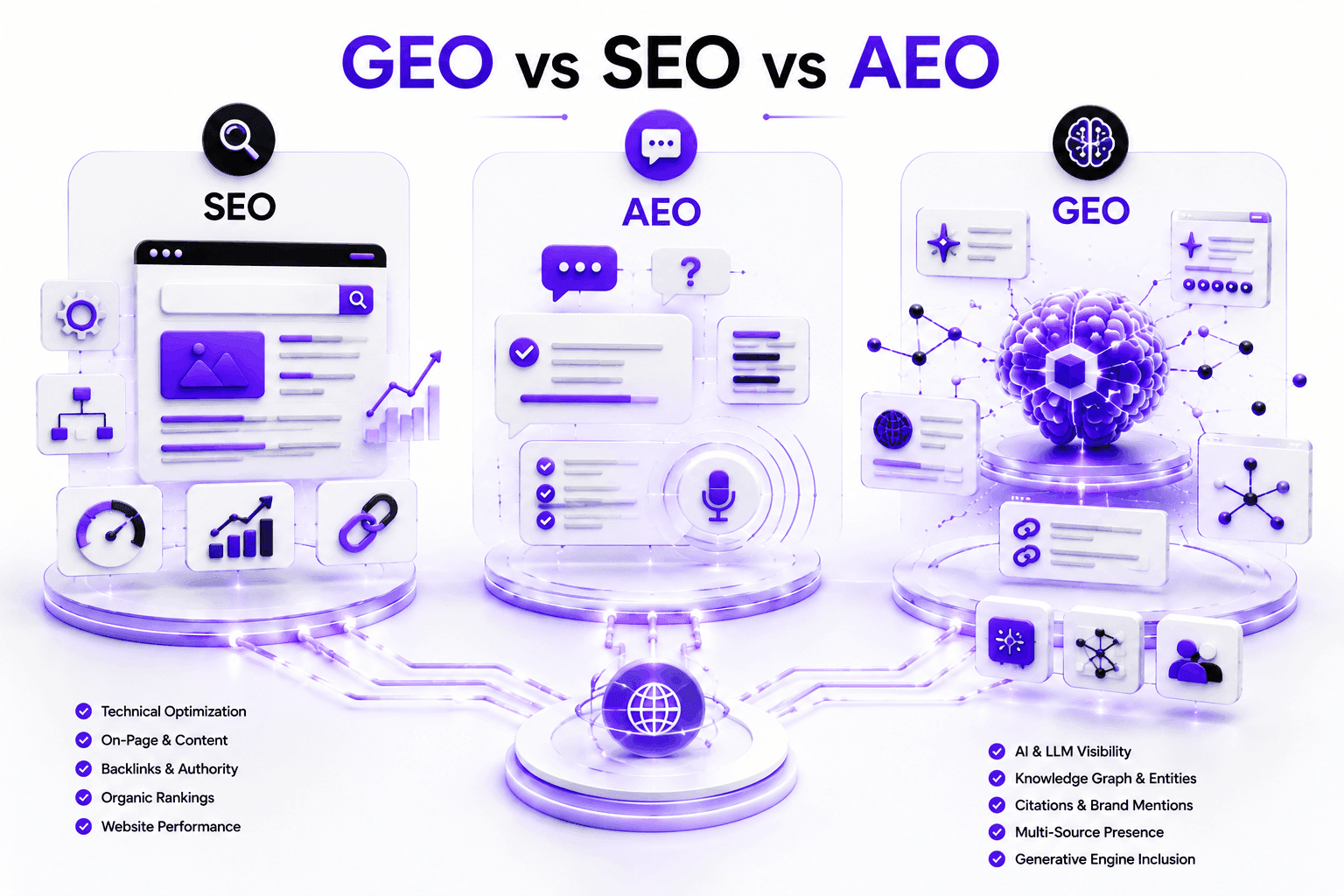
The reality is more useful: SEO, AEO, and GEO overlap heavily, but each emphasizes a different search outcome.
Current industry discussions increasingly describe them as complementary layers rather than replacements for one another.
And that distinction matters.
If you only focus on traditional rankings, you may miss opportunities to become the answer.
If you focus only on GEO, you can neglect the technical and content foundations that help search engines discover and understand your website in the first place.
If you focus only on AEO, you may optimize individual answers without building the broader authority needed for sustained visibility.
The smarter approach is to understand what each discipline does—and then combine them into one search visibility strategy.
What Is SEO?
SEO, or Search Engine Optimization, is the process of improving a website so search engines can discover, understand, and rank its pages for relevant searches.
Traditional SEO focuses heavily on organic search visibility.
That includes:
- Technical SEO
- Keyword research
- Search intent
- Content optimization
- Internal linking
- Site architecture
- Structured data
- Page experience
- Digital PR
- Links and mentions
- Topical authority
For example, suppose someone searches:
An SEO strategy aims to make your website relevant, useful, trustworthy, and technically accessible enough to compete for visibility in traditional search results.
SEO remains the foundation.
AI search has not made technical SEO, helpful content, indexing, or authority irrelevant.
In fact, Google’s AI experiences still rely on core Search systems and content-quality signals rather than providing marketers with a completely separate optimization system.
The important change is that ranking a webpage is no longer the only search visibility outcome worth measuring.
What Is AEO?
AEO, or Answer Engine Optimization, focuses on making content easy for answer engines and search systems to use when responding directly to questions.
Instead of optimizing only for:
AEO considers questions such as:
“What is AI Search Optimization?”
“How does AI Search Optimization work?”
The goal is to provide a clear, accurate answer that can be understood and extracted easily.
AEO commonly emphasizes:
- Question-based content
- Direct answers
- Conversational language
- FAQ content
- Clear headings
- Structured information
- Featured-snippet opportunities
- Voice-search compatibility
- AI-generated answer experiences
This is why AEO overlaps significantly with modern content SEO.
The distinction is primarily what you’re optimizing the content to accomplish: direct answer visibility rather than simply competing for a traditional blue-link position.
What Is GEO?
GEO, or Generative Engine Optimization, focuses on increasing the likelihood that your content, brand, or information is represented, referenced, or cited in AI-generated responses.
GEO is associated with generative search experiences such as:
- ChatGPT
- Gemini
- Perplexity
- Google AI Overviews
- Other generative answer systems
Instead of asking only:
“Can I rank for this keyword?”
GEO asks:
“Will an AI system recognize my brand or content as a useful source when answering this question?”
That creates a broader set of considerations.
GEO strategies commonly emphasize:
- Topical authority
- Original information
- Clear source attribution
- Entity recognition
- Brand mentions
- Structured content
- Citations
- Prompt coverage
- AI Share of Voice
- Digital authority
Research into GEO also highlights an important caveat: AI visibility is not a single deterministic ranking system. Generative systems can involve retrieval, reranking, citation, generation, and user-level outcomes, with substantial variation between platforms and repeated runs.
So GEO should not be treated as a magic formula for “ranking ChatGPT.”
It is better understood as optimizing your digital presence so generative systems can discover, understand, trust, and use your information.
GEO vs SEO vs AEO: The Key Difference
The easiest way to understand the three is to focus on the outcome.
SEO
Goal: Earn visibility in traditional search results.
AEO
Goal: Provide direct, extractable answers to questions.
GEO
Goal: Increase your brand’s visibility, representation, and citation within generative AI responses.
Think of them as three layers:
SEO → Discoverability
AEO → Answerability
GEO → Generative Visibility
They overlap, but they aren’t identical.
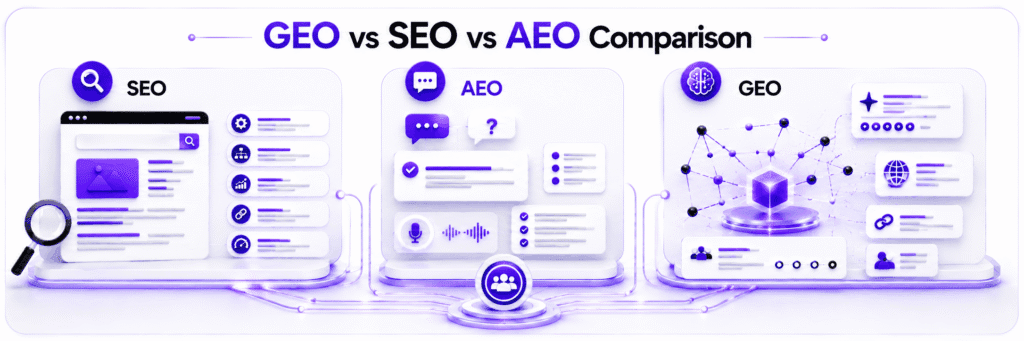
GEO vs SEO vs AEO Comparison
| Factor | SEO | AEO | GEO |
|---|---|---|---|
| Full Name | Search Engine Optimization | Answer Engine Optimization | Generative Engine Optimization |
| Primary Goal | Search visibility | Direct answers | AI-generated visibility |
| Main Environment | Search engines | Answer/search experiences | Generative AI |
| Primary Focus | Rankings & relevance | Answer extraction | Citations, mentions & recommendations |
| Content Style | Comprehensive & useful | Direct & question-focused | Authoritative & context-rich |
| Important Signals | Technical SEO, content, authority | Clarity, structure, direct answers | Authority, entities, citations, mentions |
| Typical Measurement | Rankings, clicks, impressions | Answer visibility | AI Share of Voice, Citation Rate, Prompt Coverage |
| Main User Experience | Search results | Direct answer | AI-generated response |
This is why treating GEO, SEO, and AEO as competing strategies can be misleading.
They solve different parts of the same visibility problem.
How SEO, AEO, and GEO Work Together
The strongest strategy doesn’t choose one and ignore the others.
Instead, each layer supports the next.
Consider a page about AI Search Analytics.
SEO Layer
You make sure the page is:
- Crawlable
- Indexable
- Technically sound
- Relevant to search intent
- Internally linked
- Supported by authoritative content
↓
AEO Layer
You structure the page around questions:
- What is AI Search Analytics?
- What metrics should businesses track?
- How do you measure AI visibility?
You provide concise, direct answers.
↓
GEO Layer
You strengthen:
- Original insights
- Entity signals
- Brand authority
- Citations
- Topical relationships
- Supporting content
- AI prompt coverage
↓
Result
The same resource can potentially compete across multiple search experiences.
That’s the real opportunity.
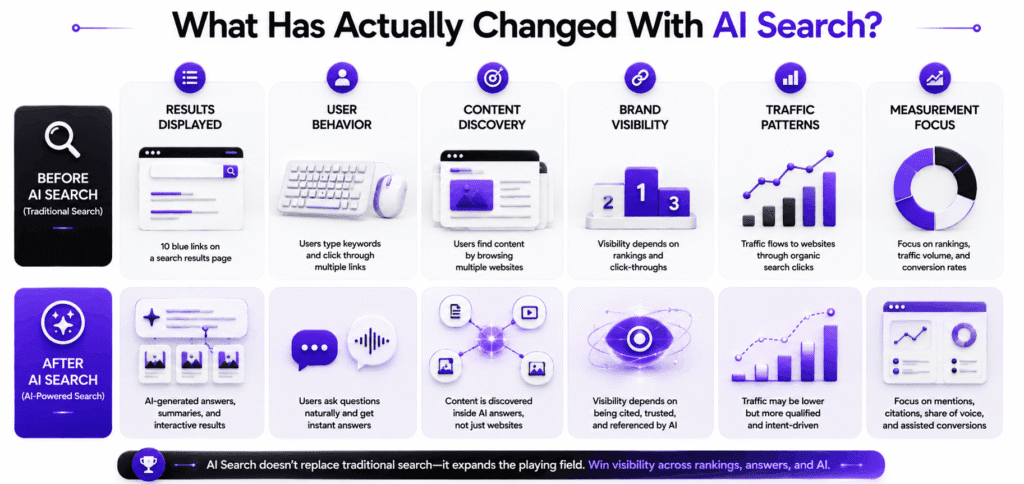
What Has Actually Changed With AI Search?
The biggest change isn’t simply that AI exists.
The biggest change is how information is presented to users.
Traditional search often gives users a ranked collection of sources.
Generative search can synthesize information from multiple sources into one response.
Research comparing web search with generative AI responses has found meaningful differences in the sources consulted, query intent, and types of domains surfaced.
That means visibility is becoming multidimensional.
Your brand can be:
- Ranking in Google
- Appearing in a featured answer
- Mentioned by an AI assistant
- Cited as a source
- Recommended alongside competitors
- Referenced in a conversational response
These are different visibility outcomes.
This is why measuring only rankings can provide an incomplete picture.
The Most Important Shift: From Rankings to Visibility
Traditional SEO asks:
Where does my page rank?
Modern AI Search asks additional questions:
Is my brand mentioned?
Is my content cited?
How many relevant prompts does my brand appear in?
Which competitors are recommended?
Does AI understand what my company does?
These questions are the foundation of your broader AI Search Visibility Metrics and KPIs framework.
Metrics such as:
- AI Share of Voice
- AI Citation Rate
- Prompt Coverage
- Entity Presence
- Brand Mentions
- Recommendation Rate
- AI Referral Traffic
help measure visibility beyond traditional rankings.
Related resource: See our complete AI Search Visibility Metrics & KPIs guide for detailed definitions and measurement strategies.
Which Strategy Should Your Business Prioritize?
The answer depends on your current situation.
If Your Website Has Weak SEO Foundations
Start with SEO.
Fix:
- Technical problems
- Indexing
- Site architecture
- Content quality
- Internal linking
- Search intent
- Authority
There is little value in building an advanced AI visibility strategy if search engines can’t properly understand your website.
If Your Content Gets Traffic but Doesn’t Win Answers
Strengthen AEO.
Look at:
- Question-based headings
- Direct answers
- FAQs
- Clear definitions
- Structured content
- Conversational search intent
If Your SEO Is Strong but AI Doesn’t Mention Your Brand
Expand into GEO.
Focus on:
- Entity SEO
- Topical authority
- Brand mentions
- Original research
- Digital PR
- Citations
- Prompt Coverage
- AI Share of Voice
If You’re Starting From Scratch
Don’t choose only one.
Build the foundation in this order:
SEO → AEO → GEO
But don’t think of this as a rigid three-stage process.
These strategies should evolve together.
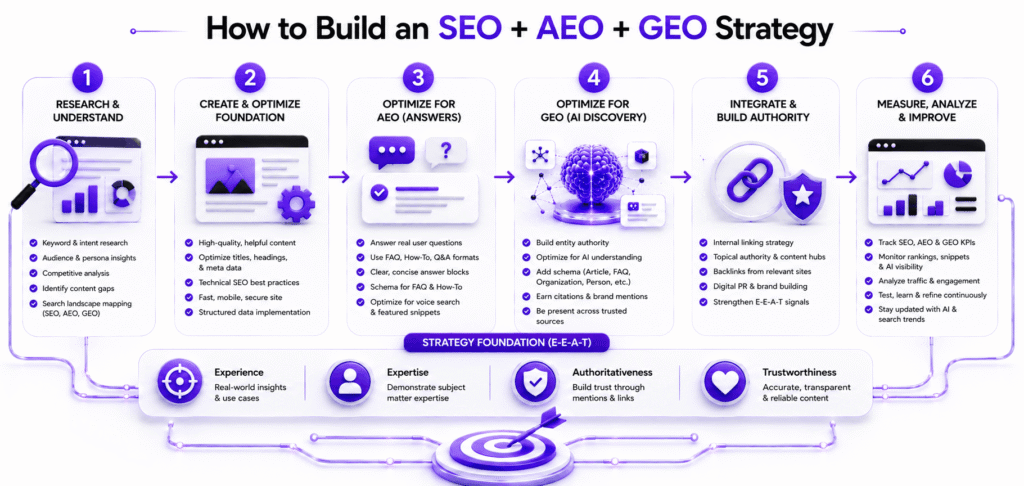
How to Build an SEO + AEO + GEO Strategy
A practical framework looks like this.
Step 1: Build Technical SEO Foundations
Make sure search engines can crawl, index, and understand your website.
Step 2: Map Search Intent
Identify what your audience wants to know, compare, solve, or purchase.
Step 3: Build Topic Clusters
Create pillar pages supported by specialized articles.
For your AI Search content hub, for example:
AI Search Visibility Metrics & KPIs
↓
↓
↓
↓
↓
This structure builds depth instead of producing disconnected blog posts.
Step 4: Add Answer-Focused Content
Create sections that directly answer important customer questions.
Use:
- Question headings
- Short definitions
- Examples
- Tables
- FAQs
- Step-by-step explanations
This strengthens AEO.
Step 5: Strengthen Entity Signals
Make sure AI can clearly understand:
- Who your company is
- What you offer
- Who you serve
- Where you operate
- Who your experts are
- Which topics you specialize in
Use consistent business information, structured data, author pages, profiles, reviews, and authoritative mentions.
Step 6: Build Generative Visibility
Expand your GEO strategy through:
- Original research
- Expert insights
- Case studies
- Digital PR
- Brand mentions
- Comprehensive content
- Strong citations
- Prompt monitoring
The objective isn’t to manipulate AI.
It’s to make your business genuinely useful and recognizable as a source.
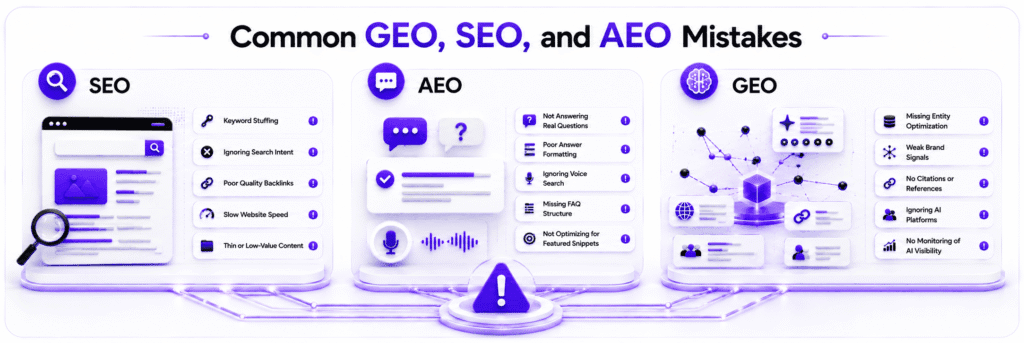
Common GEO, SEO, and AEO Mistakes
Mistake 1: Treating GEO as a Replacement for SEO
GEO doesn’t mean abandoning SEO.
Your website still needs strong technical and content foundations.
Mistake 2: Creating Content Only for AI
Don’t write robotic content designed exclusively for machines.
AI systems ultimately serve people.
Write for humans first, then structure information so machines can understand it.
Mistake 3: Keyword Stuffing
Repeating “GEO vs SEO vs AEO” dozens of times won’t establish authority.
Cover the topic comprehensively and naturally.
Mistake 4: Publishing Thin AI-Generated Articles
AI-generated content without original insight creates little differentiation.
Add:
- Experience
- Examples
- Data
- Original frameworks
- Expert commentary
- Real-world observations
Mistake 5: Measuring Only Rankings
Ranking improvements are useful, but they don’t tell you whether AI assistants recommend your business.
Track both traditional and AI Search metrics.
Mistake 6: Treating AI Visibility as Guaranteed
No legitimate GEO strategy can guarantee that ChatGPT, Gemini, Google AI Overviews, or another AI platform will cite a particular page.
AI responses can vary between queries, platforms, and time periods. Current research also emphasizes the stochastic nature of generative retrieval and citation.
A serious strategy measures visibility rather than promising guaranteed placement.
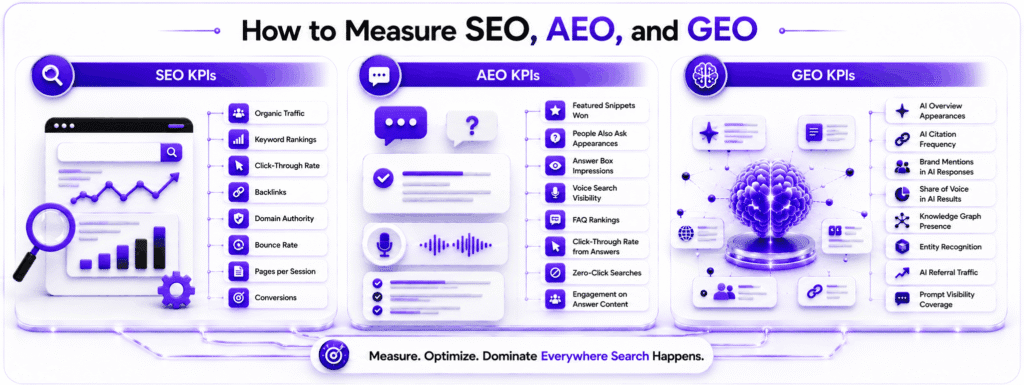
How to Measure SEO, AEO, and GEO
Use different KPIs for each layer.
SEO KPIs
- Organic rankings
- Impressions
- Clicks
- CTR
- Organic traffic
- Conversions
- Indexed pages
AEO KPIs
- Featured snippet visibility
- Question coverage
- Answer visibility
- Voice-search presence
- Direct-answer opportunities
GEO KPIs
- AI Share of Voice
- AI Citation Rate
- Prompt Coverage
- Entity Presence
- Brand Mentions
- Recommendation Rate
- AI Referral Traffic
Your reporting should bring these metrics together instead of treating them as isolated marketing channels.
The Best Strategy Isn’t SEO vs AEO vs GEO
The question “GEO vs SEO vs AEO—which one should I choose?” is actually the wrong question.
The better question is:
“How can I make my brand discoverable, answerable, and recommendable across every major search experience?”
SEO helps search engines discover and rank your content.
AEO helps systems extract and present clear answers.
GEO helps your brand and content become visible within generative responses.
And your broader AI Search Optimization strategy brings these elements together with entity optimization, topical authority, structured data, content quality, and AI visibility measurement.
Your existing Revolute X Digital content already covers the broader AIO/GEO/AEO landscape, so this article should function differently: not as another “new rules of search” overview, but as a practical comparison and decision guide. Your existing article already explains AIO, GEO, AEO, and several other search-visibility concepts.
Likewise, your dedicated AI Search Optimization guide already explains the broader concept of making a brand understandable and referenceable across AI platforms.
That means this article can strengthen the topical cluster by answering the narrower question:
What is actually different between SEO, AEO, and GEO—and how should they work together?
Conclusion
GEO vs SEO vs AEO isn’t a battle between three competing strategies.
They’re different approaches to achieving visibility across an increasingly complex search ecosystem.
SEO focuses on search-engine visibility.
AEO focuses on direct answers.
GEO focuses on visibility within generative AI responses.
The strongest businesses won’t abandon SEO because AI search is growing. They will build on their SEO foundation and add answer optimization, entity optimization, topical authority, and generative visibility strategies.
The goal isn’t simply to rank number one anymore.
It’s to make your brand discoverable, understandable, trustworthy, and recommendable wherever your customers search.
And that’s the real evolution from traditional SEO to modern AI Search Optimization.
Frequently Asked Questions About GEO vs SEO vs AEO
1. What is the difference between SEO, AEO, and GEO?
SEO focuses on improving visibility in traditional search results. AEO focuses on providing direct answers to user questions, while GEO focuses on increasing brand and content visibility within AI-generated responses. The three approaches overlap and work best together.
2. Is GEO replacing SEO?
No. GEO does not replace SEO. Traditional SEO remains important for crawling, indexing, relevance, technical accessibility, and organic search visibility. GEO adds another layer for AI-powered search experiences.
3. Is AEO the same as GEO?
Not exactly. AEO generally focuses on becoming the direct answer to a question, while GEO focuses more broadly on how brands and sources are represented or cited in generative AI responses. The terminology overlaps, and different marketers use the terms somewhat differently.
4. Which is better: SEO or GEO?
Neither is universally better. SEO remains essential for traditional search visibility, while GEO addresses generative AI visibility. Businesses should use both rather than treating them as competing strategies.
5. What does GEO stand for in SEO?
GEO stands for Generative Engine Optimization. It refers to strategies designed to improve the likelihood that a brand’s content or information is represented, mentioned, or cited in AI-generated answers.
6. What does AEO stand for in digital marketing?
AEO stands for Answer Engine Optimization. It focuses on creating content that directly answers questions and is easy for answer-oriented search experiences to understand and present.
7. Can SEO help with GEO?
Yes. SEO fundamentals can support GEO because AI-powered search systems still need to discover and interpret web content. Strong technical SEO, helpful content, internal linking, authority, and structured information provide an important foundation.
8. How do I optimize my website for GEO?
Start with strong SEO foundations, then build topical authority, publish original and useful information, strengthen entity signals, create clear answer-focused content, earn authoritative mentions, and monitor your AI visibility across relevant prompts.
9. Does AEO help Google AI Overviews?
Answer-focused content can be useful for AI-powered search experiences, but there is no guaranteed formula for appearing in Google AI Overviews. Google’s AI features use its broader Search systems and content-quality signals.
10. What are the most important GEO metrics?
Important GEO metrics include AI Share of Voice, AI Citation Rate, Prompt Coverage, Entity Presence, Brand Mentions, Recommendation Rate, and AI Referral Traffic.
11. Does Schema Markup help GEO?
Schema Markup can help search engines better understand entities, content types, relationships, and page information. It should be treated as part of a broader technical and entity strategy rather than a standalone GEO tactic.
12. How long does GEO take to work?
There is no universal timeline. AI visibility depends on factors such as content quality, authority, topic relevance, platform behavior, retrieval, and competition. Measure visibility over time instead of relying on a promised number of days or weeks.
13. Can a small business use GEO?
Yes. Small businesses can use GEO by developing strong topical authority, publishing expert content, strengthening local and brand entities, earning relevant mentions, answering customer questions, and monitoring AI recommendations.
14. Should I hire a GEO agency or an SEO agency?
Look for a team that understands both. GEO should not be treated as a replacement for technical SEO, content strategy, entity optimization, and authority building. The strongest approach combines traditional search fundamentals with AI Search measurement and optimization.
15. What should my business focus on first: SEO, AEO, or GEO?
Start with strong SEO foundations, then improve answer-focused content and build generative AI visibility. If your technical SEO and content foundation are already strong, expanding into AEO, GEO, entity optimization, and AI Search Analytics can help you compete across newer search experiences.

Zack
Zack Robinson is a Digital Marketing Specialist at Revolute X Digital, specializing in SEO, Local SEO, Google Business Profile optimization, AI automation, and lead generation. He helps businesses improve their online visibility, attract qualified customers, and achieve sustainable growth through data-driven digital marketing strategies.