
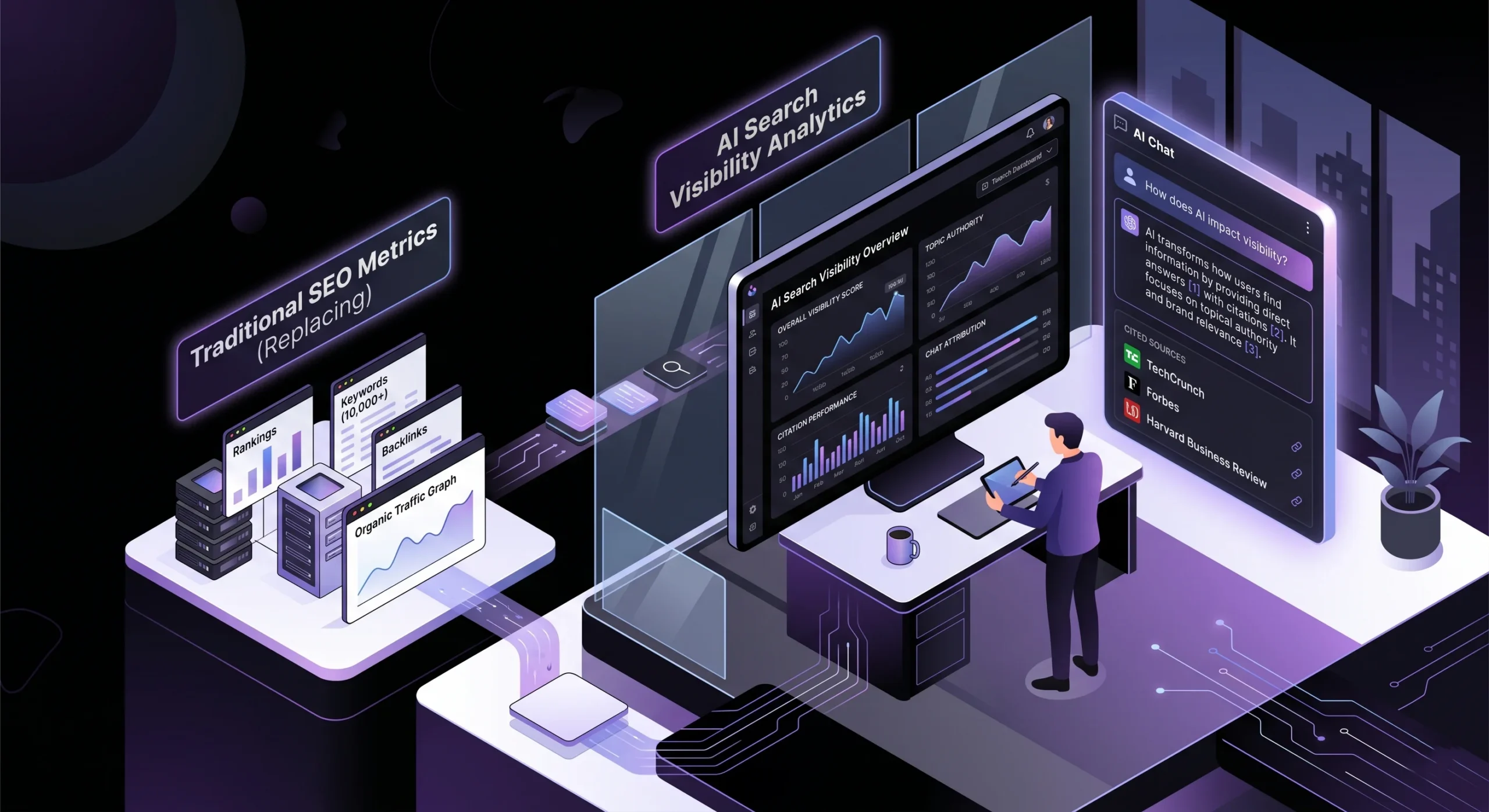
For years, SEO teams watched rankings, clicks, impressions, and conversions. That made sense when search was mostly a list of links. Now things are different. More people are asking questions in ChatGPT, Gemini, Copilot, and AI-powered search features, and getting direct answers with citations instead of browsing ten results. Microsoft has now made this shift official by adding an AI Performance report in Bing Webmaster Tools that shows when your site is cited in AI-generated answers.
That means marketers need a new visibility signal: AI search visibility. If your brand is being mentioned, cited, or summarized inside AI answers, that matters, even if the user never clicks in the old way.
Why Does AI Search Visibility Matter Now?
A lot of brands still judge SEO success only by rankings and traffic. That is incomplete now. In AI-driven search experiences, your brand may influence the answer without winning a traditional click. Microsoft’s AI Performance dashboard tracks citation counts, cited pages, and grounding queries, which shows that search platforms themselves now treat AI citations as a measurable form of visibility.
In plain terms, your content may already be helping AI tools answer questions, but if you are not tracking that, you will miss part of the picture.
Start with the Simplest Question
Before worrying about fancy dashboards, ask the obvious thing. Is your brand showing up at all?
Run a set of prompts around your services, products, competitors, and category. Look at whether AI tools mention your business, cite your pages, or describe your brand accurately. This manual check is not a scalable reporting system, but it gives you a real-world baseline.
Start with prompts like:
- best agencies for [your service]
- how to choose [your service category]
- top tools for [your niche]
- [your brand] vs [competitor]
You are not just checking presence. You are checking how the answer frames you. That matters too.
What to Track Beyond Simple Mentions
A mention alone is not enough. You need a few practical metrics.
First, track citation frequency. How often does your site appear as a cited source across important prompts? Microsoft’s new AI Performance reporting now surfaces total citations and page-level citation activity, which makes this much easier on Bing and Copilot surfaces.
Second, track which URLs are being cited. Are AI systems pulling from your homepage, your blog posts, your service pages, or your help content? That tells you what kind of content is actually working.
Third, track share of voice. Which competitors appear when you do not? Many AI visibility platforms now compare brand mentions across prompts and topics, helping marketers see where competitors are being cited instead.
Fourth, track brand sentiment and framing. A mention can still be weak if the answer describes your brand poorly or leaves out what makes you different. Some newer AI visibility platforms now score sentiment and positioning, because AI answers do more than just list names. They characterize brands.
Use Tools Where They Exist, But do not wait for Perfect Reporting
Right now, the best official reporting is on Microsoft’s side. Bing Webmaster Tools has an AI Performance report that shows citation activity across Microsoft Copilot and partner experiences. It includes metrics such as total citations, cited pages, and grounding queries.
Google has not rolled out an equivalent citation dashboard for AI Overviews, so teams still need to combine manual checks, prompt tracking, branded search trends, and site analytics to understand what is happening. Industry tools are also starting to fill the gap by monitoring prompts across platforms like ChatGPT, Gemini, Perplexity, and Claude.
That means your reporting stack will probably be mixed for a while. That is normal.
Connect AI Visibility to Business Signals
This is where many teams stop too early. They measure mentions, but not outcomes.
Look for signs that stronger AI search visibility is influencing your broader funnel:
- Branded search growth
- Direct traffic growth
- More referral traffic from AI interfaces where trackable
- Better performance on pages that are often cited
- Improved lead quality on high-authority informational pages
Some marketers are already using branded search and direct traffic as proxy indicators when AI answer visibility rises. It is not perfect, but it helps connect AI exposure to business movement.
Build a Repeatable Workflow
Do not treat this as a one-time experiment. Create a simple monthly workflow.
Pick a set of prompts. Check which brands and pages are cited. Log changes over time. Compare your presence with competitors. Then ask a useful question: what kind of content is being chosen, and why?
Usually, patterns start to appear. Clearer pages, stronger topic coverage, more direct answers, and more trustworthy content tend to get pulled in more often. Once you see those patterns, your content strategy becomes much sharper.
Conclusion
AI search visibility is becoming a real performance category, not just a thought experiment. If rankings tell you where you stand in search results, AI search visibility tells you whether your brand is making it into the answer itself. That is a different kind of influence, and it is worth tracking now.
Revolute X Digital helps brands build practical systems for this next layer of search, from content strategy to prompt tracking and AI-answer monitoring. If your business wants to understand how it appears in AI tools and improve that visibility over time, this is exactly the kind of work worth starting early. Get in touch with us to learn more!
FAQs
What is AI search visibility?
AI search visibility refers to how often your brand, content, or website is mentioned, cited, or used in AI-generated answers across platforms like ChatGPT, Copilot, and AI-powered search results. It measures influence beyond traditional rankings and clicks.
How do I track my brand in AI-generated answers?
You can start by manually testing prompts related to your services, competitors, and industry. Then, use tools like Bing Webmaster Tools AI Performance report to track citations, along with monitoring branded searches, traffic patterns, and AI visibility tools.
What metrics matter most for AI search visibility?
The most important metrics include:
- Citation frequency (how often you’re referenced)
- Cited pages (which URLs AI pulls from)
- Share of voice (presence vs competitors)
- Brand sentiment (how AI describes you)
These give a clearer picture than rankings alone.
Is AI search visibility replacing traditional SEO?
No, but it’s expanding it. Traditional SEO focuses on rankings and clicks, while AI visibility focuses on being part of the answer itself. Both now work together as part of modern search strategy.
Does Google provide AI visibility tracking like Bing?
Not yet in a structured way. Bing currently offers direct AI citation tracking, while Google still requires manual analysis and indirect signals like impressions, branded searches, and traffic trends.
Why is AI search visibility important for businesses?
Because users are increasingly getting answers directly from AI without clicking links. If your brand is not included in those answers, you lose visibility—even if your rankings are strong.
How can I improve my AI search visibility?
Focus on:
- Clear, structured content
- Answering real user questions directly
- Strong topical authority
- Trust signals (reviews, mentions, backlinks)
- Well-organized pages that are easy for AI to extract
Can blog content appear in AI-generated answers?
Yes. Blog posts that are specific, well-structured, and answer clear questions are more likely to be cited. Generic or shallow content is usually ignored.
What is the difference between citations and mentions in AI answers?
- Citations = AI directly references your content as a source
- Mentions = AI includes your brand without linking or sourcing
Citations are stronger signals of authority.
How often should I check AI visibility?
A simple monthly workflow works best:
- Test key prompts
- Track which brands appear
- Compare against competitors
- Adjust content strategy based on patterns

Jason
We are an Affordable Digital Marketing Agency in Shawnee with budget-friendly solutions to amplify your brand. Elevate your business without compromising quality or cost.