

Introduction
Traditional SEO asks a familiar question:
“Where does my website rank in Google?”
AI-powered search creates another question:
“Does AI mention, cite, or recommend my brand when customers ask about my industry?”
That distinction is becoming increasingly important.
When someone searches Google, they can see a list of webpages and compare different results.
When someone asks an AI assistant a question, the experience can be very different. The system may provide a synthesized answer and mention only a small number of businesses, products, services, or sources.
If your competitors are mentioned while your brand is absent, you may have a visibility problem—even if your traditional SEO performance looks strong.
That’s where AI Brand Visibility comes in.
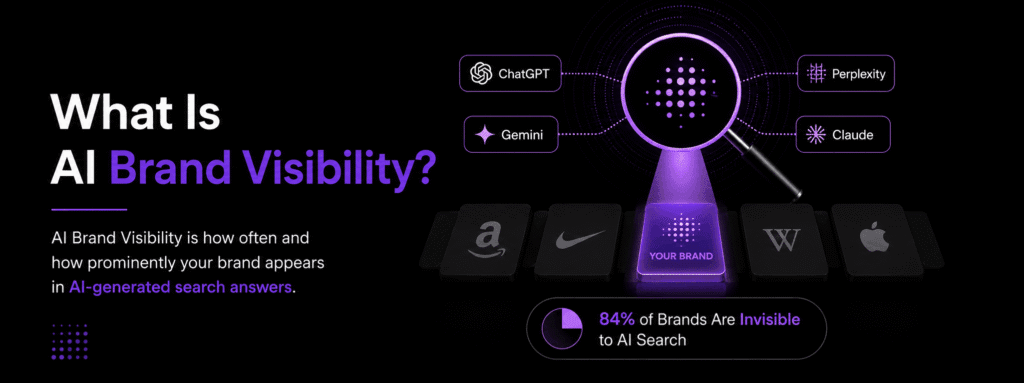
AI Brand Visibility is the extent to which a brand appears, is recognized, described, cited, or recommended within AI-generated answers for relevant customer questions.
It is not simply another name for traditional SEO.
It is a broader measurement of whether AI systems understand your brand and include it in relevant conversations.
Current industry research and tools increasingly distinguish AI brand visibility from traditional rankings and track metrics such as mentions, citations, share of voice, and sentiment across AI platforms.
What Is AI Brand Visibility?
AI Brand Visibility measures how frequently and how prominently your brand appears in AI-generated answers when users ask questions relevant to your business.
For example, imagine someone asks:
“What are the best AI SEO agencies for small businesses?”
An AI assistant may mention:
Agency A
Agency B
Agency C
If your agency isn’t included, you have no visibility for that particular AI recommendation—even if your website ranks well for traditional Google searches.
AI Brand Visibility can include several different forms of presence:
Brand Mention
The AI system names your company.
Citation
The AI system references your website or another source connected to your brand.
Recommendation
The AI system actively recommends your business as an option.
Description
The AI system explains what your company does or how it differs from competitors.
Comparison
The AI system includes your business when comparing multiple solutions.
These outcomes are related, but they are not identical.
A brand can receive a citation without being explicitly mentioned in the answer. Recent research has highlighted this distinction, including the phenomenon of “ghost citations,” where a source is cited but the associated brand isn’t named in the generated answer.
That’s why measuring AI visibility requires more than counting links.
Why AI Brand Visibility Matters
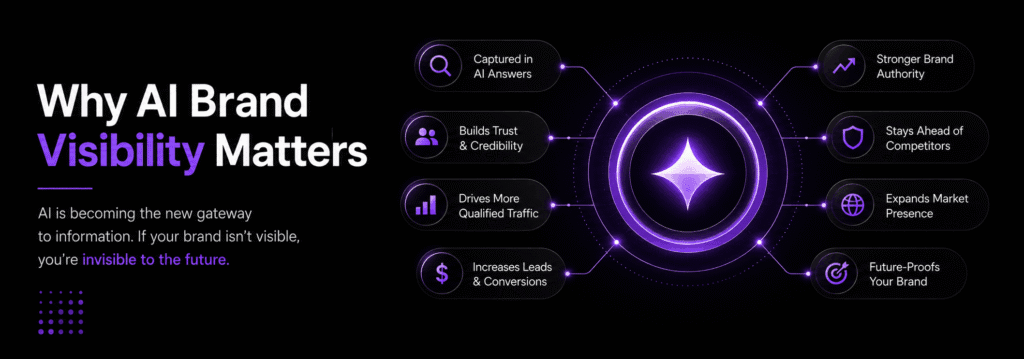
AI is increasingly becoming part of the research and discovery process.
A customer may not begin with:
“Google the best agency.”
They may ask:
“What agency can help a local business improve SEO?”
or:
“Who are the best SEO companies for small businesses?”
or:
“Compare these three SEO agencies.”
The answer can introduce brands before the customer ever visits a website.
That creates a new discovery opportunity.
Traditional Search
Query
↓
Search Results
↓
Website
↓
Brand Discovery
AI Search
Question
↓
AI-generated Answer
↓
Brand Recommendation / Mention
↓
Citation / Source
↓
Potential Website Visit
The important difference is that brand discovery can happen inside the answer itself.
Industry research on AI brand visibility increasingly focuses on exactly this shift: whether brands are named and cited inside AI answers rather than simply appearing as webpages in a conventional SERP.
AI Brand Visibility vs Traditional SEO
AI Brand Visibility does not replace SEO.
It builds on it.
| Traditional SEO | AI Brand Visibility |
|---|---|
| Keyword rankings | Brand mentions |
| SERP positions | AI answer presence |
| Organic CTR | Recommendation visibility |
| Backlinks | Citations and source relationships |
| Search impressions | Prompt-level visibility |
| Website traffic | Brand discovery inside AI answers |
| Ranking competitors | AI recommendation competitors |
This is why businesses should not abandon traditional SEO while pursuing AI Search.
Your technical SEO, content quality, authority, and website architecture still provide important foundations.
But AI Search introduces another layer:
Does the system understand and recognize your brand well enough to include it?
AI Brand Mention vs AI Citation
These two concepts are often confused.
AI Brand Mention
An AI system names your business.
Example:
“Revolute X Digital provides SEO and AI Search Optimization services.”
That’s a brand mention.
AI Citation
The AI response provides a source link to your website or another relevant page.
For example:
Answer → supporting source → your website
That’s a citation.
A page can be cited without the brand being clearly mentioned.
Conversely, a brand can be mentioned without receiving a direct citation.
That’s why your AI visibility measurement system should track both separately.
Your AI Citation Rate article goes deeper into citation behavior and source attribution.
How AI Understands a Brand
For AI systems to consistently recognize a company, the brand needs to exist as more than a single webpage.
Think about your brand as an interconnected entity.
Brand
↓
Organization
↓
Website
↓
Services
↓
Authors
↓
Locations
↓
Reviews
↓
External Mentions
↓
Industry
↓
Related Topics
This is where your AI Entity SEO strategy becomes important.
A strong entity footprint makes your brand easier to understand in context.
For example, Revolute X Digital should consistently be associated with concepts such as:
- SEO
- Local SEO
- Google Business Profile optimization
- AI Search Optimization
- AI Search Visibility
- GEO
- AEO
- Digital marketing
The goal isn’t to force these associations.
The goal is to ensure your website and relevant external sources consistently communicate what your business actually does.
What Influences AI Brand Visibility?
There isn’t one universal AI Brand Visibility algorithm.
ChatGPT, Gemini, Perplexity, Google AI Overviews, and other AI-powered systems can use different retrieval and generation systems.
However, several practical areas are worth strengthening.
1. Relevant Content
Create useful content around the topics your customers actually ask about.
2. Entity Clarity
Make your organization, services, authors, and expertise clear.
3. Topical Authority
Build a connected content ecosystem rather than publishing isolated articles.
4. Third-Party Mentions
Relevant articles, reviews, directories, publications, and community discussions can contribute additional context around your brand.
5. Reviews and Reputation
Customer feedback can provide important information about how a business is perceived.
6. Brand Consistency
Your business should be described consistently across important web properties.
7. Original Expertise
Case studies, research, testing, and first-hand experience can differentiate your content from generic information.
Recent industry analyses increasingly emphasize that AI brand visibility depends on a broader web presence rather than simply publishing more content on your own domain.
Branded vs Unbranded AI Prompts
This is one of the most important concepts when measuring AI Brand Visibility.
Branded Prompt
The user already knows your company.
Example:
“What does Revolute X Digital do?”
The AI already has the brand name.
This measures brand recognition.
Unbranded Prompt
The user doesn’t mention your company.
Example:
“What are the best AI Search Optimization agencies?”
If Revolute X Digital appears, that’s much more valuable from a discovery perspective.
Why?
Because the customer didn’t tell AI about your brand.
AI introduced the brand to the customer.
That’s a true discovery opportunity.
This distinction is increasingly used in AI visibility measurement frameworks, where branded and unbranded prompts are tracked separately.
How to Measure AI Brand Visibility
Don’t measure AI visibility by asking one question once.
AI-generated responses can vary.
Instead, create a structured prompt set.
For example:
100 Target Prompts
Informational: 25
Commercial: 25
Comparison: 20
Recommendation: 20
Local: 10
Then test across relevant platforms.
For example:
- ChatGPT
- Google AI Overviews / AI search experiences
- Gemini
- Perplexity
- Claude
Track:
| Metric | What It Measures |
|---|---|
| Brand Mention Rate | How often your brand is named |
| Citation Rate | How often your sources are cited |
| Recommendation Rate | How often AI recommends your brand |
| AI Share of Voice | Your visibility compared with competitors |
| Sentiment | How positively or negatively your brand is described |
| Prompt Coverage | How many relevant prompts produce visibility |
| Competitor Visibility | How often competitors appear |
This connects directly to your AI Search Visibility Metrics and KPIs pillar.
How to Improve AI Brand Visibility
Improving AI Brand Visibility isn’t about publishing hundreds of articles.
It is about building stronger evidence around your brand.
1. Build Topic Authority
Create useful content around your core expertise.
For Revolute X Digital, this includes:
- AI Search Optimization
- AI Search Visibility
- AI SEO
- GEO
- AEO
- Local SEO
- SEO strategy
Your existing cluster already provides a strong foundation.
2. Strengthen Your Entity
Make sure your organization is clearly represented across your website.
Use:
- Organization information
- Author pages
- Service pages
- About page
- Consistent company information
- Appropriate structured data
- Relevant business profiles
Your AI Entity SEO article provides the deeper strategy.
3. Earn Relevant Third-Party Mentions
This is an important area.
Look beyond your own website.
Potential sources include:
- Industry publications
- Relevant directories
- Reviews
- Interviews
- Podcasts
- Digital PR
- Professional communities
- Industry blogs
- Comparison resources
The goal is not to manufacture mentions.
The goal is to earn relevant, credible references that accurately describe your business.
Several current AI visibility studies emphasize the importance of third-party sources and off-site brand context.
4. Create Answer-First Content
When someone asks a question, answer it clearly.
Don’t hide the answer under unnecessary introductions.
Use:
Question
↓
Direct Answer
↓
Explanation
↓
Example
↓
Supporting Evidence
This structure also works extremely well with your existing Prompt Coverage strategy.
5. Create Comparison and Recommendation Content
Commercial AI prompts frequently involve comparisons.
Examples:
- Best SEO agencies
- Best AI SEO tools
- Best local SEO companies
- SEO agency vs freelancer
- Best AI Search Optimization services
Make sure your website provides genuinely useful information around the decision-making process.
Don’t create fake “best companies” articles designed only to promote yourself.
That destroys credibility.
Competitive AI Brand Visibility
One of the most useful applications is competitor monitoring.
Imagine tracking:
100 commercial prompts
Your Brand
Mentioned: 27
Recommended: 14
Cited: 19
Competitor A
Mentioned: 42
Recommended: 25
Cited: 31
Competitor B
Mentioned: 34
Recommended: 18
Cited: 22
Now you have something actionable.
Instead of saying:
“Our AI visibility is low.”
you can ask:
“Why is Competitor A appearing in 42% of relevant prompts while we appear in only 27%?”
Then analyze:
- Which sources are being cited?
- Which topics do they cover?
- Which third-party websites mention them?
- Which services are associated with them?
- Which prompts trigger their recommendations?
That becomes a genuine competitive intelligence process.
Common AI Brand Visibility Mistakes
Only Measuring Your Own Brand
You need competitors for context.
A 30% mention rate could be excellent—or terrible—depending on the competitive landscape.
Confusing Citations With Mentions
A citation doesn’t automatically mean the brand was named.
Track both.
Tracking Only Branded Prompts
Branded prompts measure recognition.
Unbranded prompts measure discovery.
You need both.
Publishing More Instead of Building Authority
More content isn’t automatically more visibility.
A smaller collection of excellent, connected resources can be more valuable than hundreds of generic articles.
Ignoring Third-Party Sources
Your own website is only one part of your brand’s digital footprint.
AI systems can encounter your brand through many sources.
Measuring One AI Platform
Your brand might appear frequently in one AI system and rarely in another.
Cross-platform measurement provides a more complete picture.
Real Example
Imagine a customer asks:
“What are the best AI Search Optimization agencies for small businesses?”
AI Response
Agency A
Agency B
Agency C
Revolute X Digital is missing.
You investigate.
Your website already contains:
- AI Search Visibility Metrics and KPIs
- AI Citation Rate
- Prompt Coverage
- AI Search Analytics
- AI Entity SEO
- Google AI Overviews Optimization
- AI Search Ranking Factors
So the problem isn’t simply:
“We need another blog.”
Instead, you investigate:
Content
Are you covering the relevant commercial questions?
Entity
Is Revolute X Digital clearly associated with AI Search Optimization?
Authority
Are other relevant websites discussing your agency?
Reviews
Does your reputation reinforce your positioning?
Competitive Gap
Which sources are helping competitors appear?
This creates a much better optimization strategy than simply publishing another generic AI SEO article.
AI Brand Visibility and Your Existing AI Search Cluster
This article should connect directly to your existing pillar.
Your content ecosystem now becomes:
AI Search Visibility Metrics & KPIs
↓
How to Measure AI Search Visibility
↓
↓
↓
↓
↓
↓
Google AI Overviews Optimization
↓
↓
AI Brand Visibility
The new article adds another dimension:
What happens when the metric isn’t just the page—but the brand itself?
That makes this a natural supporting article rather than a competing pillar.

The Future of AI Brand Visibility
AI Search is moving beyond simple information retrieval.
Users increasingly ask AI systems to:
- Compare businesses
- Recommend products
- Find services
- Evaluate alternatives
- Summarize reviews
- Explain differences
- Make purchasing decisions
That means brand visibility can influence the customer before the customer reaches your website.
The future measurement model may therefore look less like:
Rankings → Clicks → Traffic
and more like:
Prompt
↓
AI Answer
↓
Brand Mention
↓
Recommendation
↓
Citation
↓
Consideration
↓
Website Visit / Conversion
That doesn’t make traditional SEO irrelevant.
It makes brand visibility another layer of the search journey.
Conclusion
AI Brand Visibility is about more than getting your company name mentioned by ChatGPT or another AI assistant.
It is about whether AI systems:
- Recognize your brand
- Understand what your company does
- Associate your brand with the right topics
- Mention you for relevant questions
- Recommend you for commercial searches
- Cite credible sources connected to your brand
- Describe your business accurately
- Position you favorably against competitors
The strongest strategy isn’t to chase individual AI answers.
Build the underlying brand ecosystem.
Helpful content
↓
Topical authority
↓
Entity clarity
↓
Original expertise
↓
Third-party authority
↓
Consistent brand signals
↓
AI visibility measurement
For Revolute X Digital, this becomes another important layer of the broader AI Search Visibility Metrics & KPIs framework.

Zack
Zack Robinson is a Digital Marketing Specialist at Revolute X Digital, specializing in SEO, Local SEO, Google Business Profile optimization, AI automation, and lead generation. He helps businesses improve their online visibility, attract qualified customers, and achieve sustainable growth through data-driven digital marketing strategies.