
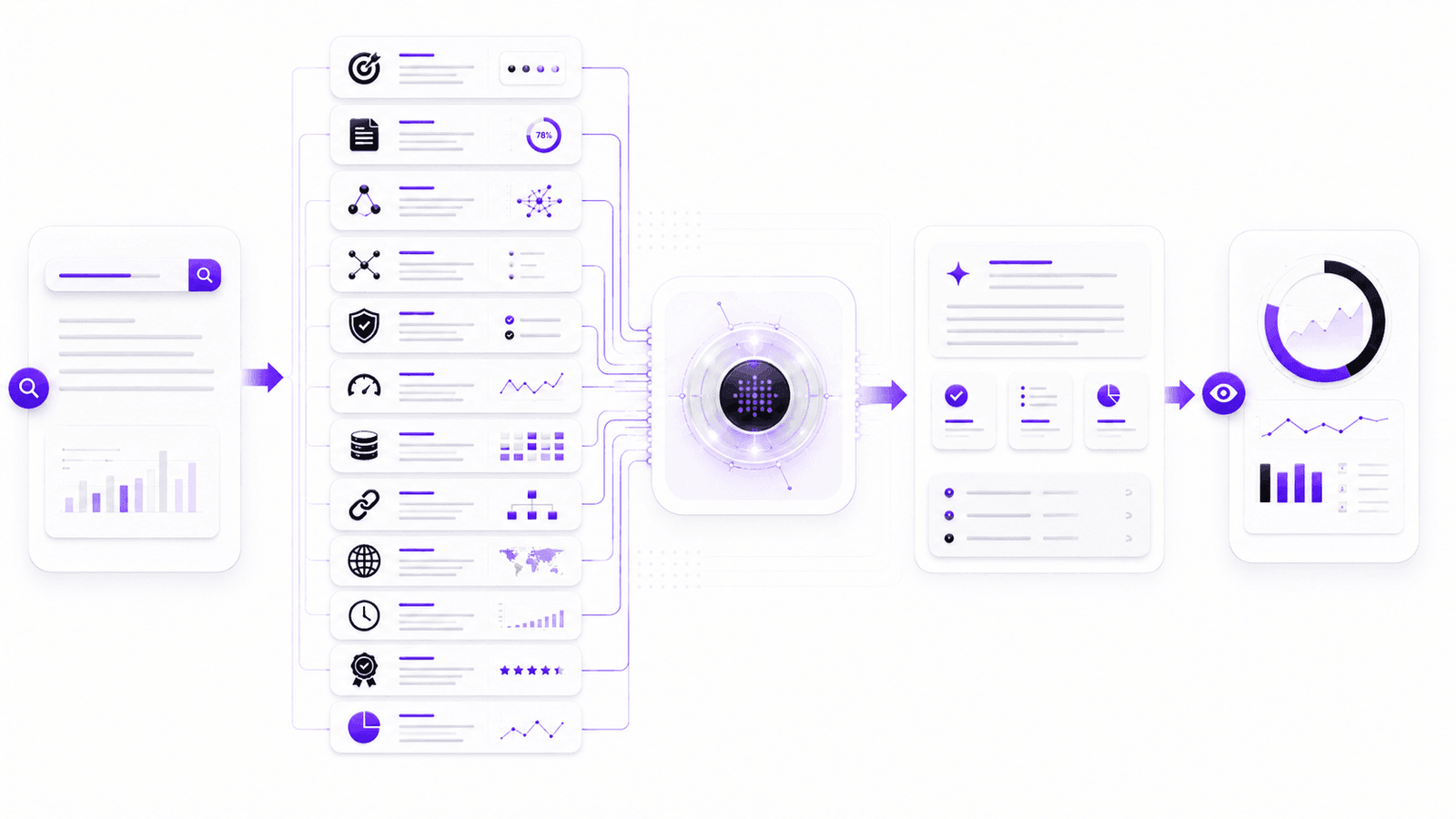
Search is no longer limited to a page of ten blue links.
People now ask increasingly complex questions and expect search systems to understand the context, compare information, summarize multiple sources, and provide recommendations.
Google’s AI Overviews and AI Mode are part of that evolution. Google explains that these AI experiences can use multiple related searches and supporting web pages to develop responses, creating opportunities for a wider range of websites to appear in AI-powered search experiences.
That creates a new question for businesses:
What are the AI Search Ranking Factors that influence whether a website gets discovered, referenced, cited, or recommended in AI-powered search?
The answer is more complicated than a traditional ranking-factor checklist.
There is no publicly confirmed formula such as:
Content + backlinks + Schema = AI ranking
And Google specifically says there are no special technical requirements or additional optimization requirements for appearing in AI Overviews or AI Mode. A page must meet Google’s normal technical requirements, be indexed and eligible for a Search snippet, and follow Search policies.
However, when we examine Google’s own documentation alongside current industry research and platform-specific observations, several themes consistently appear:
- Search intent and relevance
- Helpful, original content
- Topical depth
- Entity understanding
- Expertise and trust
- Content structure
- Technical accessibility
- Internal linking
- External authority
- Freshness when the topic requires it
- Clear source attribution
- Strong brand and entity signals
These aren’t a secret list of “AI ranking factors.”
They are the foundations that make content easier to discover, understand, evaluate, retrieve, and use in modern search experiences.

What Are AI Search Ranking Factors?
AI Search Ranking Factors are the signals and characteristics that can influence whether content is considered relevant, useful, trustworthy, accessible, and suitable for inclusion or citation within AI-powered search experiences.
Traditional search primarily asks:
Which pages are most relevant to this query?
AI-powered search can involve additional stages:
Query Understanding
↓
Related Searches / Query Expansion
↓
Content Retrieval
↓
Source Evaluation
↓
Answer Generation
↓
Citations / Supporting Links
Google says AI Overviews and AI Mode may use a technique called query fan-out, where related searches are performed across subtopics and data sources to develop the response.
This means a single user question can create multiple opportunities for relevant pages to be discovered.
For example:
“What is AI Search Optimization?”
could involve related concepts such as:
- AI Search
- GEO
- AEO
- Entity SEO
- AI citations
- Prompt Coverage
- AI visibility
- Search optimization
A page that provides useful information across these relationships can potentially offer more value than a page optimized around one exact keyword.
The Most Important AI Search Ranking Factors
There isn’t one universally confirmed ranking-factor list across Google AI Overviews, ChatGPT, Gemini, Claude, and Perplexity.
Each platform can use different systems.
So instead of pretending that one checklist applies everywhere, it’s more useful to organize the major signals into a practical framework.
1. Search Intent and Query Relevance
The first question is simple:
Does the content actually answer what the user wants to know?
This remains one of the most important foundations of search.
If someone searches:
“How does freshness influence AI Search Ranking Factors?”
they aren’t necessarily looking for a general article about AI SEO.
They want to understand the relationship between:
Freshness → Content Updates → Relevance → AI Search Visibility
A page that directly addresses that relationship has stronger intent alignment than a page that merely repeats the phrase “AI Search Ranking Factors.”
Google’s own guidance emphasizes creating helpful content that satisfies the audience rather than content created primarily to manipulate search rankings.
Practical approach
Before publishing, ask:
- What question is the user really asking?
- What problem are they trying to solve?
- What information would they need next?
- What would make the answer genuinely useful?
Start there.
2. Helpful, Original, People-First Content
Google’s current guidance puts significant emphasis on helpful, reliable, people-first content.
Google specifically recommends content that provides original information, research, analysis, or substantial value rather than simply rewriting what other websites already publish.
This is especially important in AI Search.
If five websites already explain the same concept in almost identical language, another rewritten version adds little value.
A stronger page might add:
- Original examples
- First-hand experience
- Proprietary data
- Screenshots
- Case studies
- Expert commentary
- Original frameworks
- Testing methodology
- Real implementation details
For Revolute X Digital, this is a major opportunity.
Instead of publishing:
“AI Search is changing SEO.”
Show readers how your agency actually analyzes AI visibility.
That creates information that is harder to replace with generic AI-generated summaries.
3. Topical Authority
A single page can rank.
A connected content ecosystem can establish expertise.
This is why topical authority is important to your current content strategy.
Your AI Search cluster already has multiple specialized resources:
AI Search Visibility Metrics & KPIs
↓
How to Measure AI Search Visibility
↓
↓
↓
↓
↓
Google AI Overviews Optimization
↓
Now this article adds another layer:
AI Search Ranking Factors
This creates a stronger semantic ecosystem because each article answers a different question.
Your pillar explains the measurement framework.
Your supporting articles explain individual metrics.
Your Entity SEO article explains entity understanding.
Your AI Overview article explains Google’s AI search experience.
And this article explains the signals and foundations behind AI Search visibility.
That’s topical authority—not simply publishing more articles.
4. Entity Understanding
AI-powered search needs context.
A business shouldn’t be represented as a random collection of webpages.
Search systems need to understand:
- Who the business is
- What it does
- Which services it provides
- Which people represent it
- Which locations it serves
- Which topics it specializes in
- Which other entities are associated with it
This is why Entity SEO has become an important part of your AI Search content cluster.
For example:
↓
Digital Marketing Agency
↓
SEO
↓
↓
AI Search Optimization
↓
GEO
↓
AEO
↓
These relationships create contextual meaning.
Related Reading: See our AI Entity SEO guide for a deeper explanation of entity relationships, Knowledge Graph concepts, structured data, brand consistency, and entity authority.
5. Expertise, Experience, Authority, and Trust
Google describes E-E-A-T as a useful framework for evaluating content quality, while also making clear that E-E-A-T itself is not a single specific ranking factor.
That distinction is important.
Don’t write:
“E-E-A-T is an AI ranking factor with a fixed score.”
Instead, think about the underlying signals that demonstrate trust.
Experience
Show that the information comes from actual experience.
Examples:
- Case studies
- Screenshots
- Testing
- Campaign results
- Real implementation examples
Expertise
Demonstrate subject knowledge.
Use:
- Qualified authors
- Author bios
- Relevant experience
- Detailed explanations
- Accurate information
Authoritativeness
Build recognition beyond your own website.
Examples:
- Relevant publications
- Industry mentions
- Trusted links
- Expert references
- Brand citations
Trustworthiness
Make the website transparent and credible.
Examples:
- Accurate business information
- Contact information
- Clear authorship
- Sources
- Privacy policy
- Secure website
- Transparent editorial practices
Google’s guidance specifically encourages clear authorship and information that helps readers understand who created content and why they should trust it.
6. Content Comprehensiveness
AI-powered search often needs to answer complex questions.
That means your page should not stop at the first obvious answer.
For example:
AI Search Ranking Factors
could naturally cover:
- What AI Search Ranking Factors are
- Search intent
- Content quality
- Topical authority
- Entities
- Technical SEO
- Freshness
- Structured content
- Citations
- Brand authority
- Measurement
- Common mistakes
This creates a complete resource.
However, comprehensive does not mean unnecessarily long.
Google explicitly says there is no preferred word count.
The correct question isn’t:
“How many words should I write?”
It’s:
“How much information does this topic actually require to be useful?”
7. Content Structure and Extractability
AI systems need to process information efficiently.
Clear structure also improves the human reading experience.
Use:
- Descriptive H2 headings
- H3 subtopics
- Short paragraphs
- Bullet lists
- Tables
- Definitions
- Step-by-step instructions
- Examples
- FAQs
For example:
What is an AI Search Ranking Factor?
Provide a direct definition.
Then explain it.
Then give an example.
Then explain how businesses can improve it.
This structure is easier for readers to navigate and makes individual concepts clearly separated.
SEOmonitor’s analysis similarly emphasizes relevance, content structure, readability, and direct answers as important considerations for AI Overview visibility.
8. Technical SEO and Crawlability
Before content can be evaluated, search systems need to be able to access it.
This makes technical SEO a foundational AI Search factor.
Google’s official guidance states that pages need to be indexed and eligible to appear in Google Search to be eligible as supporting links in AI Overviews or AI Mode.
Check:
- Robots.txt
- XML sitemap
- Indexation
- Canonical URLs
- Internal links
- HTTPS
- Mobile usability
- Rendering
- Page performance
- Broken links
- Redirects
Google also recommends making important content available in textual form and ensuring structured data matches visible page content.
The simple rule
If Google can’t reliably access and understand your page, content optimization can’t compensate for the technical problem.
9. Page Experience
Good content still needs a good user experience.
Google’s page-experience guidance recommends considering:
- Core Web Vitals
- Mobile usability
- Secure delivery
- Avoiding intrusive interstitials
- Clear separation between main content and distracting elements
But don’t make the mistake of treating Core Web Vitals as a magic AI ranking switch.
Google explicitly notes that good scores do not guarantee top rankings.
Think of page experience as part of the overall quality of your website—not a shortcut to AI visibility.
10. Structured Data
Structured data can help search engines understand the content and entities on a webpage.
Useful types can include:
- Organization
- Article
- Person
- Service
- Product
- FAQ
But here’s an important distinction for your agency content:
Schema is not a secret AI Overview ranking factor.
Google explicitly says there is no special Schema.org structured data required for AI Overviews or AI Mode. Existing structured-data best practices still apply, and the markup should accurately represent visible content.
So use Schema because it helps describe your content—not because someone promised it will produce AI citations.
11. Internal Linking and Semantic Relationships
Internal links help connect related resources.
For your AI Search cluster:
AI Search Visibility Metrics & KPIs
↓
↓
↓
↓
↓
Google AI Overviews Optimization
↓
AI Search Ranking Factors
Each link creates a meaningful relationship.
This also helps users move from a broad explanation to deeper resources.
12. External Authority and Brand Mentions
Your website doesn’t exist in isolation.
External references can help establish your brand’s reputation and context.
Examples include:
- Industry publications
- Relevant business directories
- Expert interviews
- Digital PR
- Podcasts
- Professional organizations
- Research references
- Relevant editorial links
But don’t reduce this to:
“More backlinks = better AI ranking.”
That’s too simplistic.
The more useful concept is earned authority.
A relevant, trusted mention about your company can provide more contextual value than dozens of unrelated links.
Google’s people-first guidance also asks whether a site would be recognized as a trusted or well-known authority in its subject area.
13. Freshness and Content Updates
Freshness matters—but not for every query.
This is one of the most important points for your target keyword:
how freshness influences AI search ranking factors
Consider two searches:
Query A
“What is a Knowledge Graph?”
This information is relatively stable.
A page doesn’t necessarily need constant updates.
Query B
“Best AI Search tools in 2026”
This information can change quickly.
New tools appear.
Features change.
Pricing changes.
Companies disappear.
The answer needs more frequent review.
Google specifically warns against changing dates without substantially changing content or adding content merely to make a site appear fresh.
So the right strategy is:
Update when information needs updating—not simply because the calendar changed.
Refresh:
- Statistics
- Examples
- Screenshots
- Tool information
- Industry developments
- Outdated recommendations
- Broken references
14. Source Quality and Attribution
AI-powered search increasingly relies on multiple sources.
That makes source quality important.
When making factual claims, especially claims involving:
- Statistics
- Research
- Industry data
- Regulations
- Product specifications
- Current events
provide credible sources.
Don’t write:
“Studies prove AI citations increase traffic by 35%.”
unless you can identify and verify the actual study.
This is particularly important because several SEO websites publish impressive statistics that may come from third-party research, proprietary datasets, or unclear methodologies.
For Revolute X Digital, transparent sourcing is a competitive advantage.
15. Clear, Quotable Information
AI-generated answers need information that can be understood in context.
That doesn’t mean writing unnatural “AI bait.”
Instead, create clear statements.
For example:
AI Search Ranking Factors are the signals and content characteristics that influence whether information is considered relevant, useful, trustworthy, and accessible within AI-powered search experiences.
Then explain the concept.
Use:
- Short definitions
- Clear paragraphs
- Lists
- Tables
- Examples
- Specific claims
This makes your content easier for people to understand and easier for systems to interpret.
How AI-Powered Search Engines Rank Results: Factors to Understand
One of the most common questions is:
How do AI-powered search engines rank results?
The answer depends on the platform.
Google AI Overviews are not the same as ChatGPT Search.
Perplexity isn’t identical to Gemini.
Claude doesn’t necessarily use the same retrieval process as Google.
That’s why you shouldn’t create one universal “AI algorithm.”
A better model is:
Query Understanding
↓
Retrieval
↓
Relevance
↓
Source Evaluation
↓
Selection
↓
Answer Generation
↓
Citation / Recommendation
Different platforms can place different emphasis on these stages.
Google’s official documentation confirms that AI Overviews and AI Mode can use query fan-out and multiple supporting sources, while also stating that AI experiences continue to rely on Google’s existing SEO foundations.
Industry analyses from SEOmonitor and SEOcrawl similarly emphasize recurring themes such as intent alignment, content quality, authority, structure, technical accessibility, and source trust.
Do You Need to Rank #1 to Appear in AI Search?
Not necessarily.
This is an important distinction.
Traditional SEO is heavily concerned with ranking position.
AI Search can involve source selection and citation.
Some industry analyses report examples of AI Overview citations coming from pages that are not the top organic result. SEOcrawl specifically emphasizes that citation selection can extend beyond the highest-ranking pages, while SEOmonitor likewise notes that AI-generated answers can draw from sources that aren’t simply the highest organic result.
However, don’t interpret this as:
“Rankings don’t matter anymore.”
That’s equally wrong.
Google’s official guidance says AI Overview and AI Mode supporting links must still be indexed and eligible to appear in Google Search.
So traditional SEO remains an important foundation.
What Factors Influence Ranking in AI-Powered Search Overviews?
For Google AI Overviews specifically, the safest way to answer this is to separate confirmed requirements from practical optimization signals.
Confirmed by Google
A page should:
- Be indexed
- Be eligible to appear in Google Search
- Meet technical requirements
- Follow Search policies
- Provide helpful, reliable, people-first content
Google says there are no additional technical requirements specifically for AI Overviews.
Practical areas worth optimizing
- Search intent
- Content relevance
- Original value
- Topical depth
- Clear structure
- Entity understanding
- Author information
- Internal linking
- Technical accessibility
- Page experience
- Accurate structured data
- External authority
- Appropriate freshness
These should be treated as a holistic optimization framework, not as a guaranteed ranking formula.
A Practical AI Search Ranking Factors Framework
For an agency, I recommend prioritizing the factors like this:
Foundation
Crawlability
↓
Indexation
↓
Technical SEO
↓
Page Experience
Relevance
Search Intent
↓
Content Quality
↓
Semantic Coverage
↓
Comprehensive Answers
Authority
Expertise
↓
Experience
↓
Brand Mentions
↓
Relevant External Authority
Entity
Organization
↓
Authors
↓
Services
↓
Locations
↓
Topics
↓
Entity Relationships
AI Visibility
↓
AI Citation Rate
↓
AI Share of Voice
↓
Entity Presence
↓
This connects directly with your existing AI Search Visibility Metrics & KPIs pillar.
How to Improve AI Search Ranking Factors
If your website isn’t appearing in AI-powered search, don’t immediately rewrite everything.
Use a diagnostic process.
Step 1: Identify Target Queries
Build a list of important informational and commercial questions.
Step 2: Analyze the Current AI Results
Record:
- Which brands appear
- Which URLs are cited
- What information they provide
- What entities are mentioned
- Which subtopics are covered
Step 3: Compare Your Content
Ask:
- What does the competitor explain that we don’t?
- Do we have stronger original information?
- Is our answer clearer?
- Is our content up to date?
- Are our entities clear?
Step 4: Improve the Content
Add genuine value rather than padding.
Step 5: Strengthen the Cluster
Add supporting articles and internal links where gaps exist.
Step 6: Strengthen Authority
Build relevant mentions and demonstrate real expertise.
Step 7: Measure
Monitor AI visibility over time.
Common AI Search Ranking Mistakes
Keyword Stuffing
Repeating a keyword doesn’t create expertise.
Writing for AI Instead of People
If the article sounds robotic and unnatural, you’ve optimized for the wrong audience.
Google explicitly recommends people-first content.
Chasing a Word Count
There is no magic AI-search word count.
Google explicitly says not to write to a particular word count because you heard Google prefers it.
Publishing Generic AI Content
If your article simply summarizes the same information available everywhere, it has limited differentiation.
Ignoring Technical SEO
Excellent content can’t help much if the page isn’t properly crawlable or indexable.
Treating Schema as a Ranking Hack
Schema can help describe content, but Google says there is no special Schema required for AI Overviews.
Ignoring Entity SEO
A website should clearly communicate who the business is and what it specializes in.
Updating Content Without Adding Value
Changing a publication date isn’t a freshness strategy.
Google explicitly warns against this.
Measuring Only Google Rankings
AI Search requires additional visibility measurements.
Track:
- AI Share of Voice
- Citation Rate
- Prompt Coverage
- Entity Presence
- Brand Mentions
- AI Referral Traffic
How to Measure AI Search Ranking Performance
This is where your AI Search Visibility Metrics And KPIs pillar should become the deeper resource.
A practical measurement system can track:
| Metric | What It Tells You |
|---|---|
| AI Share of Voice | How much AI visibility your brand owns compared with competitors |
| AI Citation Rate | How frequently your content is cited |
| Prompt Coverage | How many relevant prompts produce your brand |
| Entity Presence | Whether AI consistently recognizes your brand |
| Brand Mentions | How frequently your brand is mentioned |
| Recommendation Rate | How often AI recommends your business |
| AI Referral Traffic | Website visits originating from AI platforms |
Google’s own Search Console guidance currently reports AI Overview and AI Mode traffic within the broader Web search type rather than providing a separate AI Overview performance filter.
That makes broader AI visibility tracking especially useful for agencies that want to understand mentions and citations beyond standard Search Console reporting.
Why AI Search Ranking Factors Are Different From Traditional SEO
The biggest difference isn’t that AI Search has completely new rules.
It’s that the search experience has expanded.
Traditional SEO asks:
Where does this page rank?
AI Search asks additional questions:
Is this information relevant?
Can the system understand the entity?
Does the source appear trustworthy?
Does it answer the user’s question?
Can the information support the generated answer?
Is the brand recognized across multiple sources?
This creates a broader concept:
Search Ranking → AI Search Visibility
And that’s why your SEO strategy should evolve without abandoning the fundamentals that made SEO work in the first place.
The Future of AI Search Ranking Factors
AI Search is still evolving.
Search systems are becoming increasingly capable of handling:
- Conversational queries
- Multi-step research
- Comparisons
- Recommendations
- Complex questions
- Follow-up questions
- Multiple sources
- Multimodal information
Google’s current documentation already describes AI Mode as being particularly useful for complex questions, exploration, and comparisons, while AI features can use multiple related searches to develop responses.
That means the future of SEO isn’t simply about adding more keywords.
It is about building information ecosystems that demonstrate:
Relevance
Experience
Expertise
Authority
Trust
Entity Clarity
Technical Accessibility
Original Value
The brands that build these foundations will be better prepared as AI-powered search continues to evolve.
Conclusion
There is no single list of AI Search Ranking Factors that guarantees visibility across every AI-powered search platform.
And that is important to understand.
Google itself says that AI Overviews and AI Mode don’t require special technical optimization beyond the normal requirements for Google Search.
The opportunity is therefore not to discover a secret algorithm.
It is to build a website that consistently demonstrates relevance, usefulness, expertise, authority, trust, strong entity relationships, technical accessibility, and original value.
For Revolute X Digital, this also fits directly into the larger AI Search content ecosystem.
Your AI Search Visibility Metrics & KPIs pillar explains how to measure visibility.
Your AI Citation Rate article explains citations.
Your Prompt Coverage article explains prompt-level visibility.
Your AI Search Analytics article explains reporting.
Your AI Entity SEO article explains entity relationships.
Your Google AI Overviews Optimization article focuses specifically on Google’s AI search experience.
And this article connects those concepts by explaining the factors that influence whether information can become visible within AI-powered search.
The future isn’t about choosing between SEO and AI Search.
It’s about building a search strategy strong enough to work across both.
Frequently Asked Questions About AI Search Ranking Factors
What are AI Search Ranking Factors?
AI Search Ranking Factors are the signals and content characteristics that influence whether information is considered relevant, useful, trustworthy, accessible, and suitable for visibility in AI-powered search experiences. They include search intent, content quality, topical relevance, entity clarity, technical accessibility, authority, and other contextual signals.
How do AI-powered search engines rank results factors?
AI-powered search systems can use multiple stages to determine what information appears in an answer. These may include query understanding, retrieval, relevance evaluation, source selection, and answer generation. The exact process differs between platforms, so there is no single ranking formula that applies to every AI search engine.
How does freshness influence AI Search Ranking Factors?
Freshness matters most when information changes frequently. News, product specifications, pricing, software features, statistics, and current recommendations may benefit from timely updates. Stable topics do not necessarily require frequent changes. The goal should be to keep information accurate and useful rather than changing publication dates simply to appear fresh.
What factors influence ranking in AI-powered search overviews?
For Google AI Overviews, important foundations include search intent, helpful content, relevance, technical accessibility, indexation, topical depth, clear structure, and trustworthy information. Google says there are no additional technical requirements specifically for AI Overviews beyond normal Search eligibility and SEO fundamentals.
What factors influence ranking in AI-powered search overviews?
AI-powered search visibility can be influenced by how well content satisfies the user’s query, the quality and originality of the information, topical relevance, entity understanding, source credibility, technical accessibility, and overall usefulness. These should be treated as a holistic framework rather than a guaranteed ranking formula.
Do I need to rank #1 on Google to appear in an AI Overview?
No. Ranking highly in traditional Google Search can provide a strong foundation, but AI-generated experiences can select supporting information in ways that don’t simply mirror the traditional ranking order. Google also confirms that AI features use relevant links and can explore information across related searches.
Is E-E-A-T an AI Search Ranking Factor?
E-E-A-T is not a single ranking factor with a measurable score. Google describes E-E-A-T as a framework for thinking about experience, expertise, authoritativeness, and trustworthiness, with trust being especially important. These qualities can be demonstrated through authorship, original experience, reliable sourcing, and reputation.
Does Schema Markup improve AI Search rankings?
Schema Markup helps search engines understand structured information about a webpage and its entities. However, Google says there is no special Schema.org markup required for AI Overviews or AI Mode. Use structured data accurately when it applies to the visible content rather than treating it as an AI ranking shortcut.
Does topical authority matter for AI Search?
Topical authority can strengthen your website’s ability to demonstrate depth and expertise around a subject. A connected group of high-quality articles can provide broader context than an isolated page, especially when those articles answer different aspects of the same topic and are connected through useful internal links.
How important are backlinks for AI Search?
Relevant, high-quality backlinks can contribute to broader website authority, but backlinks should not be treated as the only factor determining AI visibility. A strong strategy combines authority with useful content, search-intent alignment, entity clarity, technical accessibility, and original information.
How important is content freshness for AI Search?
Freshness is important when the underlying information changes. Updating an article can be valuable when statistics, examples, products, recommendations, or industry conditions become outdated. Simply changing the date without materially improving the content is not a meaningful freshness strategy.
Can small businesses compete in AI Search?
Yes. Smaller businesses can build AI Search visibility by demonstrating genuine expertise, publishing original content, strengthening their brand entity, maintaining accurate business information, answering customer questions, earning relevant mentions, and building topical authority in a focused niche.
How do I measure AI Search Ranking Factors?
You cannot directly measure every underlying algorithmic signal. Instead, measure outcomes such as AI Share of Voice, AI Citation Rate, Prompt Coverage, Entity Presence, Brand Mentions, Recommendation Rate, organic search performance, and AI referral traffic.
What is the difference between AI Search Ranking Factors and traditional SEO ranking factors?
Traditional SEO focuses heavily on organic search visibility, while AI Search adds another layer involving retrieval, citations, recommendations, and AI-generated answers. The underlying foundations overlap significantly: useful content, relevance, technical accessibility, authority, and strong user experience remain important.
How can I improve my AI Search Ranking Factors?
Start with technical SEO and indexation, then improve search-intent alignment, content quality, topical coverage, entity clarity, authorship, internal linking, external authority, and appropriate content freshness. Finally, monitor AI visibility and use the results to identify content and entity gaps.

Zack
Zack Robinson is a Digital Marketing Specialist at Revolute X Digital, specializing in SEO, Local SEO, Google Business Profile optimization, AI automation, and lead generation. He helps businesses improve their online visibility, attract qualified customers, and achieve sustainable growth through data-driven digital marketing strategies.