
For years, Google Search has primarily presented users with a ranked list of webpages. Businesses competed for organic positions by improving technical SEO, creating useful content, building authority, and targeting relevant search queries.
Today, the search experience is evolving.
Google AI Overviews can provide a synthesized answer directly within the search experience, along with links to supporting sources. Instead of requiring users to open several webpages and combine information themselves, an AI-generated response can summarize relevant information and help users explore the topic further.
That changes an important question for SEO professionals and business owners.
Instead of asking only:
Modern search strategy also needs to ask:
“How can my content become useful enough to be selected, referenced, or surfaced within an AI-generated answer?”
This does not mean traditional SEO is obsolete. Organic rankings, crawlability, indexing, content quality, technical performance, links, and search intent remain important foundations.
Instead, AI Overviews add another visibility layer to Google Search.
This is where Google AI Overviews Optimization becomes relevant.
Google AI Overviews Optimization is the process of improving the quality, relevance, structure, authority, and contextual clarity of your content so it can compete for visibility within AI-generated search experiences.
However, it is important to understand what this strategy is not.
There is no secret formula that guarantees inclusion in an AI Overview. There is no specific word count, number of headings, or Schema Markup implementation that guarantees Google will select a particular page.
A sustainable strategy focuses on creating content that is:
- Helpful
- Accurate
- Relevant
- Clearly structured
- Easy to understand
- Supported by trustworthy information
- Connected to strong entities and topical authority
The objective is not to manipulate an AI system.
The objective is to create information that genuinely deserves to be discovered, understood, referenced, and presented to users.
What Are Google AI Overviews?
Google AI Overviews are AI-generated summaries that can appear within Google Search for certain queries.
Rather than presenting only a traditional list of organic results, an AI Overview can synthesize information to provide users with a broader answer to their search.
For example, a user might search a complex question that normally requires visiting several webpages.
Instead of making the user research each source independently, Google may provide an AI-generated overview that brings relevant information together and provides links to supporting webpages.
Those supporting links are important because they give users an opportunity to investigate the information further and visit the underlying sources.
For businesses and publishers, this creates a new form of search visibility.
Your webpage may not simply compete for a traditional organic position. It may also have an opportunity to become one of the sources supporting an AI-generated response.
AI Overviews Are Not Traditional Search Results
A traditional organic result generally points users toward a webpage.
An AI Overview can summarize information from multiple sources and present the user with a synthesized response.
That means the visibility experience is different.
Traditional SEO asks:
“Where does my webpage rank?”
AI Search introduces additional questions:
- Is my content relevant to the query?
- Could my information help answer the user’s question?
- Is my website understood as an authoritative source?
- Is my business or organization clearly identified?
- Does my content provide useful supporting information?
- Is my page connected to a broader topic cluster?
These questions are particularly important when developing an AI Search Optimization strategy.
Why Supporting Links Matter
AI-generated answers do not eliminate the importance of original sources.
Supporting links give users a path to investigate information beyond the summary.
For publishers and businesses, being referenced as a supporting source can create an additional visibility opportunity.
This is why content quality remains critical.
A page that simply repeats information found everywhere else has little differentiation.
A stronger resource can provide:
- Original research
- First-hand experience
- Expert explanations
- Practical examples
- Clear definitions
- Useful comparisons
- Data
- Case studies
- Comprehensive topic coverage
The goal is to become a genuinely useful source rather than simply trying to appear in an AI-generated answer.
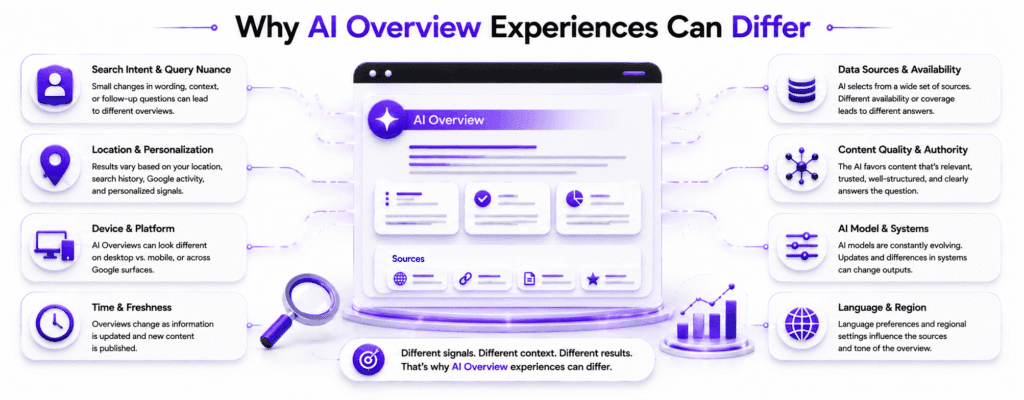
Why AI Overview Experiences Can Differ
Not every search produces the same AI-generated experience.
The response can depend on the query, the information available for that query, and the search context.
One query might produce an AI Overview while another similar query may produce a traditional search experience.
The sources presented can also vary.
This is important when measuring AI visibility.
A single manual search should not be treated as permanent evidence that a webpage will always appear in an AI Overview.
Instead, businesses should monitor a meaningful set of relevant queries over time.
This is where AI Search measurement becomes valuable.
Metrics such as AI Share of Voice, AI Citation Rate, Prompt Coverage, Entity Presence, and Brand Mentions can provide a broader view of how a brand performs across AI-powered search experiences.
Google AI Overviews vs. Traditional Search
The easiest way to understand the difference is to compare the primary visibility experience.
| Traditional Search | Google AI Overviews |
|---|---|
| Ranked webpages | AI-generated synthesis |
| Keyword and query relevance | Query understanding and synthesis |
| Blue links | Direct answer with supporting sources |
| Ranking position | Inclusion and reference opportunity |
| Primarily measured through rankings and CTR | Visibility, references, citations, and downstream traffic |
This doesn’t mean one replaces the other.
AI Overviews add another visibility layer; they don’t eliminate traditional SEO.
A business still needs a technically accessible website, useful content, strong topical relevance, and trustworthy information.
The difference is that modern search visibility now extends beyond the traditional ranking page.
The New SEO Question
For years, the central SEO question was:
“How can I rank higher?”
That question still matters.
But businesses competing in modern search should also ask:
“How can I become the source that search systems understand, trust, and use when answering my customer’s question?”
That shift is at the heart of Google AI Overviews Optimization.
It requires a broader strategy that combines traditional SEO with helpful content, clear information architecture, entity optimization, topical authority, structured information, and continuous measurement.
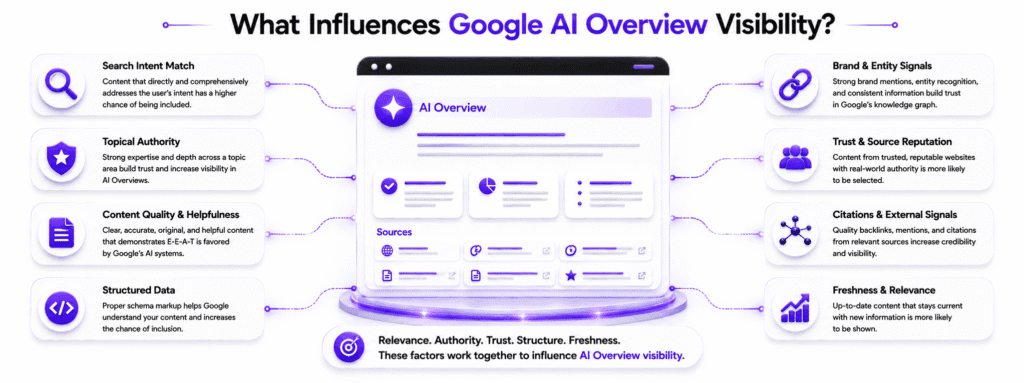
What Influences Google AI Overview Visibility?
Appearing in a Google AI Overview is not something you can achieve by inserting a keyword a certain number of times or following a single optimization formula.
A stronger approach is to make your content useful, understandable, trustworthy, and closely aligned with the user’s actual information need.
Google’s AI-powered search experiences can synthesize information from multiple sources, which means your page needs to provide clear information that can stand on its own while fitting into a broader topical ecosystem.
Several foundations are particularly important.
Search Intent
The first foundation is search intent.
Your content needs to satisfy the actual question behind the query—not simply contain the words in the query.
For example, consider the search:
A weak article might repeat the phrase local SEO throughout the page without actually explaining what the user should do.
A stronger resource would explain:
- What local SEO means
- How local SEO works
- Which factors influence local visibility
- How Google Business Profile fits into the strategy
- How citations and reviews contribute
- How businesses can measure results
The difference is important.
Keyword relevance gets you into the conversation. Search intent determines whether your content actually answers it.
When creating content for AI-powered search, start with the question the user is trying to solve and build the page around that information need.
Helpful, Complete Content
The next foundation is content quality.
Don’t create an article simply because a keyword has search volume.
Create a resource that genuinely helps someone solve a problem.
A strong page should answer the main question and anticipate the most useful follow-up questions.
For example, an article targeting “Google AI Overviews Optimization” could also explain:
- What Google AI Overviews are
- How they differ from traditional search
- How AI-generated answers affect SEO
- What makes content useful for AI search
- How entities influence understanding
- How to measure AI visibility
- Common optimization mistakes
- How to monitor changes over time
This creates a more complete resource than an article focused exclusively on one keyword.
The goal isn’t to make the page unnecessarily long.
The goal is to make it complete enough to satisfy the user’s needs.
Topical Authority
A single page can be useful, but a website becomes much stronger when multiple relevant resources demonstrate expertise around the same subject.
This is the foundation of topical authority.
For example, your AI Search content ecosystem can be structured around a central pillar:
AI Search Visibility Metrics & KPIs
↓
AI Citation Rate
↓
Prompt Coverage
↓
AI Share of Voice
↓
AI Search Analytics
↓
AI Entity SEO
↓
Google AI Overviews Optimization
↓
GEO vs SEO vs AEO
Each article addresses a different aspect of AI Search while supporting the broader topic.
This structure gives users multiple resources to explore and helps establish clear relationships between related subjects.
Related Guide: Our AI Search Visibility Metrics & KPIs guide explains the broader measurement framework, including AI Share of Voice, AI Citation Rate, Prompt Coverage, Entity Presence, and other AI Search KPIs.
The important principle is to avoid creating multiple articles that say essentially the same thing.
Each supporting page should have its own search intent, primary topic, and unique value.
Entity Understanding
Content doesn’t exist in isolation.
Search systems also need to understand who created the content, who publishes it, what the website specializes in, and how the entities discussed on the page relate to one another.
Important entity signals can include:
- Who created the content
- What organization publishes it
- What subject the website specializes in
- Which services or products are discussed
- Which people, organizations, locations, and concepts are connected to the topic
For example, if a digital marketing agency publishes an article about AI Search Optimization, its broader website should make it clear that the organization actually specializes in digital marketing, SEO, AI Search, and related services.
This creates contextual consistency.
Your website, authors, services, content, business profiles, and external mentions should tell a consistent story about your brand.
This is where your AI Entity SEO article naturally fits into the cluster.
Structured Content
The way information is organized also matters.
A well-structured page makes it easier for both users and search systems to understand the information being presented.
Use:
- Clear H2 and H3 headings
- Concise definitions
- Lists
- Tables
- Step-by-step explanations
- FAQs
- Supporting examples
- Descriptive internal links
For example, instead of creating one enormous section about AI Overviews, divide the information into logical sections:
What Are Google AI Overviews?
↓
How AI Overviews Differ From Traditional Search
↓
What Influences AI Overview Visibility
↓
↓
This creates a logical information hierarchy.
The objective isn’t to manipulate an AI system.
The objective is to make useful information easier for people and search systems to understand and evaluate.
How to Optimize Content for Google AI Overviews
Once the foundational elements are in place, you can make your content more useful for AI-powered search experiences through a practical optimization process.
1. Answer the Main Question Immediately
Don’t make readers search through a long introduction to find the answer.
When someone asks a question, provide a concise explanation early in the relevant section and then expand on it.
For example:
What is Google AI Overview Optimization?
Start with a straightforward definition.
Then explain:
- Why it matters
- How it works
- What factors influence visibility
- What businesses should do
This creates a better experience than hiding the answer underneath several paragraphs of introductory content.
2. Cover Related Questions
Users rarely stop after asking one question.
They often have follow-up questions.
For example, someone searching:
“How to improve local SEO”
may also want to know:
- What is local SEO?
- How does local SEO work?
- What affects local rankings?
- How long does local SEO take?
- How does Google Business Profile affect local SEO?
- How do reviews influence local visibility?
Covering these related questions creates semantic depth.
It also helps your article address the broader information need instead of targeting only one exact phrase.
3. Build Topic Clusters
Your website should demonstrate expertise beyond a single page.
For your AI Search content strategy, a strong topical structure could look like:
Google AI Overviews Optimization
↓
AI Search Optimization
↓
AI Search Visibility Metrics & KPIs
↓
↓
↓
↓
↓
Each supporting article should provide unique information while connecting naturally to the other resources.
This is significantly stronger than publishing several articles that target nearly identical keywords.
4. Strengthen Internal Links
Internal links help users discover related resources and establish meaningful relationships between your pages.
For this article, prioritize contextual links to:
- AI Search Visibility Metrics & KPIs
- AI Entity SEO
- AI Citation Rate
- Prompt Coverage
- AI Search Analytics
- GEO vs SEO vs AEO
For example:
To understand how AI visibility should be measured, see our AI Search Visibility Metrics & KPIs guide.
Or:
Entity recognition is another important part of AI Search Optimization. Learn more in our AI Entity SEO guide.
Avoid forcing the same anchor text repeatedly. Use natural variations that accurately describe the destination page.
5. Demonstrate First-Hand Expertise
One of the strongest ways to differentiate your content is to add information that demonstrates genuine experience.
Don’t simply rewrite what other SEO websites already say.
Where appropriate, include:
- Original examples
- Screenshots
- Your own testing methodology
- Case studies
- Expert observations
- Original frameworks
- Real-world results
For example, instead of saying:
“Monitor your AI visibility regularly.”
Show readers how you monitor it.
You could document a testing process such as:
100 target prompts
↓
ChatGPT
↓
Google AI Overviews
↓
Gemini
↓
Claude
↓
Perplexity
↓
Record:
- Brand appearance
- Competitor appearance
- Citation
- Recommendation
- Missing visibility
That turns generic advice into a practical methodology.
The Goal Is Better Information, Not an AI Overview “Hack”
Google AI Overviews should not be treated like a traditional ranking position that can be manipulated with a fixed formula.
There is no legitimate guarantee that adding a particular number of FAQs, using a specific word count, or implementing one Schema type will cause your page to appear.
Instead, build content that deserves visibility.
That means combining:
Search Intent
↓
Helpful Content
↓
Topical Authority
↓
Entity Understanding
↓
Clear Structure
↓
Original Expertise
↓
Strong Technical SEO
↓
Measurement & Continuous Improvement
This approach fits naturally into your broader AI Search Optimization strategy and gives your website a foundation that can adapt as AI-powered search continues to evolve.
Google AI Overviews Optimization Strategy
Optimizing for Google AI Overviews should not be treated as a separate shortcut or a replacement for SEO. The strongest approach is to make your content genuinely useful, easy to understand, technically accessible, and connected to a clear topic and entity structure.
The goal is simple:
Create content that provides the best available information for the user’s specific question.
That requires more than inserting the target keyword into a page. It requires understanding what people ask, answering those questions clearly, covering related concepts, and building a website that demonstrates expertise around the subject.
Optimize for Question-Based Searches
People don’t always search using short keywords.
They ask complete questions.
For example, instead of searching only:
a user might search:
- What is AI Search Visibility?
- How do you measure AI Search Visibility?
- How can I improve AI Search Visibility?
- What metrics measure AI Search Visibility?
- How does AI Search Visibility work?
Your content strategy should account for these variations.
Start by researching the questions your customers actually ask and organize them according to search intent.
Then create content that provides direct, useful answers.
This approach also helps you discover supporting topics that can become separate articles within your topical cluster.
Create Strong Definitions
When introducing an important concept, provide a clear definition near the beginning of the relevant section.
For example:
Google AI Overviews Optimization is the process of improving content quality, relevance, structure, authority, and contextual clarity to increase its potential visibility within Google’s AI-generated search experiences.
After the definition, explain the concept in greater depth.
This structure works well because readers can understand the concept immediately while still having access to detailed information below.
Definitions are particularly useful for technical topics because they establish a clear meaning before introducing more complex ideas.
Use Semantic Coverage
Don’t repeatedly use the exact keyword just to demonstrate relevance.
Instead, cover the concepts that naturally belong to the topic.
For Google AI Overviews Optimization, those concepts could include:
- Search intent
- AI-generated answers
- Supporting sources
- Citations
- Organic search
- Topical authority
- Entity understanding
- Structured data
- Internal linking
- Helpful content
- AI Search Visibility
- Content quality
- Search queries
This creates semantic depth.
A comprehensive article should explain the topic and its relationships, not simply repeat the primary keyword.
Improve Entity Signals
Search engines need to understand the entities associated with your content.
For a business website, this can include:
- Organization information
- Authors
- Services
- Products
- Locations
- Brand identity
- Related profiles
Useful implementation elements include:
Organization Schema
Clearly identifies the organization publishing the website and its associated information.
Person and Author Information
Shows who created the content and provides context about their expertise.
Article Schema
Helps describe individual articles and their relationship to the publisher and author.
Service Information
Clearly communicates what the business actually provides.
Consistent Business Details
Keep your business name, contact information, website, and other important details consistent across relevant platforms.
Relevant External Profiles
Maintain authoritative profiles that reinforce your organization’s identity and expertise.
These elements should work together rather than being treated as isolated SEO tactics.
Related Reading: Learn more about building strong entity signals in our AI Entity SEO guide.
Strengthen Your Content Architecture
Avoid building an AI Search strategy around isolated blog posts.
Instead, create a connected content architecture.
A useful structure is:
Pillar Page
↓
Supporting Article
↓
Related Article
↓
FAQ
For example:
AI Search Visibility Metrics & KPIs
↓
Google AI Overviews Optimization
↓
AI Citation Rate
↓
Prompt Coverage
↓
AI Search Analytics
↓
AI Entity SEO
Each article should have a distinct purpose and search intent.
The internal links then help users move naturally between related resources.
This is also how your existing AI Search content cluster can become more comprehensive without creating duplicate articles.
What You Should NOT Do
The growth of AI-powered search has created a large number of so-called “AI Overview hacks.”
Be careful with these claims.
Avoid strategies based on statements such as:
❌ “Use this exact word count to get into AI Overviews.”
❌ “Add 10 FAQs and Google will select your page.”
❌ “Schema guarantees AI Overview inclusion.”
❌ “There is a secret AI Overview ranking formula.”
❌ “You can guarantee a citation.”
These approaches oversimplify a complex search environment.
There is no guaranteed shortcut to AI Overview visibility.
Instead, focus on the fundamentals:
- Helpful content
- Accurate information
- Strong search-intent alignment
- Clear structure
- Topical authority
- Strong entity signals
- Technical accessibility
- Original expertise
- Useful internal linking
The goal isn’t to manipulate Google’s AI systems.
The goal is to make your content genuinely useful enough to deserve visibility.
How to Measure Google AI Overview Visibility
Optimization without measurement makes it difficult to know whether your strategy is actually working.
This is where your AI Search Visibility Metrics & KPIs pillar becomes especially important.
Monitor a representative set of relevant queries and track how your brand performs over time.
Important measurements can include:
- AI Overview appearance
- Brand mentions
- Citation frequency
- Prompt Coverage
- AI Share of Voice
- Organic impressions
- Organic clicks
- AI referral traffic
- Competitor visibility
For example, imagine you monitor 100 target queries.
Your results show:
| Result | Number of Queries |
|---|---|
| Your Brand | 27 |
| Competitor A | 34 |
| Competitor B | 19 |
| No Relevant Brand | 20 |
This immediately gives you a baseline.
You can then repeat the measurement after publishing new content, improving existing pages, strengthening internal links, or expanding your topical cluster.
The objective isn’t to obsess over one search result.
It’s to identify visibility trends.
For a complete explanation of the individual metrics, link readers to your AI Search Visibility Metrics & KPIs pillar.
Google AI Overviews Optimization Workflow
A practical workflow can be structured into nine stages:
Research
↓
Search Intent
↓
Topic Cluster
↓
Helpful Content
↓
Entity Signals
↓
Internal Links
↓
Technical SEO
↓
Measurement
↓
Content Updates
Research
Identify the questions, topics, competitors, and information gaps surrounding your target subject.
Search Intent
Determine what users actually want when they search.
Topic Cluster
Connect the target page to related resources instead of treating it as an isolated article.
Helpful Content
Answer the primary question thoroughly and address relevant follow-up questions.
Entity Signals
Make it clear who created the content, who publishes it, and what entities and topics are being discussed.
Internal Links
Connect the article with relevant pillar and supporting content.
Technical SEO
Make sure the page can be properly crawled, indexed, rendered, and understood.
Measurement
Monitor AI visibility, citations, mentions, competitors, impressions, and traffic.
Content Updates
Use your findings to improve and expand the content over time.
This workflow is more sustainable than trying to discover a single “AI Overview ranking trick.”
Common Google AI Overview Optimization Mistakes
Optimizing Only for Keywords
AI-powered search requires contextual relevance, not keyword repetition.
A page should explain the subject comprehensively rather than repeatedly inserting the same phrase.
Writing Generic AI Content
Mass-produced content that simply summarizes information already available everywhere provides little differentiation.
Add original examples, practical experience, unique frameworks, data, and expert observations whenever possible.
Ignoring Entities
If your business, authors, services, and expertise aren’t clearly represented, search systems have less contextual information with which to understand your content.
Strengthen the relationships between your organization, authors, services, website, and topics.
Weak Internal Linking
Disconnected articles don’t create a strong topical ecosystem.
Connect related pages naturally and make your site’s information architecture easy to understand.
No Original Evidence
Don’t simply tell readers what they should do.
Show them.
Use:
- Real examples
- Screenshots
- Case studies
- Testing methodologies
- Original data
- Practical observations
This makes your content more useful and more defensible.
Ignoring Traditional SEO
AI Overview optimization does not mean abandoning traditional SEO.
Your website still needs:
- Crawlable pages
- Proper indexing
- Strong information architecture
- Useful content
- Good page experience
- Internal links
- Technical accessibility
AI Search should expand your SEO strategy—not replace its foundations.
Treating AI Visibility as Permanent
AI-generated search experiences can change.
A page that appears for a query today may not appear in exactly the same way later.
That’s why ongoing monitoring matters.
Track important queries regularly and look for trends rather than assuming one result represents permanent visibility.
Real Example: Finding an AI Overview Content Gap
Consider the query:
“How do you measure AI Search Visibility?”
Google generates an AI Overview.
↓
Several sources are referenced.
↓
Your brand isn’t included.
At first, this may look like a ranking problem.
But further analysis reveals that your website already has:
- A strong AI Search Visibility Metrics & KPIs pillar
- An AI Citation Rate article
- A Prompt Coverage article
- An AI Search Analytics article
However, your existing content doesn’t clearly explain one specific subtopic that appears important to the query.
That represents a content gap.
Action
Instead of trying to force the existing page into the AI Overview, improve the information ecosystem.
You could:
- Create or improve the missing supporting content
- Strengthen internal links
- Add original examples
- Improve entity signals
- Expand the relevant section
- Update outdated information
- Monitor the query again
The objective isn’t to “force” Google to include your page.
The objective is to make your resource the best available answer for that specific information need.
Frequently Asked Questions About Google AI Overviews
1. What are Google AI Overviews?
Google AI Overviews are AI-generated summaries that can appear in Google Search for certain queries. They provide synthesized information and can include links to supporting webpages that users can explore for additional information.
2. How do Google AI Overviews work?
Google AI Overviews use Google’s search and AI systems to provide synthesized information for eligible queries. The exact experience can vary depending on the query and available information, so businesses should not assume that every search produces the same result.
3. How can I optimize my website for Google AI Overviews?
Focus on helpful, accurate, relevant, well-structured content that satisfies search intent. Build topical authority, strengthen entity signals, provide original information, maintain strong technical SEO, and connect related content through internal links.
4. How do I appear in Google AI Overviews?
There is no guaranteed method for appearing in an AI Overview. The best approach is to create authoritative content that directly addresses the user’s information need and provides useful, trustworthy information that can support an AI-generated answer.
5. Is Google AI Overview optimization different from SEO?
AI Overview optimization builds on traditional SEO rather than replacing it. Technical SEO, content quality, search intent, internal linking, and authority remain important, while AI-focused optimization adds greater emphasis on answerability, entity understanding, topical relationships, and AI visibility measurement.
6. Can Schema Markup help with AI Overviews?
Schema Markup helps search engines understand information about your organization, authors, articles, services, and other entities. However, Schema does not guarantee inclusion in an AI Overview and should be treated as one part of a broader SEO and entity strategy.
7. Do rankings affect AI Overview visibility?
Traditional rankings and AI Overview visibility are different search outcomes. A strong organic presence can provide a valuable foundation, but ranking highly for a keyword does not guarantee that a page will be selected or referenced in an AI Overview.
8. How important are backlinks for AI Overviews?
Backlinks remain part of broader website authority, but they should not be treated as a standalone AI Overview ranking factor. A stronger strategy combines authority with useful content, relevant information, topical depth, entity signals, and a strong overall website.
9. How important is topical authority for AI Overviews?
Topical authority can strengthen your website’s overall ability to demonstrate expertise around a subject. Building a connected cluster of comprehensive, relevant resources can provide more context than publishing one isolated page.
10. Can small businesses appear in Google AI Overviews?
Yes, small businesses can potentially gain visibility in AI-powered search. Building strong topical expertise, creating useful content, maintaining accurate business information, and developing clear entity signals can help smaller brands compete for relevant searches.
11. How do I track AI Overview visibility?
Create a list of important queries and monitor them consistently. Track AI Overview appearance, brand mentions, citations, competitors, Prompt Coverage, AI Share of Voice, organic performance, and relevant referral traffic over time.
12. Can AI Overviews send traffic to my website?
AI-generated search experiences can provide links to supporting webpages, creating opportunities for users to visit referenced sources. Track relevant referral and organic traffic to understand how AI-powered search contributes to your website’s overall performance.
13. Why does my competitor appear in AI Overviews but my business doesn’t?
Your competitor may have stronger topical coverage, entity signals, authority, content relevance, or information that better satisfies the particular query. Analyze the sources appearing for your target searches to identify gaps in your own content ecosystem.
14. How often should I optimize content for AI Overviews?
Don’t update content simply because a particular date has passed. Review important pages regularly and update them when information, search intent, industry developments, or competitive results indicate that improvements are needed.
15. Is there a guaranteed way to appear in Google AI Overviews?
No. There is no guaranteed formula for AI Overview inclusion. Be cautious of anyone promising guaranteed placement. Focus instead on helpful content, strong SEO foundations, topical authority, entity understanding, original expertise, and ongoing measurement.

Zack
Zack Robinson is a Digital Marketing Specialist at Revolute X Digital, specializing in SEO, Local SEO, Google Business Profile optimization, AI automation, and lead generation. He helps businesses improve their online visibility, attract qualified customers, and achieve sustainable growth through data-driven digital marketing strategies.